
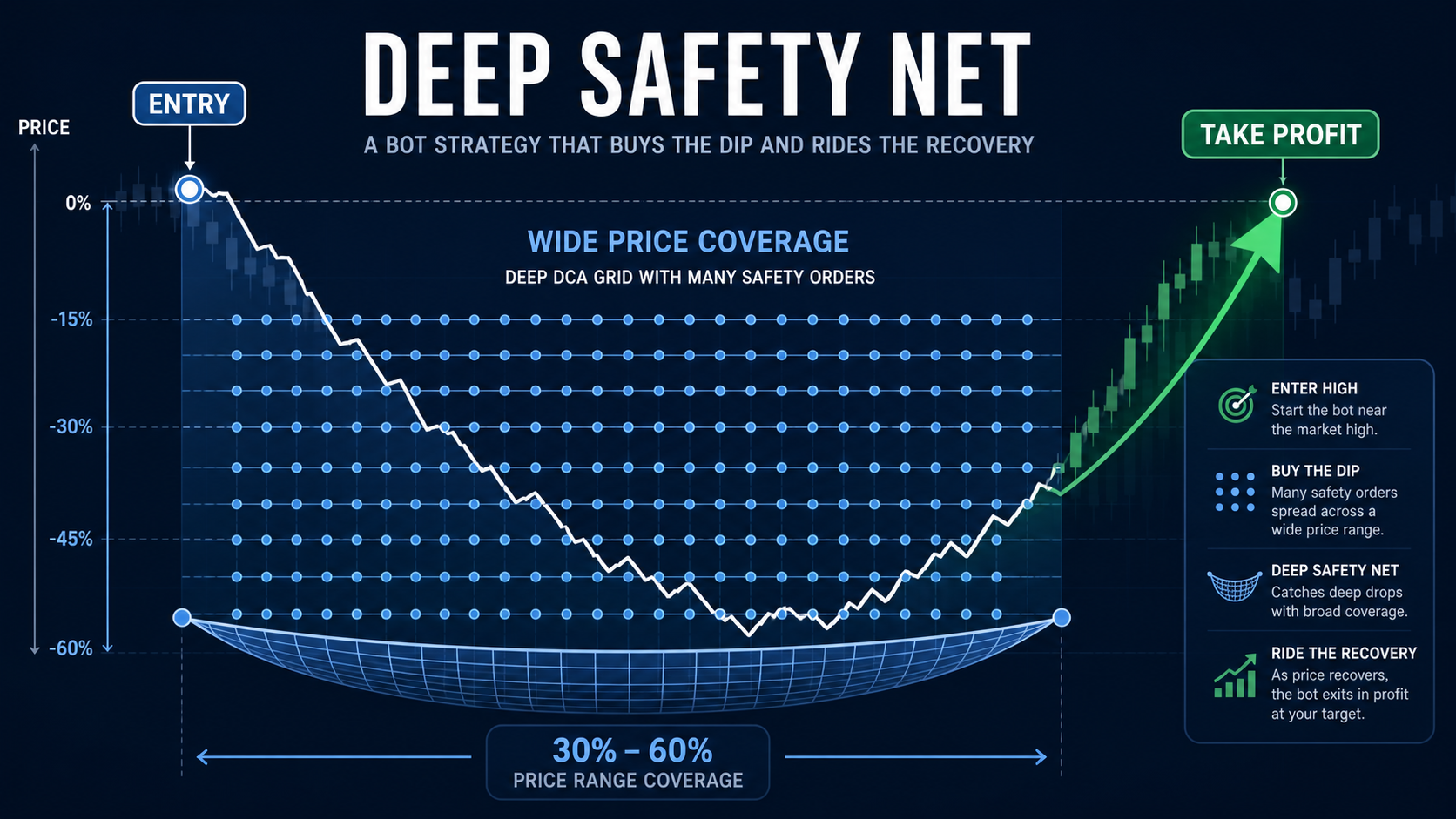
Deep Safety Net is a wide-coverage DCA strategy for a crypto bot. It uses many safety orders-often ten or more-distributed over a broad price decline, such as 30–60% or more. The purpose is to lower the average entry price progressively during a deep drawdown, so a recovery can reach Take Profit with a smaller rebound from the last fill.
This is not a low-risk shortcut. A deep grid commits capital over a large range, can leave money tied up for a long time, and may fail if the asset does not recover. On leveraged futures, liquidation risk makes conservative sizing and low leverage especially important. The article is educational, not financial advice.
How Deep Safety Net works
- A bot opens an initial position from a long-term or medium-term premise.
- Safety orders are placed below the initial entry across a deliberately broad range.
- As price declines, filled orders add to the position and reduce its average entry.
- If price eventually recovers, a Take Profit based on the average entry can close the position.
- The trader monitors exposure, remaining capital and the validity of the original market thesis.
Unlike a micro-grid, this approach is intended to survive a deeper move. That also means it has to be funded for the full planned range, not only for the first few fills.
Designing the grid responsibly
Coverage, order count and spacing
Choose the coverage range from the asset’s historical volatility and a pessimistic scenario, not a recent calm period. More safety orders create a smoother average price, but every order must be included in the capital calculation. Equal spacing is transparent; wider spacing at lower prices may reserve more capital for a deeper sell-off. Do not choose a range merely because it makes a backtest look safer.
Capital allocation and leverage
Calculate the cumulative order value, fees and worst-case margin after all fills. A grid that cannot afford its last orders is not fully designed. Spot trading avoids liquidation but still has opportunity cost and asset risk. Futures add liquidation and funding considerations; low leverage or no leverage is generally easier to control than a large leveraged grid.
Illustrative structure
Suppose a spot bot starts near 100 USDT and plans a 50% coverage range to 50 USDT. It distributes its available capital among an initial order and many safety orders rather than allocating most capital at the first entry. If price falls and orders fill, the average entry decreases. A later recovery toward that average plus the Take Profit target can close the trade. The example demonstrates the mechanism only: no asset is guaranteed to recover.
When a deep grid may or may not fit
- It may suit a liquid asset selected after independent research and a long investment horizon.
- It requires capital that can remain committed without affecting essential needs.
- It is poorly suited to highly speculative assets with a credible risk of permanent loss or delisting.
- It is not a substitute for diversification or a reason to ignore a change in an asset’s fundamentals.
Main risks and checklist
Before launching, define total capital, maximum coverage, safety-order size model, Take Profit method and an explicit rule for reassessing the thesis. Check exchange minimums, fees, spot versus futures mechanics, funding costs and liquidation distance. Do not assume that a prior drawdown establishes a future price floor. Avoid adding capital beyond the plan when the grid is under pressure.
FAQ
Does Deep Safety Net use Stop Loss?
Some implementations omit a stop or place it very far away, but that increases the possibility of capital being locked in a declining asset. The decision must be explicit and matched to the market, product and risk limit.
How many safety orders are enough?
There is no universal number. The count, spacing and volume model must be calculated together with maximum exposure and the asset’s expected volatility.
Bottom line: A Deep Safety Net is a capital-intensive position strategy, not a set-and-forget bot. Its potential benefit is a lower average entry during a broad decline; its cost is long exposure to the risk that recovery may never arrive.