
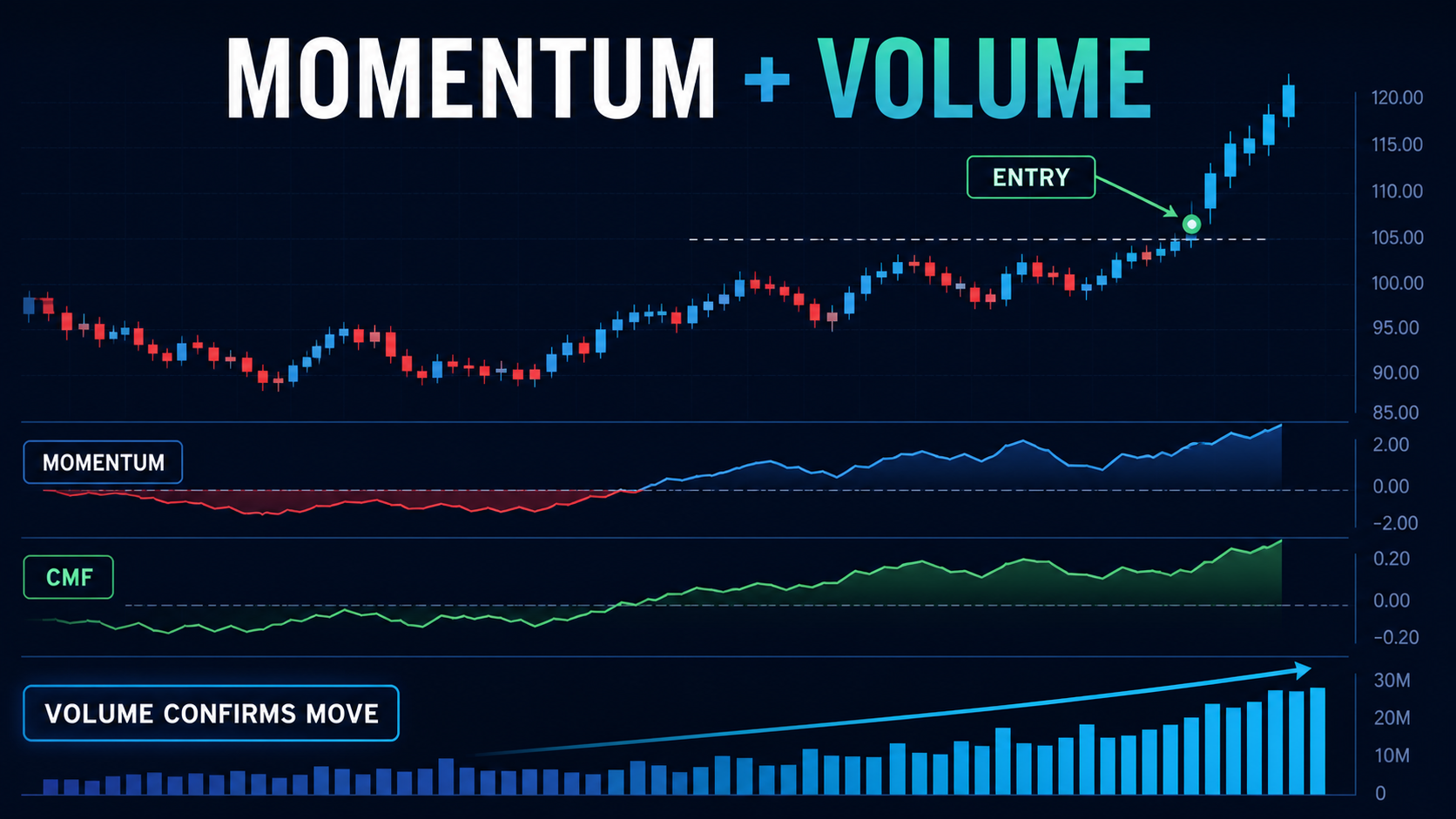
Momentum and Volume Trading is a structured crypto-bot approach. It tries to distinguish a sustained move from an isolated price print. The examples below are parameters to test on the exact pair and exchange, not a universal preset or investment advice.
Signal logic
For Long, price should break a level or accelerate upward while the selected volume measure confirms participation; for Short, reverse the direction. A tall volume bar alone is not proof: compare it with the pair’s normal volume, the candle close and whether price holds the broken area. CMF, MFI, ROC, Momentum and Volume Oscillator can be combined only with clear, non-duplicative roles.
- Compare breakout volume with a rolling average from the same timeframe.
- Require the candle to close beyond the level instead of reacting to a temporary wick.
- For Long, verify that money flow does not contradict the price impulse; mirror for Short.
Detailed settings to test
Set a price condition first, then a volume condition. Test Volume Oscillator fast/slow periods, a relative-volume baseline, CMF/MFI thresholds and ROC or Momentum length separately. A positive oscillator can be useful, but a rising value over several closed bars may be a different and more selective rule. Test the data feed from the exchange where the bot executes.
- Test fast/slow Volume Oscillator values independently of the price breakout period.
- Use CMF, MFI or ROC as an optional extra filter only if it improves out-of-sample results.
- Define a maximum permitted distance from the trigger in ATR or percent.
Entry, exit and bot exposure
Use one exact entry type after confirmation: market at the close, stop above the confirming candle, or limit on a retest. Reject signals already extended far beyond a structure or ATR distance. Size the position from a stop under the momentum structure and choose a Take Profit rule for fading volume, an ATR target, trailing exit or fixed reward-to-risk.
- Cancel if price loses the breakout zone before the order is filled.
- Stop below/above structural invalidation and calculate size from that distance.
- Log relative volume, indicator values, spread and actual fill for each cycle.
Limits specific to this strategy
Volume spikes can be produced by a news headline, liquidations or one large order and then disappear. Thin markets may show impressive relative volume but poor fills. Include fees, spread and slippage; do not interpret volume confirmation as permission to increase leverage.
Conclusion. The most useful volume rule is one that is precise enough to reject weak moves and simple enough to test across market regimes.