
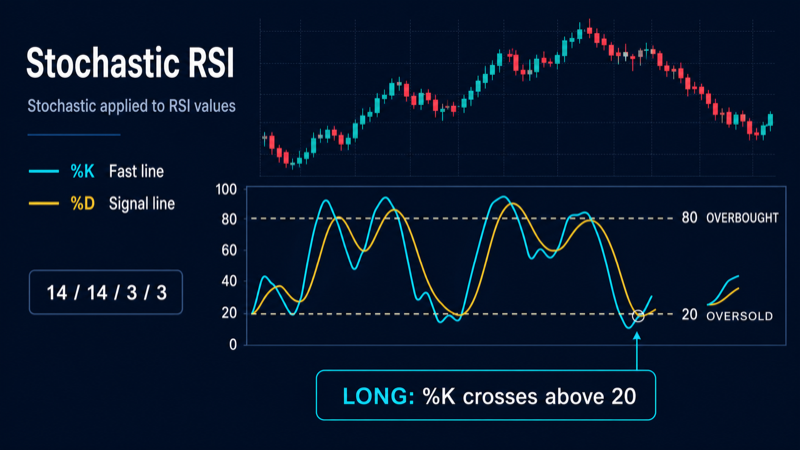
The Start Bots Signal category describes signals and indicators that can start a trading bot. One of the technical indicators is Stochastic RSI (StochRSI).
When creating or editing any bot, there is a Start signal builder block at the bottom of settings. You can choose individual indicators, ready-made presets, and their combinations. Conditions are grouped: AND inside a group, OR between groups. The same indicator can be configured in different ways - for Long and Short, for breakouts and bounces, for level comparisons and for crosses.
What is Stochastic RSI
Stochastic RSI (StochRSI) is an oscillator that applies the Stochastic Oscillator formula to RSI values rather than price. The result is two lines (FastK and FastD) on a 0–100 scale showing where the current RSI sits relative to its recent minimum and maximum.
StochRSI is more sensitive than classic RSI: it enters oversold and overbought zones faster and signals momentum shifts earlier. In the ELIXOAI start signal builder, StochRSI is used as an automatic bot start condition - on crosses of 20/80 levels or FastK/FastD lines.
Because of its high sensitivity, StochRSI produces more signals than RSI or Stochastic alone - and more false triggers in ranges. It is almost always combined with a trend filter (EMA, price position) or confirmation from a second oscillator.
StochRSI vs RSI and Stochastic
All three oscillators relate to momentum, but measure it differently:
- RSI compares average price gains and losses and normalizes the result to a 0–100 scale. It answers “how strong was the price move.” Levels 30/70 mark oversold and overbought.
- Stochastic shows where the closing price sits within the High–Low range over a period. The %K and %D lines react to price position in the channel, not RSI velocity.
- StochRSI combines both approaches: RSI is calculated first, then Stochastic is applied to RSI values. You get “Stochastic of RSI” - a faster, more sensitive oscillator with FastK/FastD lines and 20/80 levels.
How StochRSI works
The calculation runs in several steps:
- First, RSI is computed with rsiPeriod (default 14) - the classic Relative Strength Index.
- The Stochastic formula is applied to recent RSI values over stochasticPeriod (default 14): min and max RSI are found, current RSI is normalized to 0–100 - this is FastK.
- FastD is a smoothed version of FastK (moving average over dPeriod, default 3). Parameter kPeriod (default 5) sets additional FastK smoothing.
In the builder you set a comparison condition on FastK or FastD: “FastK crosses above 20,” “FastK crosses above FastD,” “FastK greater than 80,” and so on. The system fetches live values from the exchange via TAAPI and checks the condition on your timeframe - at candle close or every minute.
Two StochRSI outputs
The builder exposes two numeric StochRSI outputs:
- valueFastK (FastK): the fast line - main output for presets. Used in stochrsi_oversold_exit (cross up 20) and stochrsi_signal_cross (cross up FastD). Reacts faster than FastD.
- valueFastD (FastD): the signal line - smoothed FastK. Acts as the cross target in stochrsi_signal_cross; rarely set as the sole condition output.
When FastK > FastD, bullish StochRSI momentum dominates; when FastK < FastD, bearish momentum dominates. FastK crossing above FastD is equivalent to the classic Stochastic “golden cross,” but based on RSI.
Parameters: kPeriod 5, dPeriod 3, rsiPeriod 14, stochasticPeriod 14
- kPeriod (K): FastK smoothing period. Range 1–100, default 5. Lower values make FastK react faster - more signals and noise.
- dPeriod (D): FastD signal line period. Range 1–100, default 3. FastD is a moving average of FastK over dPeriod.
- rsiPeriod (RSI): base RSI calculation period. Range 2–300, default 14 - Wilder’s classic.
- stochasticPeriod (Stoch): period over which min/max RSI are found for normalization. Range 2–300, default 14.
Settings 5/3/14/14 work well on 15m–1h. For 5m scalping, reduce rsiPeriod and stochasticPeriod (e.g. 9/9); for 4h swing, keep defaults or increase to 21/21.
Ready-made presets in the builder
The builder offers two StochRSI presets with default settings. Each can be fully customized: different operator, level, output, parameters, or timeframe.
stochrsi_oversold_exit - FastK cross up 20 (oversold exit)
Default condition: valueFastK crosses level 20 from below to above (cross up) on the selected timeframe (15m interval, parameters 5/3/14/14, check at bar close).
A Long signal on early oversold exit: FastK was below 20 and rose above - RSI is recovering relative to its recent low. An earlier signal than RSI cross up 30, but needs a trend filter. For Short, set cross down 80.
stochrsi_signal_cross - FastK cross up FastD (momentum signal)
Default condition: valueFastK crosses valueFastD from below to above (cross up) on 15m, check at bar close.
A fast momentum signal: FastK overtakes FastD - bullish StochRSI momentum strengthens. Works best with 20/80 levels or a trend filter; crosses in the middle of the range (40–60) often produce noise. For Short - FastK cross down FastD.
Available operators- Crosses above (cross up): FastK was below the level (or FastD) and moved above. Classic Long setup - cross up 20 or cross up FastD.
- Crosses below (cross down): FastK was above the level (or FastD) and dropped below. Short signal - cross down 80 or cross down FastD.
- Greater than (gt): FastK is strictly above the level right now. E.g. FastK > 50 - bullish context without requiring a fresh cross.
- Less than (lt): FastK is strictly below the level. FastK < 20 - oversold zone, useful for Long filters.
- Greater or equal (gte): FastK is at or above the threshold. Handy for “FastK ≥ 50” filter on a higher timeframe.
- Less or equal (lte): FastK is at or below the threshold. Bearish context filter: FastK ≤ 80 on 4h.
Like Stochastic, StochRSI uses classic levels 20 (oversold) and 80 (overbought). The stochrsi_oversold_exit preset uses cross up 20 - exiting oversold, not entering it. For Short symmetrically: cross down 80. In a strong trend FastK can stay above 80 or below 20 for a long time - gt/lt gives earlier entry while cross gives a more precise momentum shift.
General builder settings
- Timeframe (interval): 1m, 5m, 15m, 30m, 1h, 4h, 1d. Shorter intervals give more signals but more noise. Swing bots often use 1h–4h; scalping uses 5m–15m.
- Check mode: At candle close checks after the candle closes - fewer false triggers. Every minute checks inside the current candle - faster reaction, higher false-start risk.
- Operator: greater than, less than, crosses above, crosses below, greater or equal, and others define how the indicator value is compared to the target.
- Target value: a number (e.g. 30 for RSI), an indicator line (e.g. %D for Stochastic), or price (for Bollinger Bands).
- Condition groups: up to 3 groups with up to 5 conditions each. Example: group 1 - RSI < 30 AND price < lower band; group 2 - Stochastic < 20. The bot starts if group 1 OR group 2 is satisfied.
Setup examples for different strategies
Scalping: stochrsi_signal_cross on 5m–15m
Goal: frequent starts on short impulses.
Long: stochrsi_signal_cross preset, FastK cross up FastD, 5m timeframe, parameters 5/3/14/14, check at bar close.
Short: FastK cross down FastD, same settings.
Filter: add FastK < 30 in the same group - crosses only in the lower range.
Swing: stochrsi_oversold_exit on 1h–4h
Goal: fewer but more meaningful bounces.
Long: FastK cross up 20 on 4h, parameters 5/3/14/14, check at close - bot starts on StochRSI oversold exit on higher TF.
Short: FastK cross down 80 on 4h.
On 4h signals are rarer but closer to a “real” momentum reversal.
Trend confirmation
Goal: Long only when StochRSI and trend align.
Group 1: stochrsi_oversold_exit (FastK cross up 20) on 15m AND close price above EMA 50 on the same 15m.
Short: FastK cross down 80 AND price below EMA 50.
EMA shows direction; StochRSI confirms momentum is turning.
Oversold exit vs FastK/FastD cross
Goal: two entry types on one instrument.
Group 1 (early): stochrsi_oversold_exit - FastK cross up 20 on 15m.
Group 2 (momentum): stochrsi_signal_cross - FastK cross up FastD on 15m + FastK < 40.
OR logic: either scenario can start the bot. Oversold exit is earlier; signal cross on confirmed momentum.
StochRSI + EMA
Long: price cross up EMA 20 on 15m AND stochrsi_oversold_exit (FastK cross up 20) on the same 15m - double confirmation: both price and oscillator turned up.
Short: price cross down EMA 20 AND FastK cross down 80.
Alternative: FastK > 50 on 1h AND price > EMA 50 - trend Long on sustained momentum.
Short on overbought
Condition: FastK cross down 80 or FastK cross down FastD, parameters 5/3/14/14, 15m, check at close.
Filter: RSI > 65 in the same group - short after overbought with fading StochRSI momentum confirmation.
Fits short grids at local peaks.
Strong momentum (gt filter)
Long: FastK gt 50 on 1h - bot starts only with clear bullish StochRSI context, without waiting for a cross.
Short: FastK lt 50 on 1h.
Useful in trends where cross up 20 already happened but momentum still favors you.
Pullback in trend
Group 1: FastK on 4h greater than 50 AND stochrsi_oversold_exit (FastK cross up 20) on 15m.
Logic: higher TF shows sustained bullish momentum; lower TF catches resumption after a short correction. Fewer false starts against the global trend.
StochRSI + RSI
Long: RSI cross up 30 on 15m AND stochrsi_signal_cross (FastK cross up FastD) on 15m - classic and stochastic RSI aligned.
Short: RSI cross down 70 AND FastK cross down FastD.
RSI catches oversold/overbought; StochRSI provides an earlier momentum signal.
Multi-timeframe
Long: FastK on 4h ≥ 50 (separate condition, gte) AND stochrsi_oversold_exit (FastK cross up 20) on 15m.
Short: FastK 4h ≤ 50 AND FastK cross down 80 on 15m.
This avoids buying every local StochRSI bounce against global bearish momentum on the higher interval.
DCA on pullback
Long: stochrsi_oversold_exit (FastK cross up 20) on 1h AND RSI < 45 on 1h - StochRSI bounce from weakness without extreme RSI oversold.
Short: FastK cross down 80 AND RSI > 55.
For a DCA bot on trend pullbacks, cross up 20 is softer than strict RSI < 30.
Condition groups: practical example
Bot with two Long scenarios:
Group 1: stochrsi_oversold_exit on 15m AND price > EMA 50 - trend momentum resumption.
Group 2: stochrsi_signal_cross on 15m + FastK < 35 AND RSI < 40 - momentum bounce with confirmation.
Groups combined with OR: either scenario can start the bot. Configure Short symmetrically (cross down 80, FastK cross down FastD).
Tip
StochRSI is more sensitive than RSI and Stochastic - cross up 20 and FastK/FastD crosses trigger often and produce false starts in ranges. Increase rsiPeriod/stochasticPeriod, add an EMA filter, or require FastK ≥ 50 on a higher timeframe. FastK/FastD crosses in the middle of the range (40–60) are almost always noise - filter with 20/80 levels. Use check at bar close to ignore intrabar noise.