
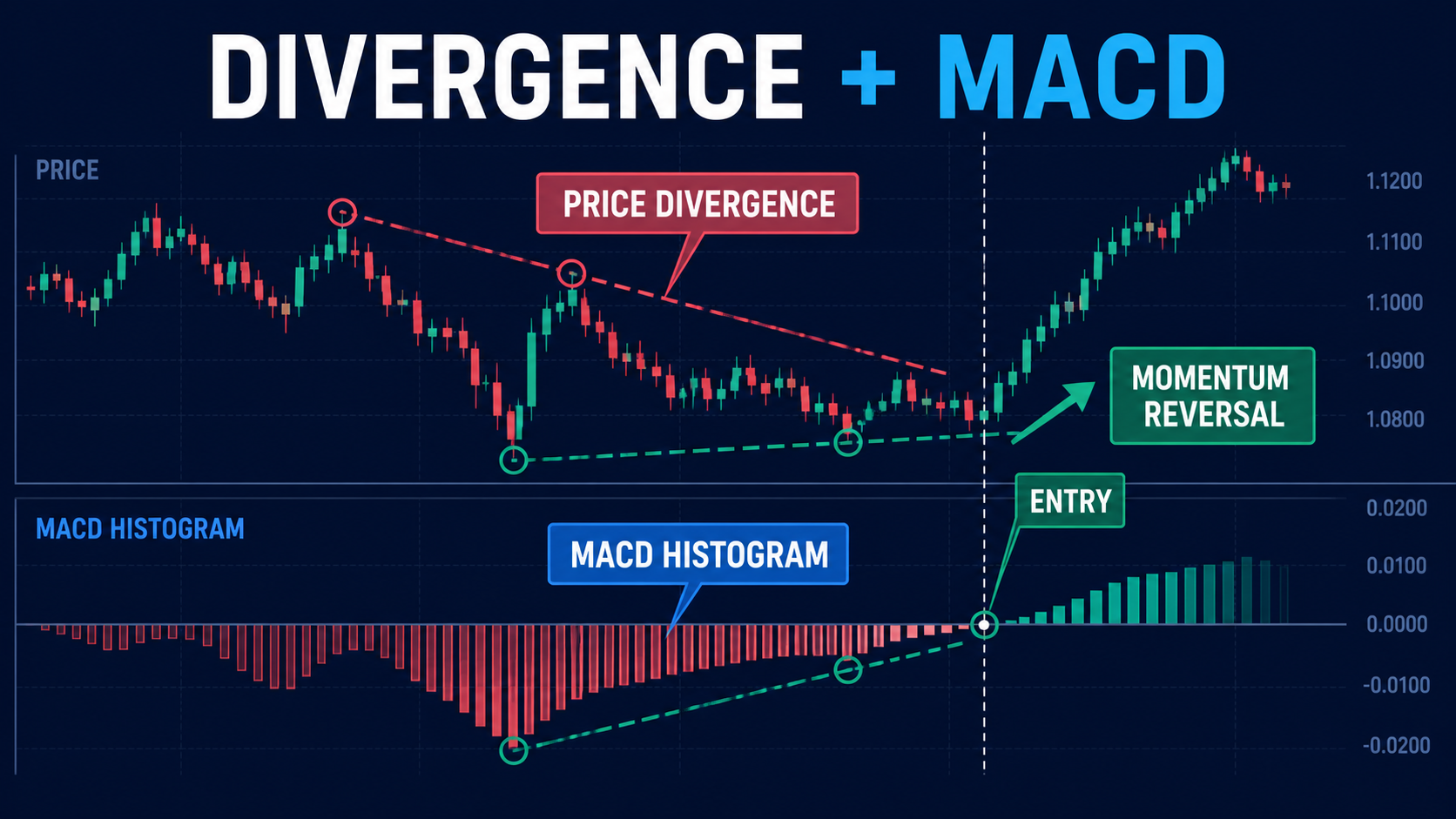
MACD Divergence and Momentum Reversal is a structured crypto-bot approach. A divergence is a warning condition, not an instruction to enter against every trend. The examples below are parameters to test on the exact pair and exchange, not a universal preset or investment advice.
Signal logic
Bullish divergence appears when price makes a lower low while MACD, its histogram or a related momentum measure makes a higher low; bearish divergence is the inverse. Confirm whether the divergence occurs at a meaningful support/resistance level and wait for price action: a break of a local swing, histogram recovery or MACD/signal-line cross can be a separate trigger.
- Mark price and MACD pivots with a consistent minimum distance and lookback.
- Use regular divergence for a possible reversal; test hidden divergence separately as a continuation concept.
- Require a market-structure or candle confirmation before opening against the prior impulse.
Detailed settings to test
The classic MACD 12/26/9 is a baseline, not a requirement. Shorter values react faster and produce more changes; longer values smooth noise but delay confirmation. Test which component defines divergence-MACD line, histogram or both-and set a minimum separation between pivots so tiny fluctuations do not qualify. Use closed pivot candles, not hindsight-only visual interpretation.
- Compare MACD 12/26/9 with alternative fast/slow/signal values on the same data set.
- Define whether histogram zero-cross, slope change or signal-line cross is required.
- Reject signals whose price extreme is too far from the planned stop.
Entry, exit and bot exposure
For a reversal bot, set the entry after confirmation rather than at the first divergent low/high. A structural Stop Loss belongs beyond the price extreme that created the divergence. Take Profit can target the prior swing, a risk multiple or a trailing rule, while safety orders must have limited total exposure because the original trend may resume.
- Enter only after the selected confirmation closes; do not anticipate an unfinished cross.
- Set Stop Loss beyond the divergence pivot and limit averaging orders.
- Exit or reduce if price breaks the opposite local structure or momentum returns to the original trend.
Limits specific to this strategy
Divergence can continue for many candles during a strong trend. News, liquidation moves and fast markets can invalidate a pretty oscillator pattern. Include fees and slippage, cap the number of attempts at one level and distinguish a failed reversal from a normal pullback.
Conclusion. MACD divergence offers context for a reversal attempt only when price, pivot rules and risk invalidation are all defined.