
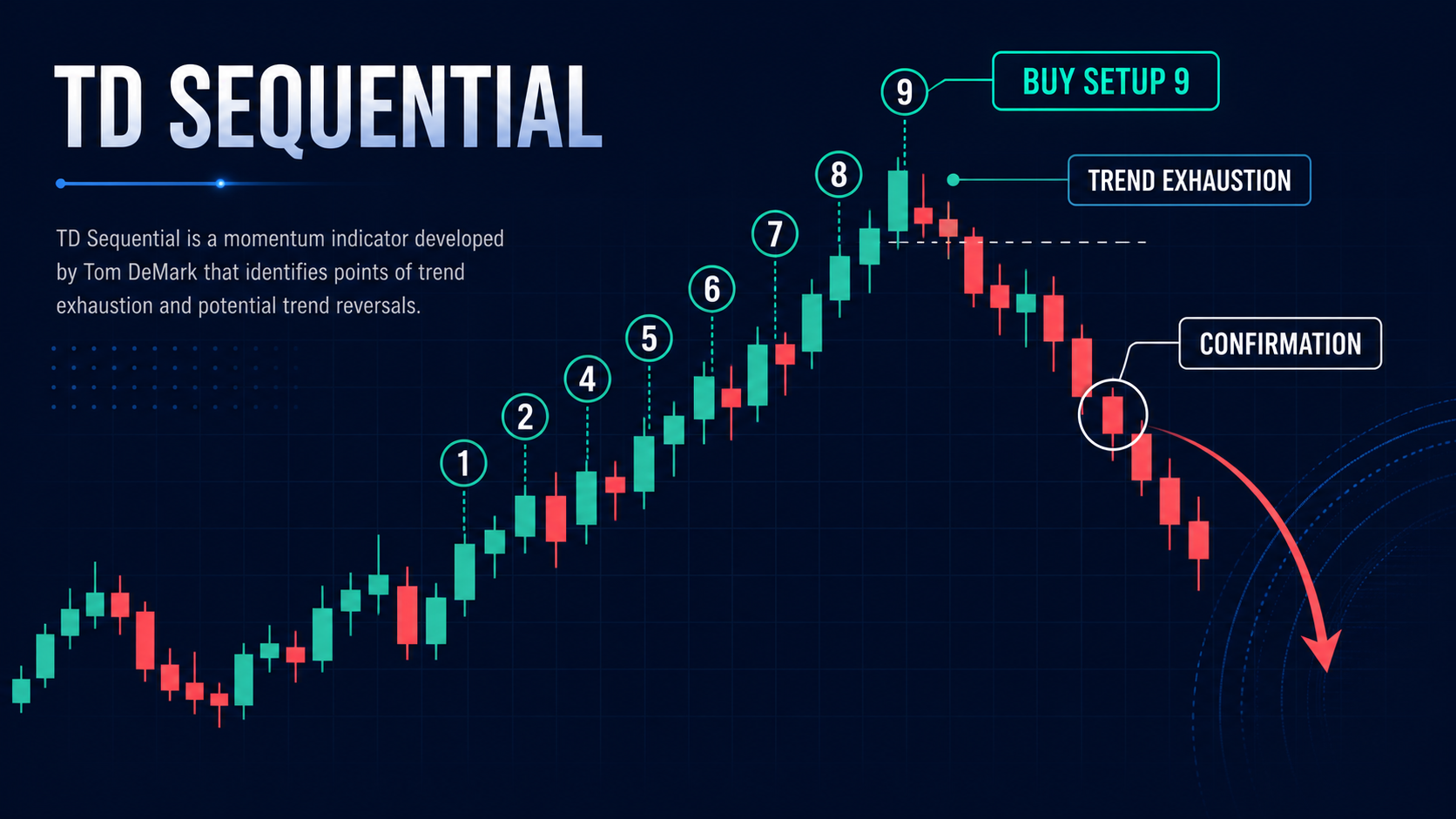
TD Sequential Trend Exhaustion Trading is a structured crypto-bot approach. A completed setup is an alert to assess reversal conditions, not a promise that the next candle must turn. The examples below are parameters to test on the exact pair and exchange, not a universal preset or investment advice.
Signal logic
A Buy Setup usually develops after a sequence of closes lower than the close four bars earlier; a Sell Setup uses the opposite sequence. The familiar count of nine is only one stage of the method. The bot must define exactly what it counts, whether perfection or countdown rules are used, and whether a level of support/resistance or momentum confirmation is required.
- Specify the price-flip rule that starts a setup before relying on any count.
- For Buy and Sell setups, define the close comparison and interruption rule exactly.
- Treat a completed 9 as a condition for confirmation, not as an automatic market order.
Detailed settings to test
Choose the exact TD implementation, because platforms can differ in treatment of setup, countdown, recycling and price flips. Test whether nine consecutive qualifying closes are required, how an interrupted count is handled, and whether the signal remains valid for a limited number of candles. Evaluate the count on 1h, 4h or daily separately: the same count represents different holding periods and risks.
- Test setup-only versus setup-plus-countdown; do not combine variants in the same statistics.
- Decide whether “perfected” setup is required and how the platform defines it.
- Set an expiry for a completed count if price does not confirm within the tested window.
Entry, exit and bot exposure
Do not enter merely because a 9 prints. A price rejection, break of a local swing, oscillator confirmation or retest of a support/resistance zone can be the entry rule. Stop Loss belongs beyond the exhaustion extreme or structural invalidation. Targets may be the range midpoint, prior swing or fixed risk multiple; cap any grid because a mature trend can extend.
- Enter on a confirmation candle or structure break, not before the rule is complete.
- Place Stop Loss beyond the extreme that invalidates the exhaustion idea.
- Pause the strategy around major events or when slippage makes a structural stop unreliable.
Limits specific to this strategy
TD Sequential can repeatedly flag exhaustion while a strong trend continues. Counts around major news, thin liquidity or liquidation cascades are particularly fragile. The method is sensitive to implementation details and hindsight marking, so save raw count data and analyze losing sequences, not only successful reversals.
Conclusion. TD Sequential is useful when its candle-count rules are explicit and its exhaustion alert is combined with independent price confirmation.