
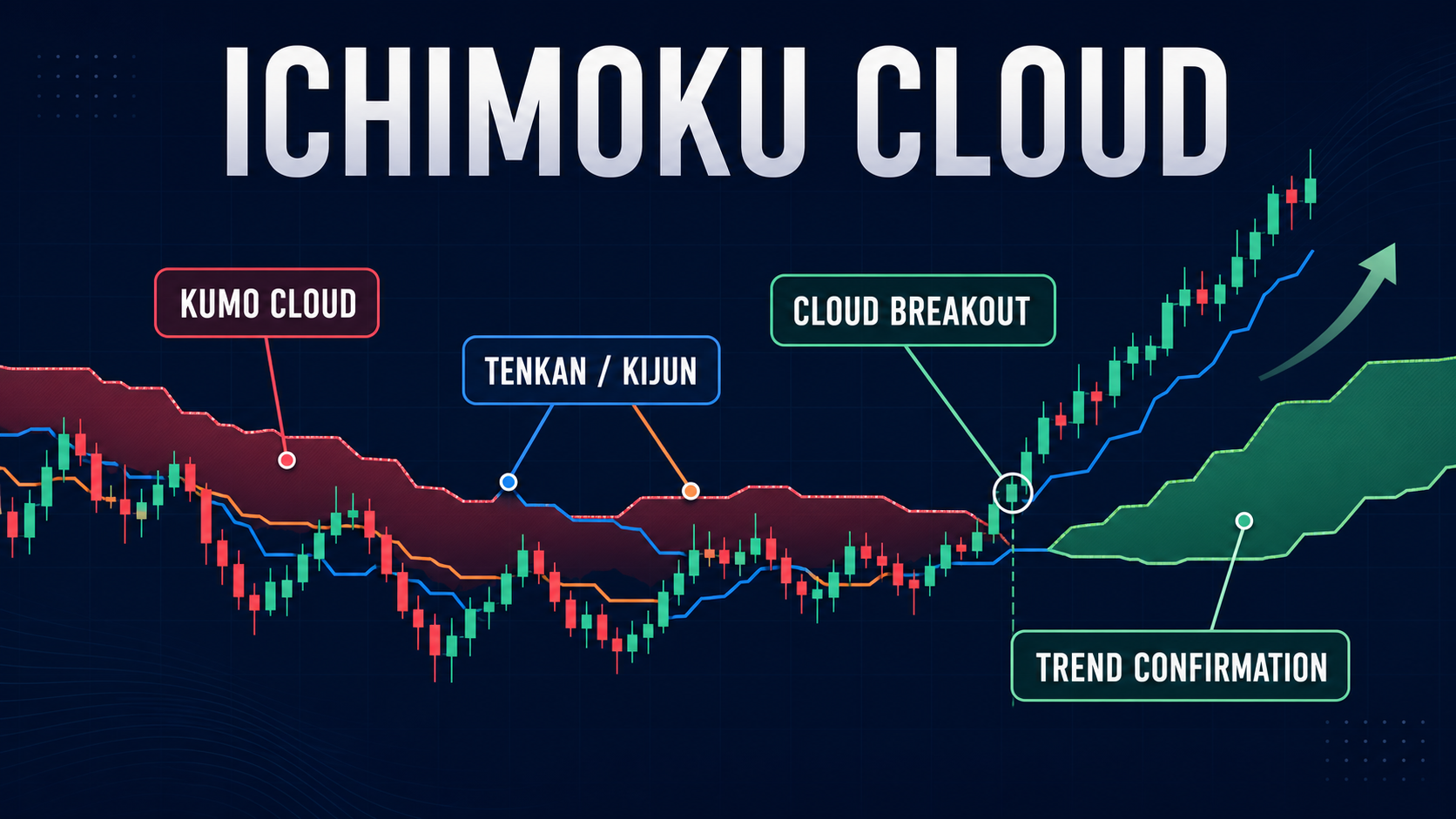
Ichimoku Cloud Trading is a structured crypto-bot approach. It is most useful when each component has a stated role instead of being treated as a single buy/sell button. The examples below are parameters to test on the exact pair and exchange, not a universal preset or investment advice.
Signal logic
For a bullish context, price is above the Kumo cloud, Tenkan-sen is above Kijun-sen and the forward cloud is supportive; a bearish context reverses the relationship. Chikou Span and the cloud thickness add context: a thin cloud is typically weaker support/resistance than a thick one. A cloud breakout becomes more credible when price closes outside it and the other lines agree.
- Classify the chart as above, inside or below the Kumo before looking for an entry.
- For Long, check price, Tenkan/Kijun and future cloud alignment; reverse the logic for Short.
- Treat Chikou Span as confirmation only when its rule is explicitly testable.
Detailed settings to test
The traditional 9/26/52 values are a reference designed for the original charting convention, not a requirement for every crypto timeframe. Test standard settings first, then compare a limited set of alternatives rather than optimizing each line independently. Define whether the bot uses cloud position as the filter and Tenkan/Kijun as the trigger, or requires both at once.
- Start with 9/26/52 and compare only a few coherent alternatives by timeframe.
- Decide whether a cloud breakout requires a close, a retest, or both.
- Measure cloud thickness and Kijun distance to avoid entering after an extended move.
Entry, exit and bot exposure
A conservative entry waits for a closed breakout and may use a retest of the cloud edge; a faster entry takes a confirmed Tenkan/Kijun cross in an already aligned trend. Put Stop Loss beyond the relevant cloud edge, Kijun or price structure based on the tested rule. Choose a target at the next higher-timeframe level, a risk multiple or trailing Kijun/SuperTrend; keep grid exposure shallow around a cloud breakout.
- Cancel a pending Long if price closes back into the cloud before execution.
- Place Stop Loss according to cloud edge, Kijun or structure-not a random percentage.
- Use a separate no-trade rule for the cloud interior and repeated line crosses.
Limits specific to this strategy
Inside the cloud, Ichimoku signals often conflict and trend direction is less clear. A thin cloud, flat Kijun and repeated crossovers indicate noisy conditions. Sudden volatility can cross several lines at once, and futures funding/fees can matter over the longer holding period.
Conclusion. Ichimoku is a complete context system: the best settings define which of its components filters, confirms and invalidates a trade.