
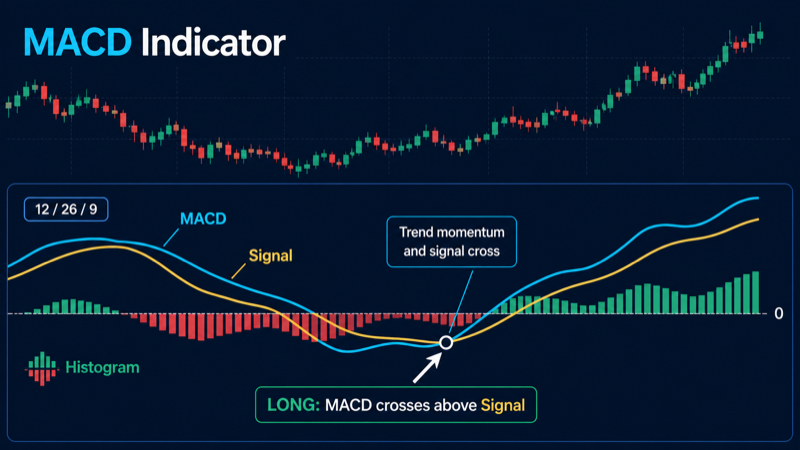
The Start Bots Signal category describes signals and indicators that can start a trading bot. One of the technical indicators is MACD (Moving Average Convergence Divergence).
When creating or editing any bot, there is a Start signal builder block at the bottom of settings. You can choose individual indicators, ready-made presets, and their combinations. Conditions are grouped: AND inside a group, OR between groups. The same indicator can be configured in different ways - for Long and Short, for breakouts and bounces, for level comparisons and for crosses.
What is MACD
MACD (Moving Average Convergence Divergence) is one of the most popular trend and momentum indicators. It was developed by Gerald Appel in the 1970s. MACD is built on the difference between two exponential moving averages (EMAs) of price and helps you see when bullish or bearish momentum is strengthening or fading.
Unlike oscillators such as RSI, MACD is not bound to a fixed 0–100 range. The MACD line and histogram can take any value - positive when bullish momentum dominates, negative when bearish momentum dominates. In the ELIXOAI start signal builder, MACD is used as an automatic bot start condition: line crosses or a histogram zero cross can open a new grid or trade sequence.
MACD is often combined with trend filters (EMA, price position) or oscillators (RSI, Stochastic) because it lags price - a consequence of EMA smoothing.
How MACD works
Classic MACD(12, 26, 9) is calculated in three steps:
- MACD line = EMA(12) − EMA(26) - the difference between “fast” and “slow” EMA. When the fast EMA is above the slow EMA, MACD is positive; when below, negative.
- Signal line = EMA(9) of the MACD line - a smoothed version of MACD to filter noise.
- Histogram = MACD − Signal - shows the distance between the MACD line and Signal; visually reflects acceleration or deceleration of momentum.
When MACD crosses above Signal, the histogram moves from negative to positive (crosses 0). When MACD crosses above zero, it is a stronger but later signal that bulls dominate bears over the selected period.
In the ELIXOAI builder you do not configure the formula - you set a comparison condition on one of three outputs: “histogram crosses above 0,” “MACD crosses above Signal,” “MACD crosses above 0.” The system fetches live values from the exchange via TAAPI and checks the condition on your timeframe.
Three MACD outputs
The builder exposes three numeric MACD outputs. Each suits a different signal type:
- valueMACD - the MACD line (fast EMA minus slow EMA). Used in macd_signal_cross (cross with Signal) and macd_zero_cross (zero cross). Shows “raw” momentum direction relative to the two EMAs.
- valueMACDSignal - the Signal line, EMA of valueMACD with the signal period (default 9). Rarely set as the sole target, but acts as the second line in MACD cross Signal conditions.
- valueMACDHist - the histogram (MACD − Signal). Used in the macd preset: histogram crossing above 0 equals MACD moving above Signal. Handy for early momentum signals - reacts to acceleration faster than a MACD zero cross.
Mathematically: if valueMACDHist > 0, then valueMACD > valueMACDSignal. Histogram zero cross and MACD/Signal cross happen at the same moment - choose the preset that matches your logic.
Parameters: fast 12, slow 26, signal 9
All MACD presets share three parameters:
- Fast period (optInFastPeriod): fast EMA period. Range 2–200, default 12. Lower values make MACD more sensitive to recent moves.
- Slow period (optInSlowPeriod): slow EMA period. Range 2–300, default 26. Must exceed fast; the classic 12/26 pair is Appel’s standard.
- Signal period (optInSignalPeriod): EMA period for the Signal line. Range 1–100, default 9. Higher signal smooths Signal more, fewer crosses, less noise.
Settings 12/26/9 work well on 15m–4h. For 5m scalping some traders use faster values (8/17/9); for 4h swing, slower (12/26/9 or 19/39/9). Parameters are always tied to the timeframe: MACD(12,26,9) on 15m and on 4h are different indicators.
Ready-made presets in the builder
The builder offers three ready-made MACD presets. Each can be customized: different operator, output, parameters, or timeframe.
Histogram crosses above 0 - Long (macd)
Default condition: valueMACDHist crosses level 0 from below to above (cross up) on 15m, check at bar close.
The earliest of the three presets in time: a momentum shift when MACD rises above Signal. The histogram was negative (bearish momentum dominated) and turned positive. Fits impulse Longs after pullbacks in a trend or scalping on short timeframes.
For Short, use operator “crosses below” - histogram drops below 0.
MACD crosses above Signal - Long (macd_signal_cross)
Default condition: valueMACD crosses valueMACDSignal from below to above (cross up).
The classic MACD crossover. Mathematically identical to macd (histogram through 0), but the UI explicitly sets a cross between two lines. Usually stronger below or near zero when confirmed by a higher-timeframe trend.
For Short: MACD crosses below Signal.
MACD crosses above 0 - Long (macd_zero_cross)
Default condition: valueMACD crosses level 0 from below to above (cross up).
A slower trend signal: fast EMA(12) overtakes slow EMA(26) - bullish momentum confirmation for the period. Fewer trades than MACD/Signal cross but filters weak bounces in ranges. Good for swing bots and DCA on pullbacks in uptrends.
For Short: MACD crosses below 0 - bearish EMA fast below EMA slow dominance.
General builder settings
- Timeframe (interval): 1m, 5m, 15m, 30m, 1h, 4h, 1d. Shorter intervals give more signals but more noise. Swing bots often use 1h–4h; scalping uses 5m–15m.
- Check mode: At candle close checks after the candle closes - fewer false triggers. Every minute checks inside the current candle - faster reaction, higher false-start risk.
- Operator: greater than, less than, crosses above, crosses below, greater or equal, and others define how the indicator value is compared to the target.
- Target value: a number (e.g. 30 for RSI), an indicator line (e.g. %D for Stochastic), or price (for Bollinger Bands).
- Condition groups: up to 3 groups with up to 5 conditions each. Example: group 1 - RSI < 30 AND price < lower band; group 2 - Stochastic < 20. The bot starts if group 1 OR group 2 is satisfied.
Setup examples for different strategies
Scalping: histogram (macd) on 5m–15m
Goal: early impulse starts on short moves.
- Long: macd preset, valueMACDHist cross up 0, 5m or 15m, 12/26/9, check at bar close.
- Short: same preset, cross down 0.
- Histogram reacts faster than MACD zero cross - more signals, more whipsaw in ranges.
Swing: MACD/Signal (macd_signal_cross) on 1h
Goal: classic crossover on a medium timeframe.
- Long: macd_signal_cross, 1h, 12/26/9, check at close.
- Short: MACD cross Signal down on 1h.
- Add filter: price above EMA 50 on 1h - Long only with trend.
Trend: zero cross (macd_zero_cross) on 4h
Goal: rare but meaningful starts when EMA dominance shifts.
- Long: macd_zero_cross, 4h, 12/26/9, check at close.
- Short: MACD cross 0 down on 4h.
- Fewer false starts in ranges than histogram on 15m, but later entry.
Histogram vs zero line: comparison
Goal: understand signal speed on the same instrument.
- Group 1 (early): macd - hist cross up 0 on 15m.
- Group 2 (late): macd_zero_cross - MACD cross up 0 on 15m.
- OR between groups: bot starts on first trigger. Histogram fires earlier on bounces; zero cross when trend is already confirmed.
Signal cross vs histogram: when to use which
Presets macd and macd_signal_cross trigger at the same moment, but:
- macd (histogram) - convenient if you build conditions on valueMACDHist (> 0, < 0) or want explicit “MACD minus Signal” momentum.
- macd_signal_cross - familiar “MACD crossed Signal” wording; you can add custom: MACD > Signal AND valueMACDHist > 0 for confirmation.
- In practice for Long after pullback in uptrend, histogram or signal cross on 15m is common; for trend confirmation - zero cross on 4h.
Multi-timeframe: 15m + 4h
Goal: impulse on lower TF, trend on higher TF.
- Long: macd (hist cross up 0) on 15m AND MACD > 0 on 4h (separate condition) or zero cross already on 4h.
- Short: hist cross down 0 on 15m AND MACD < 0 on 4h.
- Avoids catching every histogram bounce against a global downtrend.
MACD + RSI
MACD momentum plus RSI oscillator - double confirmation.
- Long: macd_signal_cross on 15m AND RSI cross up 30 (or RSI < 40) on the same 15m.
- Short: MACD cross Signal down AND RSI > 70 or cross down 70.
- RSI filters MACD crosses in mid-range without oversold/overbought context.
MACD + EMA filter
Long: macd hist cross up 0 on 15m AND close > EMA 50 on 1h.
Short: hist cross down 0 AND close < EMA 50 on 1h.
Logic: MACD impulse only in the direction of the higher-timeframe trend.
MACD + Bollinger Bands
Long: macd hist cross up 0 on 15m AND price touched or closed below lower BBands (20, 2) on 15m.
Short: hist cross down 0 AND price at upper band.
Logic: impulse reversal from a volatility boundary.
DCA on trend pullback
Long: price > EMA 200 on 4h AND macd (hist cross up 0) on 1h after a dip.
Parameters: 12/26/9, check at close.
Logic: grid starts on local momentum bounce in a global uptrend.
Fast parameters for 5m
Preset: macd_signal_cross.
Parameters: fast 8, slow 17, signal 9.
Timeframe: 5m, check at close.
Logic: more frequent crosses for scalping; always add a 15m or 1h filter.
Condition groups: early and late entry
Bot with two Long scenarios:
- Group 1: macd hist cross up 0 on 15m - early impulse.
- Group 2: macd_zero_cross on 4h - confirmed trend.
Groups combined with OR: either scenario can start the bot. Configure Short symmetrically (cross down).
Tip
MACD is a lagging indicator: it is built on EMAs and reacts to price with delay. Histogram or MACD/Signal crosses often arrive after the move has started; zero cross comes even later. In ranges all three presets produce many false starts (whipsaw). Use a higher-timeframe filter, EMA, or zero cross for trend confirmation - and always respect grid risk management.