
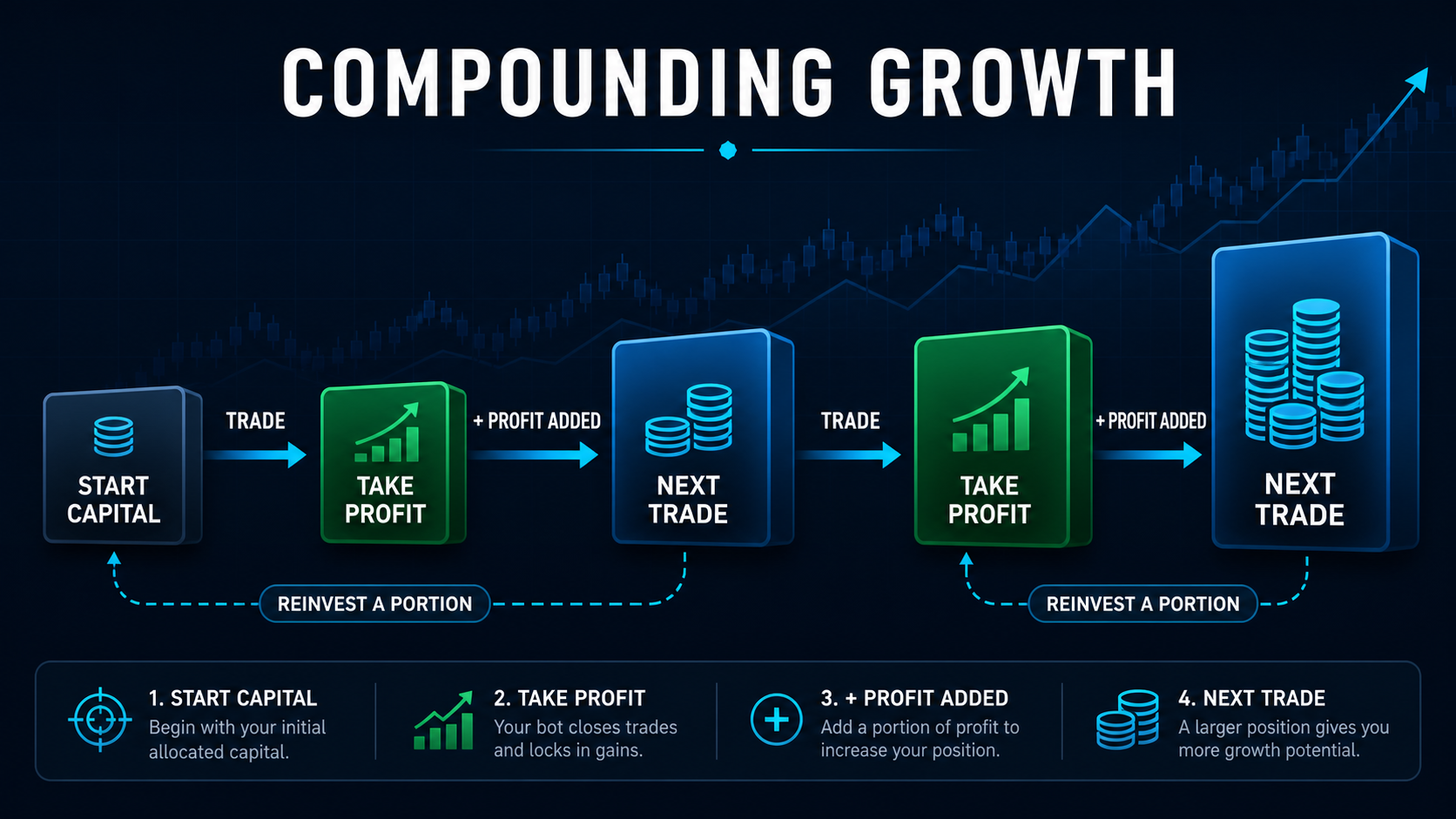
Compounding Growth is a crypto-bot money-management approach in which part or all of the profit from a closed Take Profit trade is added to the bot’s allocation for the next trade. Instead of keeping each successful trade at the same size, the bot can grow position size gradually as realized profit accumulates.
Compounding magnifies both the benefit of a favorable sequence and the monetary impact of later losses. It is not a guaranteed growth mechanism: trading losses, fees, periods without profitable signals and changing market conditions still apply. A prudent configuration includes a percentage to reinvest, a maximum allocation and a rule for what happens after a loss.
How compounding works
- The bot starts with a chosen base allocation.
- A trade closes at Take Profit and realizes a profit after execution costs.
- The configured portion of that profit is added to the next-trade allocation.
- The next position can be larger, subject to platform limits and your allocation cap.
- The cycle repeats only while its risk rules remain satisfied.
For example, reinvesting 50% means half of each realized profit stays outside the bot and half increases future allocation. Reinvesting 100% maximizes the compounding effect but also causes position size to grow faster. The exact behavior depends on the bot setting, so check how it handles fees, partial closes and a Stop Loss outcome.
Parameters to set before launch
Reinvestment share and maximum cap
Choose whether to reinvest none, a fixed portion or all eligible profit. A partial share provides a buffer: some gains are retained while the allocation can still grow. Always set a maximum bot deposit or position-size cap. Without a cap, an unusually long positive sequence can create an allocation larger than your current risk tolerance.
Loss handling and review frequency
Pair compounding with a defined response after Stop Loss: keep the same allocation, reduce it, pause the bot, or revert to a base size. Do not increase allocation automatically after losses to “win it back”-that is a different and more aggressive Martingale behavior. Review the allocation after a fixed number of trades or at a fixed schedule, rather than changing it emotionally after one result.
Illustrative example
A bot starts with 1,000 USDT. It realizes 40 USDT after costs and reinvests 50%, so the next allocation becomes 1,020 USDT while 20 USDT is kept outside. If the next trade loses, that loss is calculated from the larger allocation, illustrating why position caps still matter. The figures explain the mechanism only, not expected returns.
When compounding may fit
- The base strategy has been tested independently and has clear position-sizing rules.
- You want controlled allocation growth without manual recalculation after every successful trade.
- You can set a cap and monitor total account exposure across all bots.
- You accept that a growth phase can reverse and that profits should not be treated as risk-free capital.
Checklist and FAQ
Before enabling compounding, verify the reinvestment percentage, base allocation, maximum cap, fees, precision rules, behavior after partial Take Profit and behavior after Stop Loss. Keep an account-level limit, especially if multiple bots compound simultaneously.
Is 100% reinvestment always best?
No. It maximizes the growth rate during a positive sequence, but it also increases future trade size fastest. A partial share and cap can better match a conservative risk limit.
Does compounding fix an unprofitable strategy?
No. It only changes capital allocation. A strategy should be evaluated on its own before profit is reinvested.
Bottom line: Compounding Growth is a sizing rule, not a trading edge. Reinvest only realized profit according to a clear cap, and keep loss controls separate from the growth rule.