
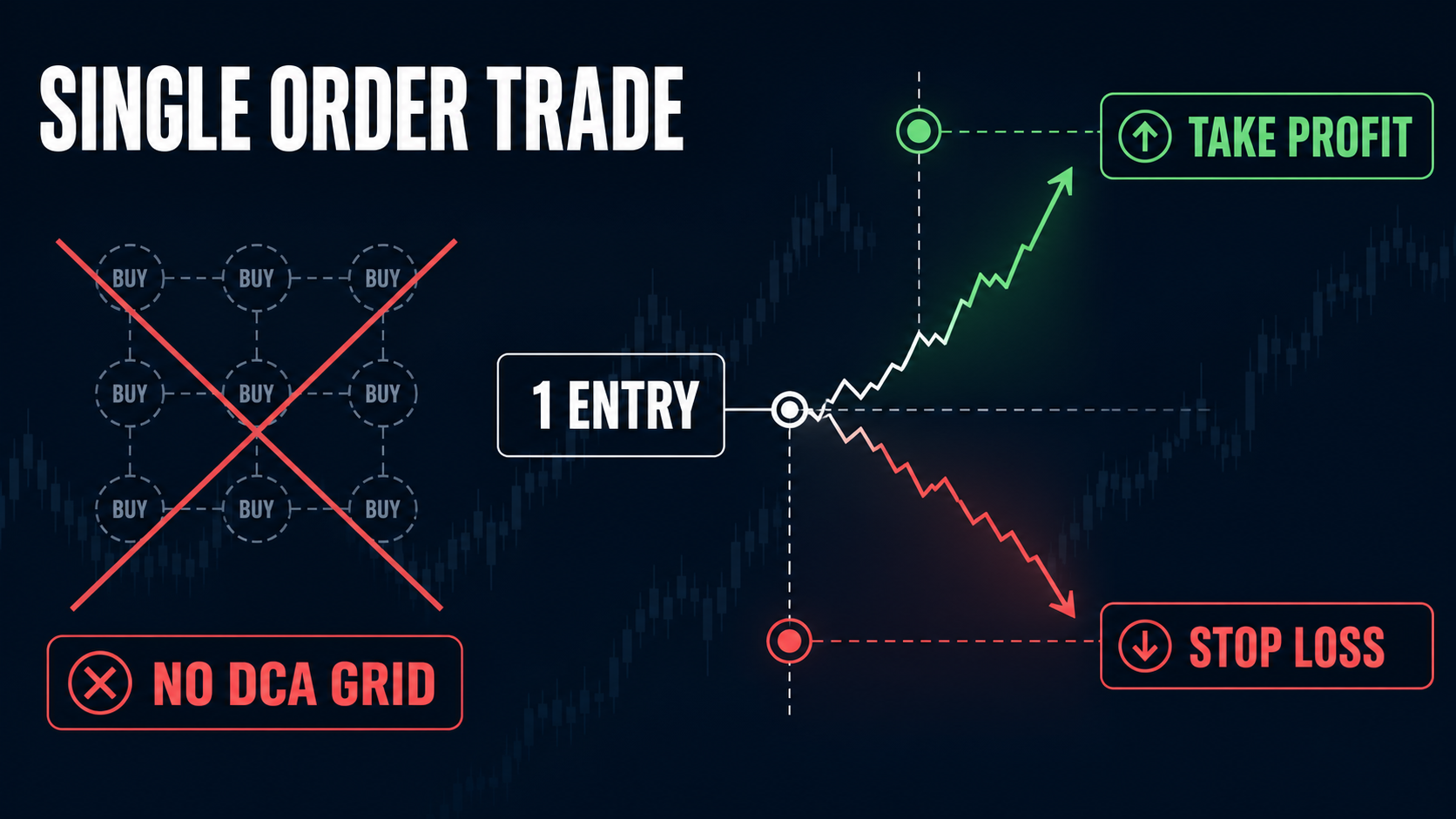
Single Order Trade, also called No Grid, is a crypto-bot approach in which a bot opens one position from one entry order. It does not place safety orders to average the entry price. Before the trade starts, the trader defines an exit for a favorable move (Take Profit) and a maximum acceptable loss (Stop Loss). The result is a compact, rule-based trade with a known risk plan.
This strategy is useful when the trading idea depends on a specific price level, a clear technical signal, or a short-lived market move. It is not a promise of profit: a stop loss can be triggered, fees and slippage affect results, and leveraged trading can magnify losses. Treat every example below as educational, not financial advice.
How the Single Order Trade strategy works
- Define the setup. Choose a liquid trading pair, direction (Long or Short where available), entry condition and position size.
- Place one entry. The bot opens the planned position with a market or limit order when the entry condition is met.
- Set Take Profit. If price reaches the profit target, the bot closes the position according to its configured order logic.
- Set Stop Loss. If price invalidates the idea and reaches the loss limit, the bot exits instead of adding more capital through DCA orders.
- Review the result. Record the signal, entry, exits, fees and outcome before changing the rules.
The key difference from a DCA grid bot is simple: there is no second, third or tenth safety order. The initial entry is the entire planned exposure. This makes the strategy easy to audit, but it also means a temporary move against the position is not averaged down.
Core bot parameters
Entry and direction
Use an entry that has a reason: a breakout with confirmation, a pullback into support or resistance, a range boundary, or a tested indicator signal. For a Long trade, profit is generally sought above the entry and the protective stop below it. For a Short trade, the relationship is reversed. Avoid entering only because price has moved quickly; define the invalidation point first.
Position size
Size the order from the amount you are prepared to lose if the stop is hit, not from the amount you hope to make. A practical risk calculation considers entry price, stop distance, leverage, trading fees and possible slippage. On futures, keep liquidation distance and maintenance margin in view; a stop loss is a risk-control instruction, not a guarantee of the exact exit price in a fast market.
Take Profit and Stop Loss
Take Profit can be set as a percentage, price level or risk/reward target. Stop Loss should sit at the point where the trade thesis is no longer valid, rather than at an arbitrary round number. A tighter stop may reduce loss per trade but can be hit by normal volatility; a wider stop requires a smaller position to keep the same monetary risk.
Illustrative setup example
Assume a trader identifies a Long setup on a liquid pair at 100 USDT. They use one entry order, set Take Profit near 102 USDT (+2%), and set Stop Loss near 99 USDT (-1%). The risk/reward before fees is about 1:2. If price reaches the target, the trade closes with the planned gain; if it reaches the stop, the loss is limited to the planned amount. There are no safety orders at 99, 98 or lower. These numbers are only an example, not a recommended configuration.
When No Grid can be a good fit
- Trading a defined breakout, retest or reversal signal with a clear invalidation level.
- Short-term spot or futures trades where limiting time in the market matters.
- Strategies tested with a fixed risk/reward model and consistent position sizing.
- Traders who prefer a simple trade journal and do not want averaging orders to change their original risk.
It may be a poor fit for a highly volatile, directionless market if the stop is so close that routine noise repeatedly closes positions. It is also unsuitable for a plan that actually relies on lowering the average entry price; in that case, a deliberately designed grid or DCA strategy is a different tool with different capital requirements.
Benefits and risks
Benefits
- Transparent exposure: maximum initial position size is easy to see.
- No hidden averaging: the bot does not add funds to a losing trade through safety orders.
- Fast decision cycle: each trade has a planned entry, target and invalidation point.
- Useful with leverage discipline: one controlled position can be easier to manage than a deep grid, provided leverage and size remain conservative.
Risks and limitations
- Price can hit the stop before moving in the expected direction.
- Gaps, volatility, liquidity limits, fees and slippage can make the realized exit worse than the configured level.
- A high win rate is not enough; the average loss, average gain and frequency of trades all matter.
- Leverage increases both potential returns and the speed and size of losses. Never treat a stop loss as a substitute for prudent sizing.
Pre-launch checklist
- Write down the entry signal and the condition that invalidates it.
- Choose a liquid pair and verify contract type, direction and leverage.
- Calculate position size from the stop distance and a fixed account-risk limit.
- Set Take Profit and Stop Loss before launching the bot.
- Check minimum order size, fees and whether the platform supports the intended order type.
- Test with a small amount or in a simulated environment where possible.
- After a series of trades, review results by market condition instead of changing parameters after one outcome.
Frequently asked questions
Is Single Order Trade the same as DCA?
No. A DCA strategy places additional orders to change the average entry as price moves. Single Order Trade uses one entry order and no safety-order grid.
Can I use this strategy on futures?
It can be used where the platform and local rules allow it, but futures carry additional leverage and liquidation risks. Use smaller size, understand margin requirements and include fees and slippage in the plan.
What Take Profit and Stop Loss percentages should I use?
There is no universal percentage. Use levels that match the asset's volatility, timeframe, market structure and your tested risk limit. A percentage that works in one market regime may be unsuitable in another.
Bottom line: Single Order Trade is a disciplined alternative to averaging. It turns a market idea into one defined entry and two predefined exit paths. Its strength is clarity; its requirement is consistent risk management.