
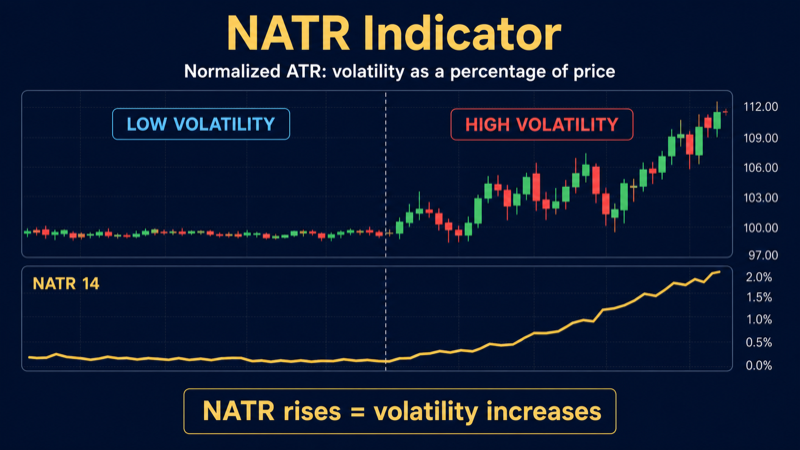
The Start Bots Signal category describes signals and indicators that can start a trading bot. One of the technical indicators is NATR (Normalized ATR).
When creating or editing any bot, there is a Start signal builder block at the bottom of settings. You can choose individual indicators, ready-made presets, and their combinations. Conditions are grouped: AND inside a group, OR between groups. The same indicator can be configured in different ways - for Long and Short, for breakouts and bounces, for level comparisons and for crosses.
What is NATR
NATR (Normalized Average True Range) is a volatility indicator that expresses average true range as a percentage of the current price. If ATR answers “how many points the asset moves on average,” NATR answers “what percent of price” - making volatility comparable across BTC, altcoins and timeframes.
In the ELIXOAI start signal builder, NATR is mainly used as a volatility filter for automatic bot starts: launch only when the market is active enough for your strategy, or pause during compression and low amplitude. The indicator output is a single number: value (NATR %).
NATR does not show trend direction - only intensity of movement. Traders combine it with trend tools (EMA, Supertrend) and oscillators (RSI, CCI): NATR answers “is there enough range for the grid or breakout,” other indicators answer “which way and when to enter.”
NATR vs ATR
Both indicators are based on True Range, but scale and use differ:
- ATR (Average True Range) measures average candle amplitude in absolute price units (dollars, USDT). BTC ATR might be 1500 while a $0.05 coin shows 0.002. Comparing “ATR > 100” across assets is meaningless; thresholds must be tuned per pair.
- NATR normalizes ATR by dividing by closing price and multiplying by 100: NATR = (ATR / Close) × 100. A value of 2 means average true range is about 2% of price - on any asset at any price level. Threshold “NATR > 2” transfers across coins much more easily than absolute ATR.
- When to use which: ATR suits stops, targets and channel width (Keltner) in price points. NATR suits universal volatility filters in the signal builder when one bot trades multiple pairs or you want one “enough/not enough movement” threshold without recalculating per instrument.
How NATR works
NATR calculation is ATR expressed as a percentage:
NATR = (ATR / Close) × 100, where ATR is average True Range over optInTimePeriod candles and Close is the current candle close. True Range accounts for gaps: max(High−Low, |High−Close[1]|, |Low−Close[1]|).
- High NATR (e.g. > 3–4%) - expanded volatility, large candles, often impulse or news. Suits breakout bots, wide grids, continuation strategies.
- Low NATR (e.g. < 1–1.5%) - compression, narrow range, sleepy market. Little point starting a trend bot; useful for DCA pullbacks or preparing for a squeeze breakout.
- Moderate NATR (1.5–3% on 15m for many crypto pairs) - workable zone for most intraday strategies. The preset 2% threshold is a starting point: 5m altcoins often need 3+, 4h BTC may need 1.5.
In the builder you set a comparison condition on output value: “NATR greater than 2,” “NATR crosses above 2,” etc. The system fetches live NATR via TAAPI and checks the condition on your timeframe - at candle close or every minute.
optInTimePeriod parameter
- Range: 1 to 300 (parameter key in the builder -
optInTimePeriod). - Default: 14 - classic ATR/NATR period; balanced for 15m–1h.
- Short period (7–10): NATR reacts faster to volatility spikes - useful on 5m for scalping and early range expansion detection.
- Long period (20–30): smoother NATR, fewer false threshold crosses. Better for 4h–1d and swing filters for sustained high/low volatility.
NATR(14) on 5m and NATR(14) on 4h are different contexts. When changing timeframe, revisit both period and numeric threshold (2% on 15m ≠ 2% on 1d).
Ready-made presets in the builder
The builder offers one NATR preset with default settings. Fully customizable: different operator, threshold, period or timeframe.
NATR gt 2 - volatility above 2% (natr)
Default condition: NATR value greater than 2 (gt) on the selected timeframe (15m interval, optInTimePeriod 14, check at bar close).
The bot starts only when average candle amplitude exceeds 2% of price - the market is active enough for strategies that need “room to move.” Unlike cross up 2, gt does not require a fresh cross: holding above the threshold is enough. For a “quiet market” filter use lt 1.5; for the start of expansion use cross up 2.
Available operators- Greater than (gt): NATR strictly above the level. NATR > 2 - sustained elevated volatility, classic filter for breakouts and wide-step grids.
- Greater or equal (gte): NATR at or above the threshold. Handy for “NATR ≥ 2” on a higher timeframe as background filter.
- Less than (lt): NATR strictly below the level. NATR < 1.5 - low volatility: pause trend bot or prepare for squeeze breakout.
- Less or equal (lte): NATR at or below the threshold. “Calm market” filter for DCA or mean reversion in a tight range.
- Crosses above (cross up): NATR was below the level and moved above. Expansion signal - cross up 2 often aligns with impulse start after compression.
- Crosses below (cross down): NATR was above the level and dropped below. Contraction signal - cross down 2: fading move, market calming down.
Absolute thresholds depend on asset and timeframe, but for crypto on 15m traders often use: < 1% - very low volatility, chop; 1–2% - moderate; 2–3% - active market (default preset); > 3–4% - elevated risk and amplitude, caution with grid size. Tune the threshold from pair history: typical NATR in trend vs flat on your interval.
General builder settings
- Timeframe (interval): 1m, 5m, 15m, 30m, 1h, 4h, 1d. Shorter intervals give more signals but more noise. Swing bots often use 1h–4h; scalping uses 5m–15m.
- Check mode: At candle close checks after the candle closes - fewer false triggers. Every minute checks inside the current candle - faster reaction, higher false-start risk.
- Operator: greater than, less than, crosses above, crosses below, greater or equal, and others define how the indicator value is compared to the target.
- Target value: a number (e.g. 30 for RSI), an indicator line (e.g. %D for Stochastic), or price (for Bollinger Bands).
- Condition groups: up to 3 groups with up to 5 conditions each. Example: group 1 - RSI < 30 AND price < lower band; group 2 - Stochastic < 20. The bot starts if group 1 OR group 2 is satisfied.
Setup examples for different strategies
Breakout: high volatility + break
Goal: start the bot only on impulse with enough range.
Long: natr preset, NATR gt 2 on 15m (period 14) AND price cross up upper Bollinger Band (20, 2).
Short: NATR gt 2 AND price below lower BBands.
NATR confirms the break happens on expanded volatility, not in a dead market.
Low volatility filter (bot pause)
Goal: avoid starting the bot in a sleepy market.
Condition (inverse): use NATR lt 1.2 as a separate “do not start” group or combine with the main signal via group logic.
Long alternative: main signal (RSI, EMA) AND NATR gte 1.5 - minimum movement threshold.
On 5m altcoins 1.2 is often too low - try 2–2.5.
Scalping: NATR gt 3 on 5m
Goal: frequent starts only with clear intraday activity.
Long: NATR gt 3, 5m timeframe, optInTimePeriod 10, check at close AND Momentum cross up 0 on the same 5m.
Short: NATR gt 3 AND Momentum cross down 0.
High threshold filters chop; period 10 catches NATR spikes faster.
Swing: NATR gte 2 on 4h
Goal: fewer but more meaningful higher-timeframe moves.
Long: NATR gte 2 on 4h, period 20, check at close AND price above EMA 50 on 4h.
Short: NATR gte 2 AND price below EMA 50.
Period 20 smooths short spikes; gte 2 on 4h means sustainably active market.
Volatility expansion: cross up 2
Goal: catch the start of impulse after compression.
Long: NATR cross up 2 on 15m (period 14), check at bar close.
Short: symmetric with trend filter (price below EMA 20).
Cross up is more precise than gt for “squeeze exit”: captures the transition moment, not just high NATR.
Contraction: cross down 2
Goal: short grid or long pause as movement fades.
Short: NATR cross down 2 on 15m AND RSI > 60 - volatility drops after overbought.
Long pause: do not combine cross down 2 with aggressive long - market is cooling.
Useful to lock grid profit before flat phase.
NATR + EMA (trend on active market)
Long: NATR gt 2 on 15m AND price cross up EMA 20 on 15m - trend resumes with enough amplitude.
Short: NATR gt 2 AND price cross down EMA 20.
Filter: NATR gte 2 on 4h AND price > EMA 50 on 15m - globally active bullish context.
NATR + RSI (filtered mean reversion)
Long: RSI cross up 30 on 15m AND NATR gte 1.8 on 15m - bounce has room to move but not extreme chaos (NATR < 5).
Short: RSI cross down 70 AND NATR gte 1.8.
Lower NATR bound filters chop; add upper bound (lt 4) to avoid catching panic knives.
Squeeze: low NATR → cross up
Group 1 (background): NATR on 1h lt 1.5 (period 20) - market compressed.
Group 2 (trigger): NATR cross up 2 on 15m (period 14) AND price cross up upper Bollinger Bands.
Logic: accumulation first, then breakout on expansion. Use separate bots or OR between groups with care.
Multi-timeframe
Long: NATR on 4h gte 2 (period 20) AND NATR cross up 2 on 15m (period 14).
Short: NATR 4h gte 2 AND NATR cross down 2 on 15m AND price below EMA 50 on 4h.
Higher TF confirms overall volatility regime; lower TF gives entry timing.
DCA on low volatility
Long: NATR lt 1.8 on 1h (period 14) AND RSI < 40 on 1h - calm pullback in moderate range.
Short: NATR lt 1.8 AND RSI > 60.
For DCA bots low NATR means less “grid blow-through” risk; avoid lt 0.8 - market may be dead with no bounce.
Condition groups: practical example
Bot with two Long scenarios:
Group 1: NATR gt 2.5 on 15m AND price cross up EMA 20 - aggressive breakout on high volatility.
Group 2: NATR cross up 2 on 15m AND RSI < 45 on 15m AND NATR 4h gte 1.5 - bounce after expansion with confirmed higher context.
Groups combined with OR. Short: NATR gt 2 AND price below EMA 50 or NATR cross down 2 AND RSI > 65.
Tip
The preset 2% threshold is a starting point, not a universal constant: on BTC 4h NATR 2% is already high activity; on a memecoin 5m it may be normal. Compare NATR to recent pair history (percentile), not an abstract number. NATR does not replace grid risk management: at NATR > 4 reduce order size or widen step. Use check at bar close to ignore intrabar volatility noise.