
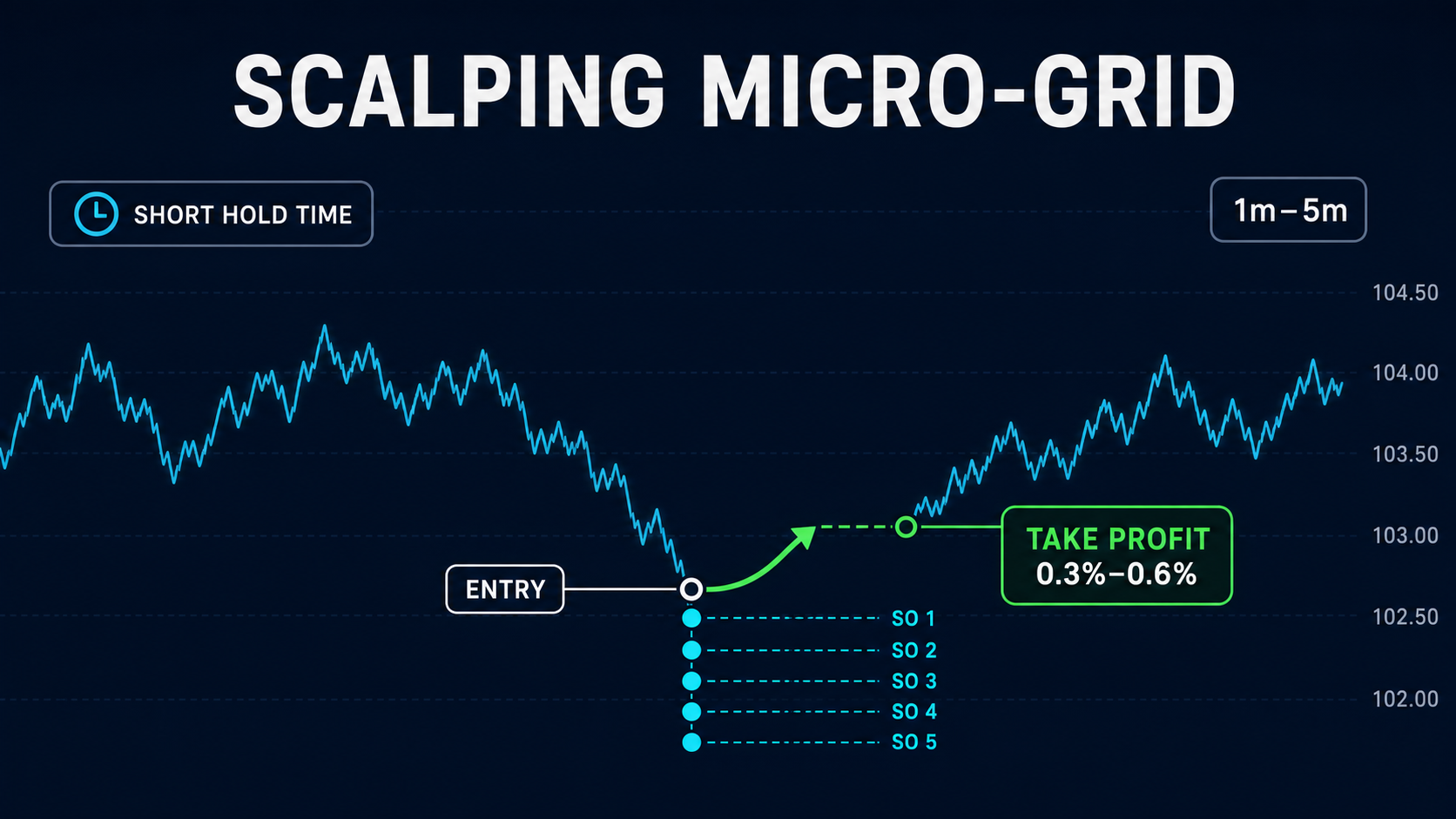
Scalping Micro-Grid uses a compact set of nearby safety orders-often three to six-and a very small Take Profit target, such as 0.3–0.6%. The idea is to capture small intraday price oscillations and close positions quickly rather than wait for a large move.
Small targets make execution quality essential. Fees, bid-ask spread, slippage, funding and partial fills can consume much of a micro-profit target. Fast markets can fill the whole grid before a rebound, so a Stop Loss or strict maximum range is still required. This article is educational, not financial advice.
How the scalping grid works
- Choose a liquid pair and a short operating timeframe, often 1m–5m.
- Open from a defined signal and place a few close safety orders.
- When price dips into the tight grid, the average entry changes modestly.
- A short rebound can trigger the small Take Profit and close the combined position.
- If volatility exceeds the plan, Stop Loss or a range rule closes the trade.
Critical settings
Set order spacing from actual short-term volatility, not an arbitrary tiny number. Calculate the target after all trading costs. Check exchange minimum order size and rate limits because many quick cycles increase operational load. Keep the total grid exposure small enough for a sudden impulse. On futures, low targets do not remove liquidation risk.
Illustrative structure
A bot uses five close safety orders and aims for a 0.5% gross Take Profit. If round-trip fees and expected slippage total 0.2%, the remaining margin is much smaller than 0.5%. The target must therefore be tested net of costs, not judged by the gross percentage alone.
When it may fit
- The pair is highly liquid and has a narrow spread.
- You can monitor execution, connectivity and fee impact.
- The bot uses a strict range, risk cap and stop policy.
- The strategy has been tested across quiet and high-volatility periods.
FAQ
Does a smaller Take Profit mean lower risk?
No. A small target can increase sensitivity to costs and requires frequent accurate execution. Risk depends on position size, grid range and exit controls.
Can it make dozens of trades every day?
It can in suitable conditions, but more trades also mean more fees, operational risk and a greater need for monitoring.
Bottom line: Scalping Micro-Grid is an execution-sensitive strategy. Net profitability must be evaluated after every cost and within a strict loss limit.