
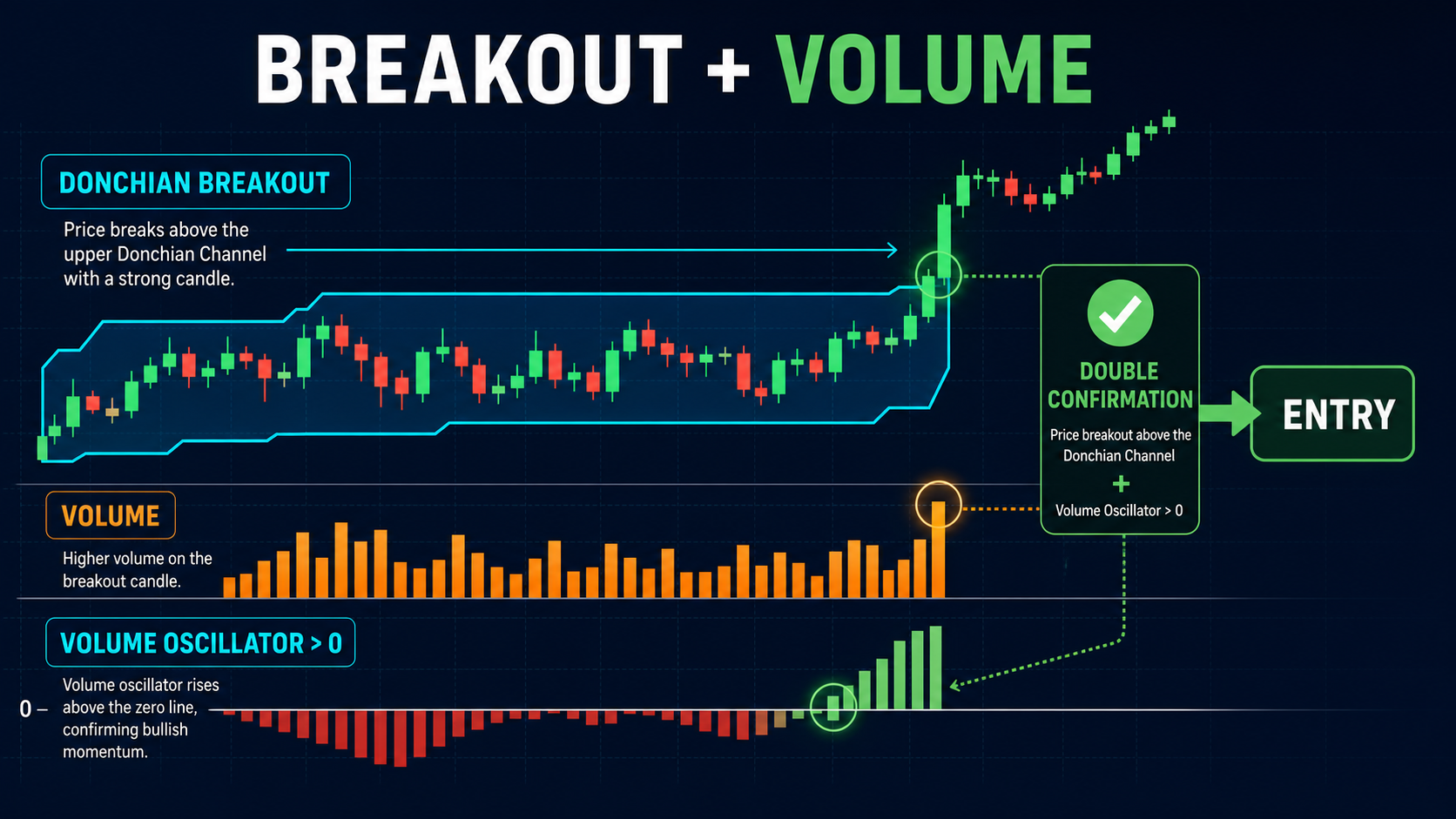
Breakout trading is vulnerable to false moves: price can briefly cross a range boundary and immediately return. This strategy requires two independent events before a bot opens a position: a confirmed Donchian Channel breakout and evidence that volume is expanding. The volume condition is not a prediction; it is a way to demand visible participation behind the move.
Defining the double breakout
A Donchian Channel uses the highest high and lowest low over a chosen lookback. For a Long, the conservative signal is a candle close above the prior upper channel, not merely a wick through it. The second filter can require Volume Oscillator above zero and rising, or the breakout candle’s volume to exceed a tested multiple of recent average volume. Reverse the price direction for Short.
- Use the prior completed channel boundary to avoid comparing a candle with a channel it has already changed.
- A common lookback such as 20 is only a starting candidate; shorter channels create more signals and more noise.
- Require both conditions on the same closed candle or specify exactly how many candles the volume confirmation may lag.
Detailed setting choices
Separate the price rule from the volume rule while testing. For the channel, test lookback length, close-versus-wick confirmation and whether a retest is required. For Volume Oscillator, test its fast and slow averages and define what “positive” means: above zero, rising for several bars, or above a historical threshold. Add CMF or MFI only when it improves results out of sample.
- Price trigger: close outside the channel, then a market order, stop order, or retest limit rule-do not mix them opportunistically.
- Volume trigger: Volume Oscillator > 0 plus a minimum relative-volume condition may be stricter than either filter alone.
- Distance control: reject an entry when the closing price is too far beyond the channel relative to ATR, because the stop and slippage expand.
Stops, targets and bot exposure
A failed breakout often returns inside the channel. A structural stop can be placed beyond the breakout candle or back inside the channel according to the tested rule; it must be far enough to allow normal noise and close enough to invalidate the premise. Size the initial order from that distance. If using a grid, keep it shallow and define total exposure before launch rather than adding to an unconfirmed breakout.
- A retest that holds the former channel boundary can be an alternative entry condition, but it will miss some fast moves.
- Take Profit may use a tested risk multiple, ATR objective, trailing mechanism or partial exit; pick one rule set.
- Cancel waiting orders when price closes back inside the channel or volume confirmation expires.
False-breakout risks
High volume can be caused by a news headline, liquidations or one-time order flow and may not represent durable demand. Thin pairs can show impressive relative volume while still having poor fills. Fees and spread can turn a small breakout into a loss. Keep a maximum account loss, check the live order book and measure results separately for normal and news-driven sessions.
- Do not chase a breakout after several extended candles.
- Use exchange-specific volume data-the same symbol can trade differently across venues.
- Backtest with realistic fees and assume worse fills during fast candles.
Conclusion. The channel tells where price escaped; volume asks whether participation accompanied it. The two filters must be defined with precise, testable settings and paired with a strict invalidation rule.