
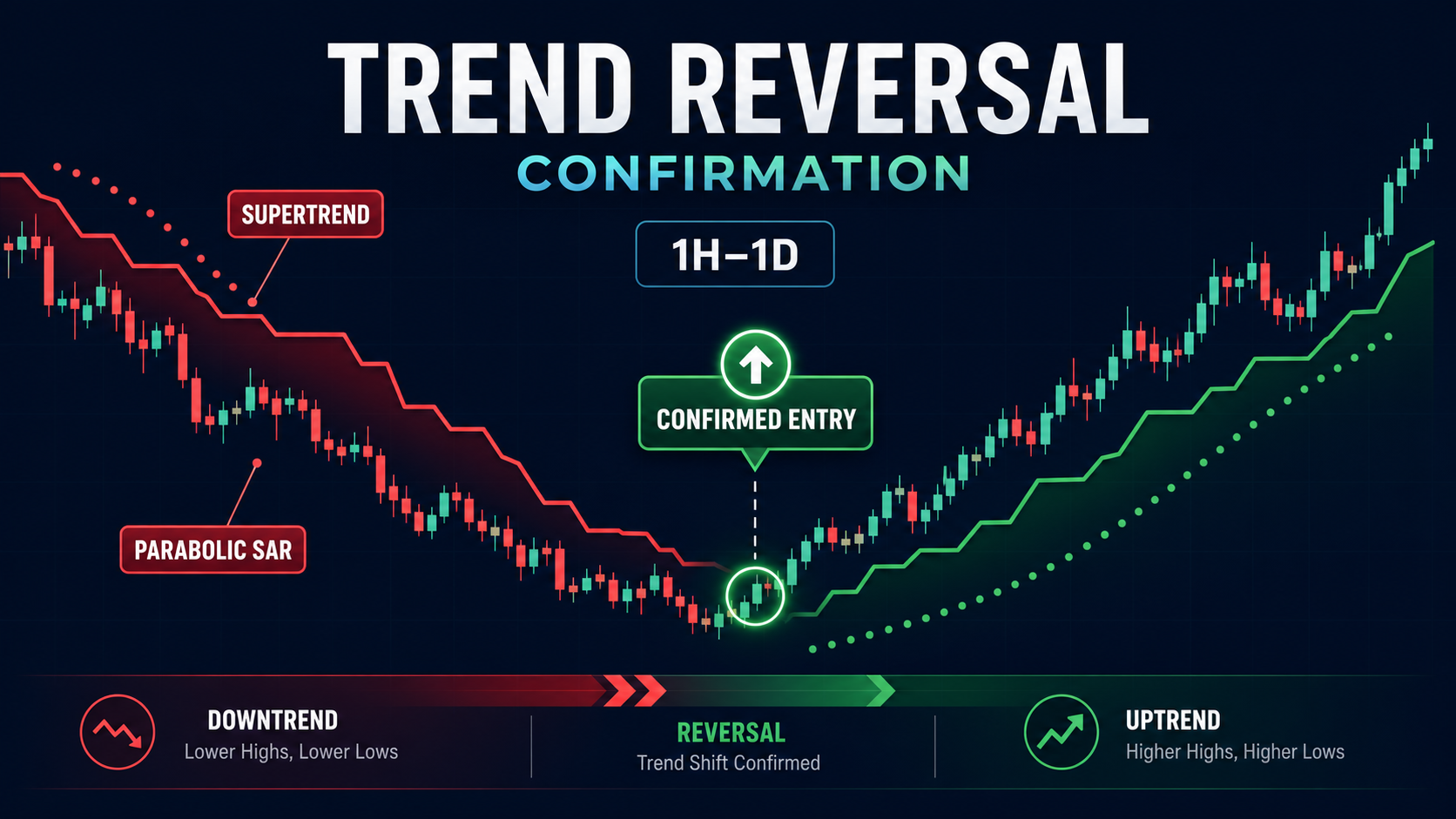
Global Trend Reversal Indicators is a structured crypto-bot approach. The task is to identify a transition, not to treat one colour change as a complete reversal. The examples below are parameters to test on the exact pair and exchange, not a universal preset or investment advice.
Signal logic
Start from 1h, 4h or daily market structure. A Long candidate may require SuperTrend bullish, SAR dots below price and a momentum measure such as STC or RVGI improving; Short reverses the conditions. Require the chosen higher candle to close and distinguish a first pullback from a full structural reversal.
- Read the global direction on closed 1h, 4h or daily candles.
- Separate a trend flip from a correction by requiring price structure confirmation.
- For Short, test independently; do not assume a Long model is automatically symmetric.
Detailed settings to test
Test SuperTrend ATR period and multiplier, SAR step/maximum acceleration, and STC/RVGI lengths separately. Faster settings react early but whipsaw more; slower settings filter noise but give a wider stop and later entry. Include a confirmation rule such as a higher high/lower low, close beyond a swing level, or agreement across two uncorrelated tools.
- Test SuperTrend ATR period and multiplier as a pair, not a copied default.
- Adjust SAR step and maximum acceleration to the volatility of the selected timeframe.
- Specify how STC/RVGI confirms: level, direction, cross or divergence.
Entry, exit and bot exposure
A lower timeframe can refine a permitted higher-timeframe direction, but it cannot rewrite the higher trend. Position size must be based on the structural stop, which is typically larger than for a scalp. Use a target at a higher-timeframe level, a trailing rule, or staged exits; define what happens when the signal loses agreement while a position is open.
- Enter on a lower-timeframe trigger only while the higher trend filter remains valid.
- Place Stop Loss at market-structure invalidation and size the position from that distance.
- Review funding, overnight gaps and liquidation margin before using leverage.
Limits specific to this strategy
These swing setups carry gap risk, funding costs on futures and long exposure to a regime change. In choppy ranges, flip-based indicators can alternate repeatedly. Check liquidation distance, use a maximum account loss and do not add to a trade solely because an indicator remains the same colour.
Conclusion. Trend-reversal indicators are best used as a confirmation stack anchored to higher-timeframe structure.