
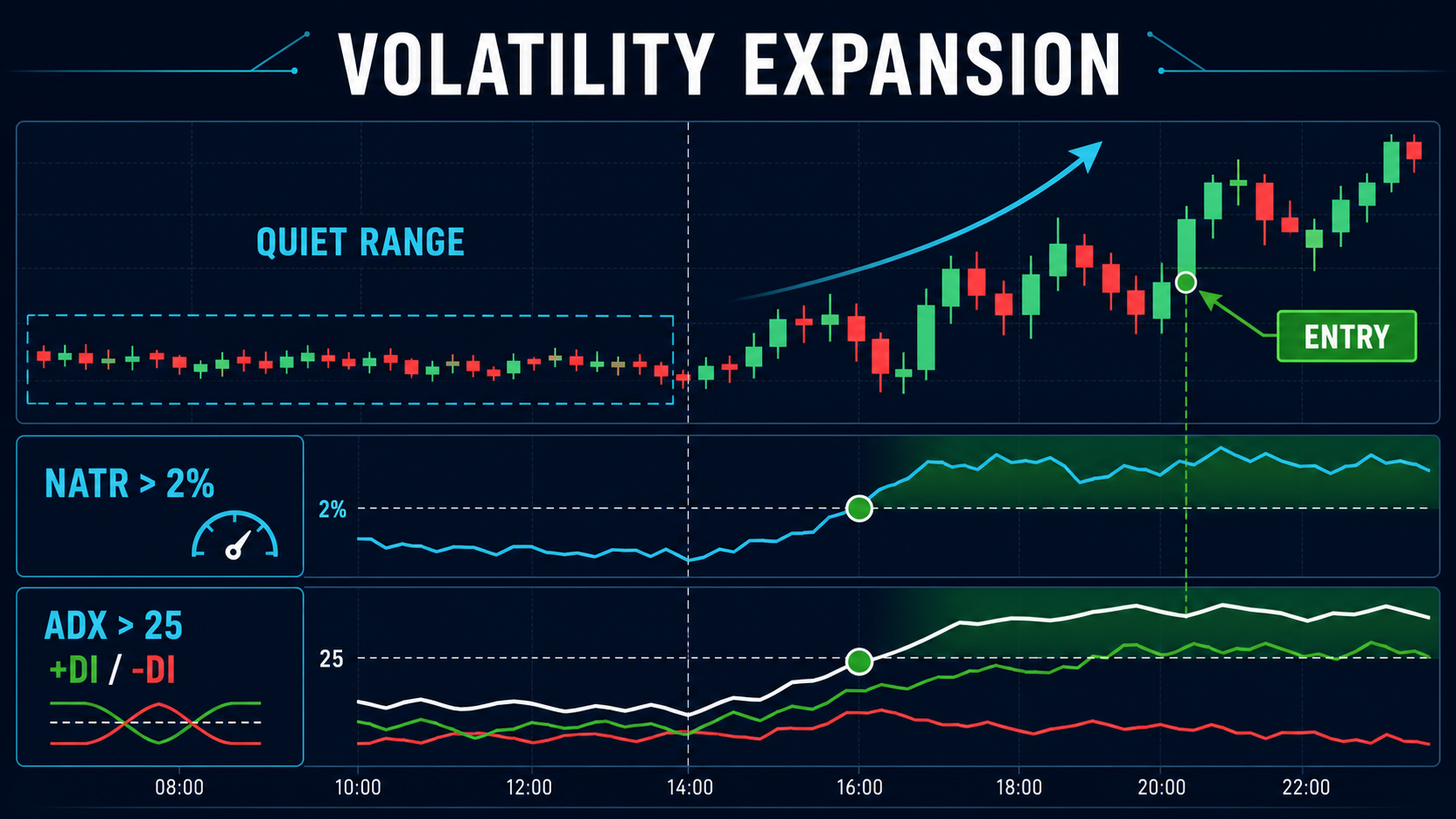
Volatility expansion trading is a rule set for moments when a previously quiet crypto pair starts to travel far enough to justify an active trade. Rather than treating every candle as an opportunity, it uses NATR to measure current range relative to price and ADX/DMI to assess whether directional movement is developing. The objective is selectivity, not a promise that every expansion will continue.
What confirms the setup
NATR converts average true range into a percentage, so a reading of 2% means the recent average range is roughly two percent of price. ADX measures trend strength, while +DI and -DI help describe direction. A practical Long filter can require NATR to cross a tested threshold, ADX to rise above 25, and +DI to be above -DI at the close. For Short, reverse the DI relationship.
- Use a candle close for the decision; an intrabar spike can disappear before the interval ends.
- Treat NATR > 2% and ADX > 25 as examples to test, not universal settings.
- Compare the reading with the pair and timeframe: 2% on a five-minute chart is not equivalent to 2% on four hours.
Detailed bot settings
Start with one liquid pair and a fixed timeframe. A 14-period NATR and 14-period ADX are common baselines because they make historical comparison simple. Set an activation threshold from that pair’s own history: for example, a percentile of its normal NATR or a tested fixed value. Require the ADX line to be rising, not merely above the threshold, if you want to avoid late flat readings.
- Entry trigger: first closed candle satisfying NATR, ADX and DMI direction; optionally require a break of that candle’s high or low.
- Grid use: keep the coverage narrow and the number of safety orders limited, because an expansion can continue against the first entry. Space orders from ATR/NATR rather than a random fixed percentage.
- Exit: define Take Profit before launch; use a structure level or ATR multiple for Stop Loss and keep the account risk fixed.
A configuration example
On a 15-minute liquid pair, a trader may test NATR(14) crossing above 1.2%, ADX(14) above 25 and rising, and +DI above -DI for Long. The bot can wait for the confirming candle to close, then place the initial order only if price has not already moved an excessive distance. This is an illustration for testing, not a recommended preset.
- Cancel the signal if NATR is already extremely above its normal range; late entries can face wider slippage.
- Pause during scheduled news or thin order-book periods when printed range can be misleading.
- Record the NATR, ADX, DI relationship, spread and realized fill for every trade.
Limits and risk control
ADX and NATR are derived from past candles; they do not know whether the next move will reverse. Volatility also increases stop distance, fees and slippage. Position size must therefore be calculated from the invalidation distance, not from an expectation of a fast grid close. On leveraged markets, liquidation distance and maintenance margin need a separate check.
- Set a maximum acceptable spread and a maximum distance from the triggering level.
- Do not turn a volatility filter into permission to use more leverage.
- Evaluate the rules over quiet, trending and news-driven samples before changing thresholds.
Conclusion. NATR identifies expanding range, while ADX/DMI adds a directional filter. The combination is useful only when its thresholds, order spacing and loss limit have been tested for the exact market.