
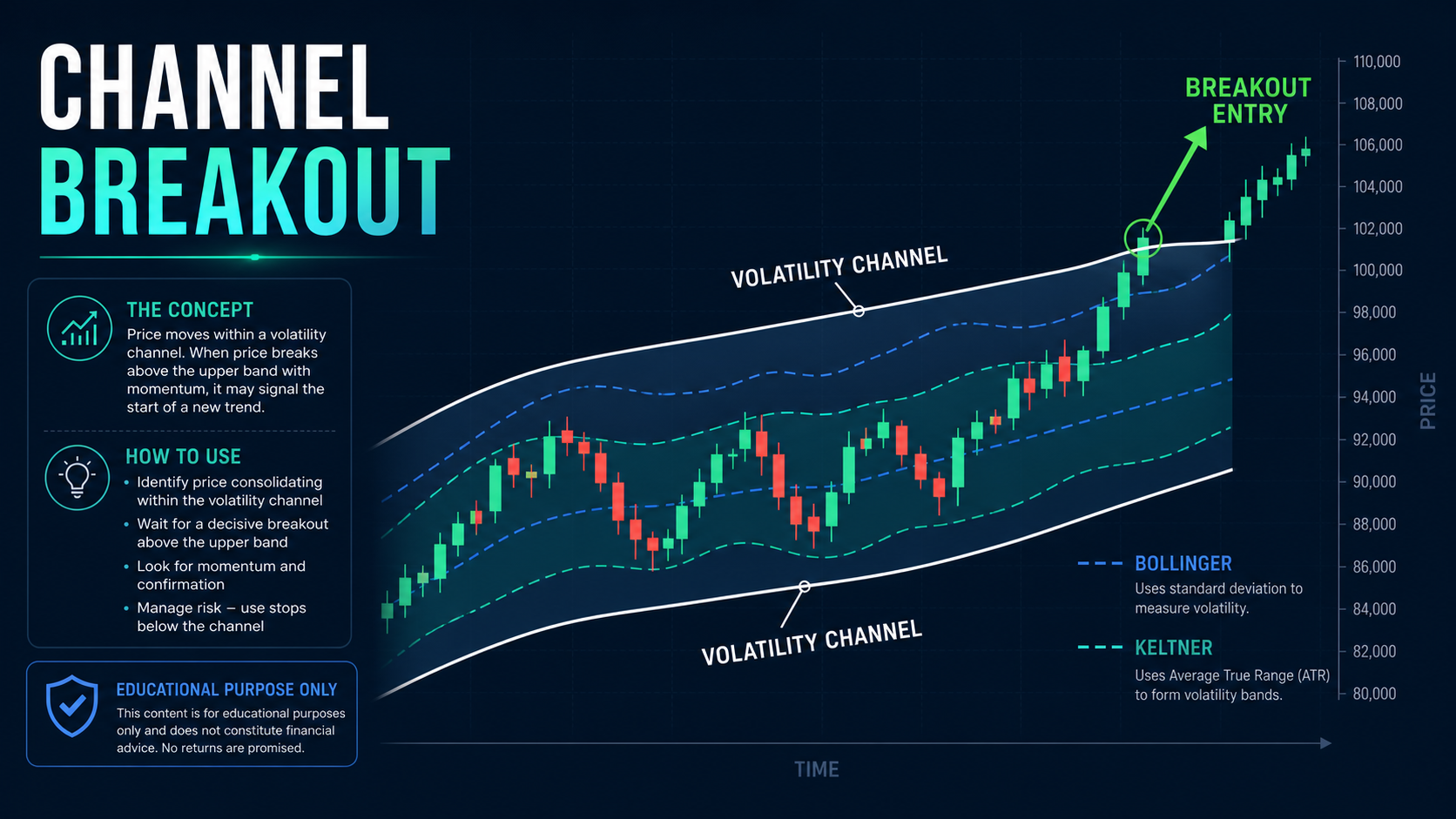
Channel breakout trading looks for price leaving a volatility envelope. Bollinger Bands expand with standard deviation, Keltner Channels use an ATR-based envelope, and Donchian Channels mark recent highs and lows. The strategy trades the possibility that new momentum continues beyond the established range.
Signal logic
A close outside an upper boundary can create a Long candidate; a close outside a lower boundary can create a Short candidate. Better filters include a closing-candle requirement, increasing volume, channel expansion or a retest of the broken boundary. The channel itself is not directionally predictive: it defines the reference range from which a break is measured.
Bot setup
Select one channel type and make its period and multiplier explicit. Define whether the bot enters immediately, after a close, or on retest. Place Stop Loss inside the old range or at a structural invalidation level, and define an exit for fading momentum. Position size must account for wider spreads and slippage during breakout candles.
Risks and validation
False breakouts are the central risk. News, thin liquidity and short squeezes can push price outside a boundary and immediately reverse. Do not widen the stop merely because the channel was broken; test the rule through different volatility regimes and evaluate results after realistic slippage.
FAQ
Bollinger, Keltner or Donchian? They measure different channel concepts. Use the one whose logic and parameters you have tested, not the one that produced the latest attractive chart.