
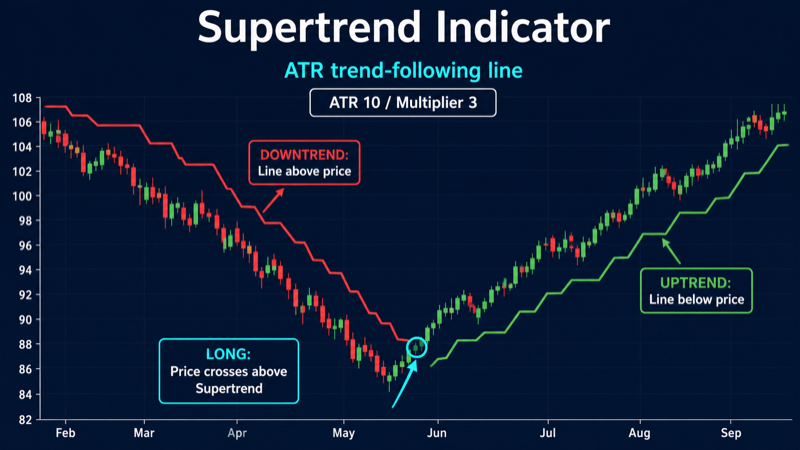
The Start Bots Signal category describes signals and indicators that can start a trading bot. One of the technical indicators is Supertrend.
When creating or editing any bot, there is a Start signal builder block at the bottom of settings. You can choose individual indicators, ready-made presets, and their combinations. Conditions are grouped: AND inside a group, OR between groups. The same indicator can be configured in different ways - for Long and Short, for breakouts and bounces, for level comparisons and for crosses.
What is Supertrend
Supertrend is a popular trend indicator built on ATR (Average True Range). It draws one dynamic line that trails price and acts as a trailing support or resistance level. When the close is above the line, the indicator is in Long mode; when below, in Short mode.
Supertrend does not show trend strength as a percentage like RSI, and it does not build a histogram like MACD. Its job is simpler: give a clear answer - bullish or bearish context right now - and capture the flip moment when price breaks through the line. In the ELIXOAI start signal builder, Supertrend is used as an automatic bot start condition when Long/Short direction matches your strategy or has just changed.
The indicator shines in trending markets: the line lags less than simple moving averages and reacts faster to volatility thanks to ATR. In sideways markets Supertrend often flips back and forth - so traders combine it with filters (higher timeframe, EMA, RSI) or use the supertrend_change preset, which catches direction changes rather than simply holding Long.
Supertrend vs EMA and Parabolic SAR
All three tools help trade with the trend, but the logic differs:
- EMA is a smoothed average of price. Signals come from price crossing the line or two EMAs crossing each other. EMA does not directly account for volatility: at the same period, the line sits equally far from price in calm and wild markets.
- Parabolic SAR (PSAR) uses dots above/below price that also flip on reversals. PSAR accelerates over time and can give early reversals in chop. Supertrend uses an ATR band × multiplier - line width adapts to current volatility.
- Supertrend offers one continuous line plus text direction Long/Short (valueAdvice). Ideal for conditions like “direction equals Long” or “direction changed to Long.” To compare price with the numeric line level, use output value with cross_up/cross_down or gt/lt operators.
How Supertrend works
The calculation relies on ATR over the chosen period and multiplier - the classic 7 and 3 pair:
- In Long mode the Supertrend line sits below price and trails upward as price rises. While close stays above the line, valueAdvice = Long.
- In Short mode the line is above price and moves down with declines. While price stays below the line, valueAdvice = Short.
- A flip happens when price breaks the line: Short → Long or Long → Short. The supertrend_change preset with changed_to captures exactly that moment.
In the start signal builder you set a comparison condition: “valueAdvice equals Long,” “valueAdvice changed to Long,” “price crossed Supertrend line up,” and so on. The system fetches live values from the exchange via TAAPI on your timeframe - default 15m, check at bar close.
Indicator outputs
Supertrend has two outputs in the builder - pick the one you need in the condition settings:
- value (Supertrend line): numeric line value on the current candle. Compare with price: cross_up/cross_down, gt/lt - “price above line,” “price crossed line up.”
- valueAdvice (direction): text value Long or Short. Operators eq/neq - “currently Long”; changed_to/changed_from - “just became Long” or “no longer Short.”
Period and multiplier parameters
- Period (ATR period): 2 to 300.
- Default: 7 - TAAPI standard; balanced volatility response for 15m–1h.
- Multiplier (ATR multiplier): 0.1 to 20, step 0.1.
- Default: 3 - classic setting; line at a comfortable distance from price.
- Low multiplier (1.5–2): line closer to price, more flips, more signals and noise - scalping on 5m–15m.
- High multiplier (4–5): line farther from price, fewer Long/Short changes - swing on 1h–4h, fewer false flips in ranges.
Supertrend(7, 3) on 5m and on 4h are different indicators. When changing timeframe, revisit period, multiplier, and signal type (hold Long vs changed_to Long).
Ready-made presets in the builder
The builder offers two Supertrend presets with default settings. Each can be fully customized: different operator, Short direction, period, multiplier, or timeframe.
Supertrend Long - direction Long (supertrend)
Default condition: valueAdvice equals Long (eq) on the selected timeframe (15m interval, period 7, multiplier 3, check at bar close).
Long signal for sustained bullish context: price holds above the Supertrend line, indicator in Long mode. The bot starts while the trend is “green,” without requiring a fresh flip. For Short, set target Short and eq. All operators are available: direction comparison, changed_to/changed_from, plus price vs value line.
Operators for supertrend preset- Equals (eq): valueAdvice is strictly Long (or Short if target Short). Preset classic - eq Long: bot runs in Supertrend bullish context.
- Not equal (neq): direction is not Long - filter to avoid Long starts while Supertrend is Short, or vice versa.
- Changed to (changed_to): valueAdvice just became Long (or Short). Alternative to supertrend_change within the same preset.
- Changed from (changed_from): direction stopped being Short - fine-tuning transitions between modes.
- Crosses above (cross up): for value output: price crossed Supertrend line from below - trailing support breakout.
- Crosses below (cross down): price crossed line from above - weakening bullish trend or Short start signal.
- Greater than (gt): price strictly above value line - bullish context without relying on valueAdvice.
- Less than (lt): price strictly below line - bearish context for Short filters.
- Greater or equal (gte): price at or above line - handy as a higher-timeframe filter.
- Less or equal (lte): price at or below line - bearish context filter on 4h.
Supertrend changed to Long (supertrend_change)
Default condition: valueAdvice changed to Long (changed_to) on the selected timeframe (15m interval, period 7, multiplier 3, check at bar close).
Long signal at the flip moment: Supertrend just switched from Short to Long - price broke the line upward. Unlike “valueAdvice eq Long,” the bot does not start on every Long candle, only on a fresh direction change. For Short use changed_to Short. Operators are limited to direction comparison: eq, neq, changed_to, changed_from.
Operators for supertrend_change preset- Equals (eq): equivalent to supertrend preset - holding Long without requiring a fresh flip.
- Not equal (neq): direction does not match target - opposite-mode filter.
- Changed to (changed_to): main preset operator - valueAdvice just became Long. Ideal for “enter on flip” setups.
- Changed from (changed_from): direction stopped being previous value - e.g. exiting Short context before Long.
If you select output value, compare close price with the numeric line: cross up - breakout above, gt - price above line. Alternative to valueAdvice eq Long with more flexibility (levels, gte/lte). For pure “trend flip” signals, valueAdvice changed_to Long is cleaner.
General builder settings
- Timeframe (interval): 1m, 5m, 15m, 30m, 1h, 4h, 1d. Shorter intervals give more signals but more noise. Swing bots often use 1h–4h; scalping uses 5m–15m.
- Check mode: At candle close checks after the candle closes - fewer false triggers. Every minute checks inside the current candle - faster reaction, higher false-start risk.
- Operator: greater than, less than, crosses above, crosses below, greater or equal, and others define how the indicator value is compared to the target.
- Target value: a number (e.g. 30 for RSI), an indicator line (e.g. %D for Stochastic), or price (for Bollinger Bands).
- Condition groups: up to 3 groups with up to 5 conditions each. Example: group 1 - RSI < 30 AND price < lower band; group 2 - Stochastic < 20. The bot starts if group 1 OR group 2 is satisfied.
Setup examples for different strategies
Trend Long: eq Long on 15m
Goal: start the bot in sustained bullish context.
Long: supertrend preset, valueAdvice eq Long, 15m, period 7, multiplier 3, check at bar close.
Short: eq Short, same settings.
Suits trend grids that should run while Supertrend stays “green.”
Flip entry: changed_to Long
Goal: one start on Short → Long change, no repeats every candle.
Long: supertrend_change preset, changed_to Long, 15m, period 7, multiplier 3.
Short: changed_to Short.
Classic trend-following: buy the Supertrend line breakout up.
Scalping: period 5, multiplier 2 on 5m
Goal: frequent flips on a short TF.
Long: changed_to Long on 5m, period 5, multiplier 2.
Short: changed_to Short.
Filter: valueAdvice eq Long on 15m - skip small flips against the higher trend.
Swing: period 10, multiplier 4 on 4h
Goal: rare but meaningful trend shifts.
Long: changed_to Long on 4h, period 10, multiplier 4, check at close.
Short: changed_to Short.
Wide line smooths noise - signals closer to a “real” cycle reversal.
Supertrend + EMA
Long: valueAdvice eq Long on 15m AND close price above EMA 50 on the same 15m.
Short: eq Short AND price below EMA 50.
Supertrend gives volatility-aware direction; EMA adds a trend filter.
Short on downward flip
Condition: changed_to Short or valueAdvice eq Short, 15m, period 7, multiplier 3.
Filter: RSI > 60 - short after overbought with Supertrend flip confirmation.
Fits short grids at local peaks.
Pullback in trend
Group 1: valueAdvice eq Long on 4h (period 7, multiplier 3) AND changed_to Long on 15m (period 7, multiplier 2).
Logic: higher TF in Long, lower TF catches resumption after correction. Fewer false starts against the global trend.
Supertrend + RSI
Long: changed_to Long on 15m AND RSI cross up 40 on 15m - Supertrend flip plus oscillator bounce.
Short: changed_to Short AND RSI cross down 60.
RSI filters overheated flips in chop.
Multi-timeframe
Long: valueAdvice eq Long on 4h AND changed_to Long on 15m.
Short: eq Short on 4h AND changed_to Short on 15m.
Avoid buying every local 15m flip against bearish Supertrend on 4h.
Breakout: price cross up value line
Long: value output, cross up operator (price crossed line up) on 15m, period 7, multiplier 3 AND Momentum gt 0 on the same TF.
Short: cross down value.
Confirm breakout with impulse, not direction alone.
DCA on flip after correction
Long: changed_to Long on 1h (period 7, multiplier 3) AND RSI < 50 on 1h - Supertrend bounce without extreme oversold.
Short: changed_to Short AND RSI > 50.
For DCA bots, changed_to is softer than eq Long every candle - one start per cycle.
Condition groups: practical example
Bot with two Long scenarios:
Group 1: changed_to Long on 15m AND price > EMA 50 - flip entry with trend filter.
Group 2: valueAdvice eq Long on 4h AND RSI < 45 on 15m - DCA in bullish context on pullback.
Groups combined with OR. Configure Short symmetrically (changed_to Short, eq Short).
Tip
In sideways markets Supertrend flips often: changed_to Long and changed_to Short alternate and produce false bot starts. Increase multiplier (4 instead of 2), add eq Long filter on 4h, or combine with EMA. The eq Long preset keeps the bot active all through bullish mode - for one-shot entries prefer supertrend_change. Use check at bar close to ignore intrabar noise.