
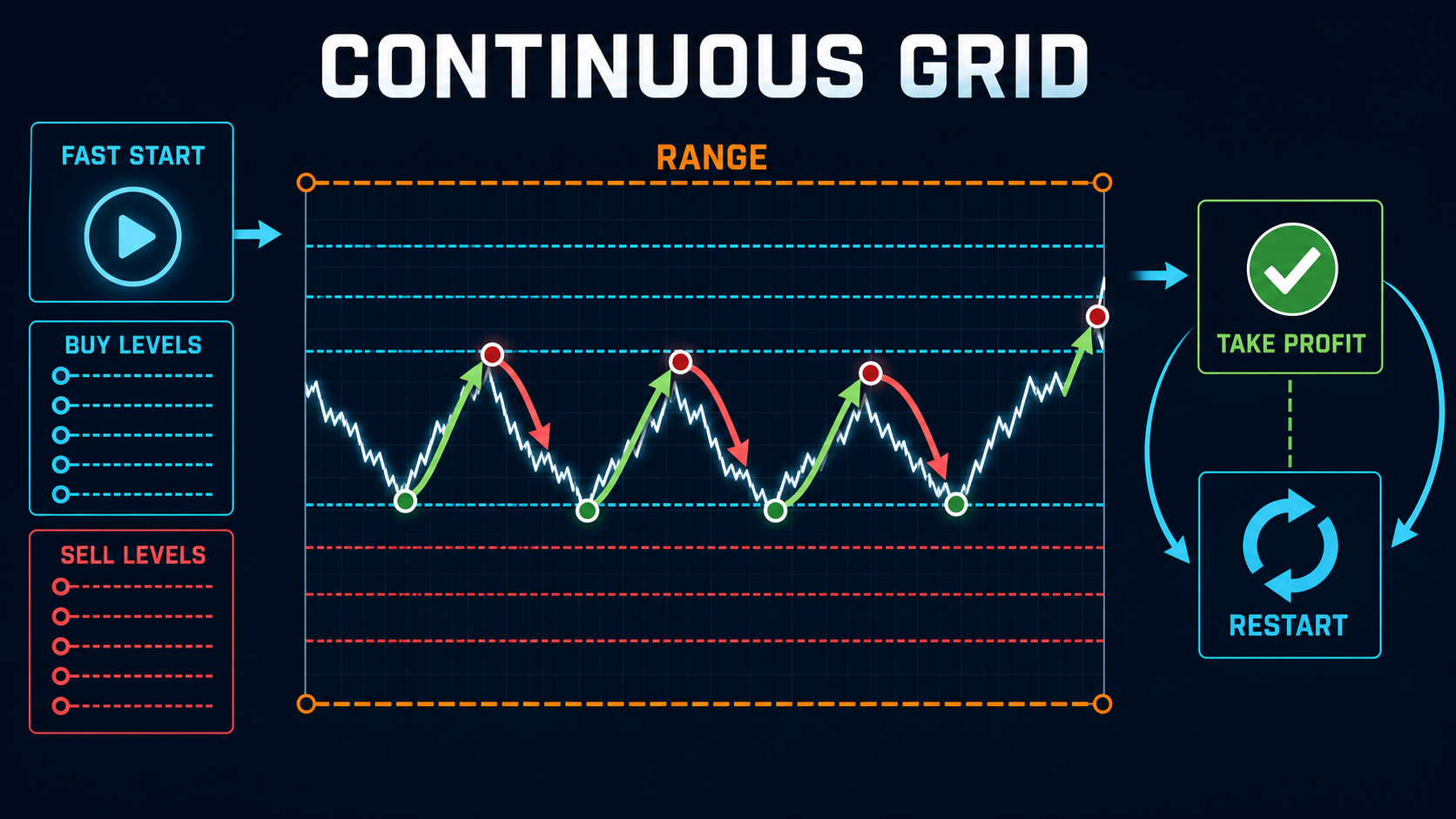
Fast indicator-free algorithmic scalping is a continuous-grid approach. The bot does not wait for RSI, EMA or a chart pattern: it opens according to its configured “fast start” rule, places its grid, closes by the exit logic and starts the next cycle. This can suit a liquid, sideways market only when the range, order spacing, fees and maximum exposure are explicitly controlled. Immediate start is not a claim that every market is safe for a grid.
What “continuous” actually means
After creation-or after the prior deal reaches Take Profit-the bot is permitted to begin another cycle without waiting for a new technical signal. The entry condition is therefore operational, not predictive. A continuous setting must include clear rules for when it is allowed to stop: manual pause, Stop Loss, maximum drawdown, price outside the configured range, abnormal spread or scheduled risk event.
- Fast start: initial order is placed immediately according to the chosen direction and order type.
- Cycle close: the configured Take Profit or exit condition closes the current deal.
- Restart: the next cycle may start automatically only if all account-level and market-safety limits remain valid.
Calculate the grid before launch
Begin with the expected operating range, not the number of orders. The lower and upper boundaries should be wide enough for normal range noise yet narrow enough that capital is not silently committed to an unrealistic move. Define how many grid/safety orders fit inside the coverage, whether the spacing is fixed percentage or ATR-based, and whether order size is flat or increases. These choices determine the worst-case exposure.
- Coverage: choose an explicit lower/upper price range or adverse-move percentage from a tested scenario.
- Order count and step: more orders with smaller steps can fill more often but increase fees and operational churn.
- Order sizing: flat sizing is easier to audit; increasing size lowers average entry faster but increases capital concentration.
- Take Profit: it must exceed estimated fees, spread and expected slippage for the full cycle, not only the first order.
Practical start profiles
A conservative test profile uses a liquid spot pair, no leverage, a limited coverage range, equal order sizes and a Take Profit that is assessed after costs. A more active profile uses closer grid steps but must lower per-cycle size and set a firm account loss cap. Parameters such as 3–6 orders or a 0.3–0.6% target can be test ranges on suitable markets, never defaults to copy into every pair.
- Use one direction or neutral/range logic only when the platform’s exact behaviour is understood.
- Set a maximum simultaneous exposure and check the exchange minimum order size after every planned safety order.
- Define a cooldown after a loss or unusually fast cycle rather than assuming immediate restart is always desirable.
When not to run it
A continuous grid is most exposed when the market leaves its range and trends one way. The absence of indicators does not remove the need for a market-regime decision. News, delistings, thin liquidity, large funding costs on futures and a widening spread can all turn frequent fills into growing inventory. Use Stop Loss or a hard pause rule, avoid leverage until the risk is fully understood, and review maximum drawdown rather than only closed Take Profit cycles.
Conclusion. Continuous Grid replaces a signal with a repeatable operating cycle. Its safety comes from range coverage, total exposure, costs and stop conditions-not from the fact that it starts quickly.