
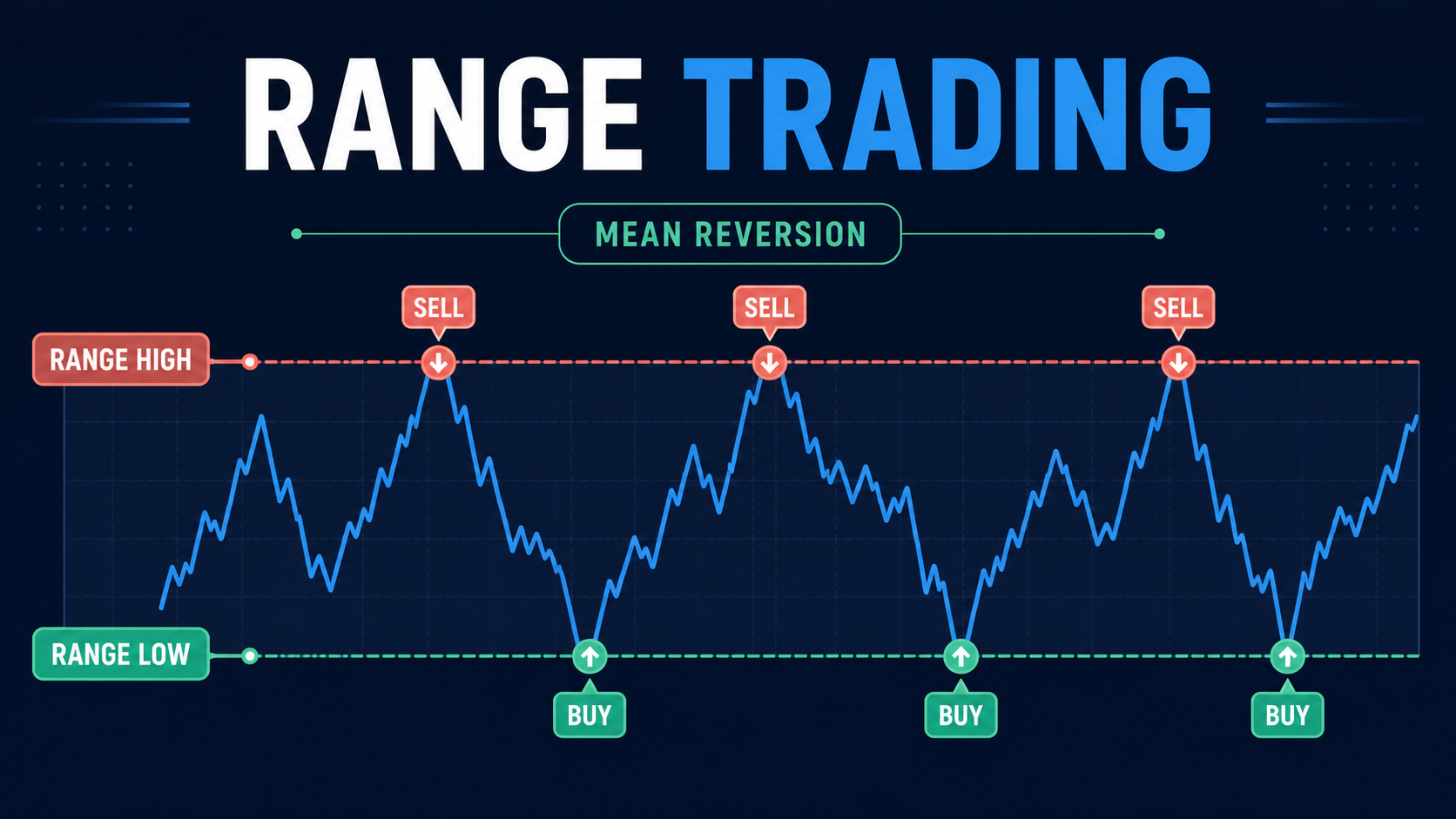
Horizontal Channel Range Trading is a structured crypto-bot approach. It is a mean-reversion method for a confirmed consolidation, not for chasing a breakout in progress. The examples below are parameters to test on the exact pair and exchange, not a universal preset or investment advice.
Signal logic
First map a horizontal range from at least two meaningful reactions on each side. A Long setup is considered near the lower boundary only after rejection or a return back inside; the Short logic is mirrored near the upper boundary. Bollinger Bands or Keltner Channel can refine timing, while ADX and NATR identify whether the market is still compressed.
- Mark the range only after price has reacted repeatedly, not from two arbitrary lines.
- Avoid initiating in the middle third of the corridor, where reward-to-risk is usually poorer.
- For Long, require a rejection from the lower zone; for Short, require the equivalent upper-zone rejection.
Detailed settings to test
Test the lookback used to draw boundaries, the minimum number of touches, and how much tolerance is allowed around a level. Bands are timing tools, not a replacement for the horizontal range. A low or falling ADX may support a range regime; a rising ADX, widening bands or expansion in NATR can disqualify new mean-reversion entries.
- Test Bollinger period/deviation or Keltner ATR multiplier separately from the range definition.
- Set an ADX/NATR pause threshold from the history of the selected pair and timeframe.
- Measure level tolerance in ATR or percentage so it adapts to price scale.
Entry, exit and bot exposure
Enter after a closed rejection candle, oscillator turn, or limit retest-choose one repeatable trigger. Place the initial order small enough for a stop outside the invalidation side, and cap any safety orders before launch. Take Profit can target the range midpoint, the opposite boundary, or a tested partial-exit sequence.
- Cancel a waiting entry if a candle closes decisively outside the defined range.
- Put Stop Loss beyond the structural range invalidation, not exactly on the visible line.
- Review results separately for quiet ranges, expanding ranges and news periods.
Limits specific to this strategy
The primary failure is a genuine breakout. A level that held many times can fail abruptly during news or a volatility-regime change. Do not keep averaging beyond the invalidation boundary; account for spread, fees and slippage near both edges.
Conclusion. A range bot needs a verified range first; channel indicators only help time a trade inside it.