
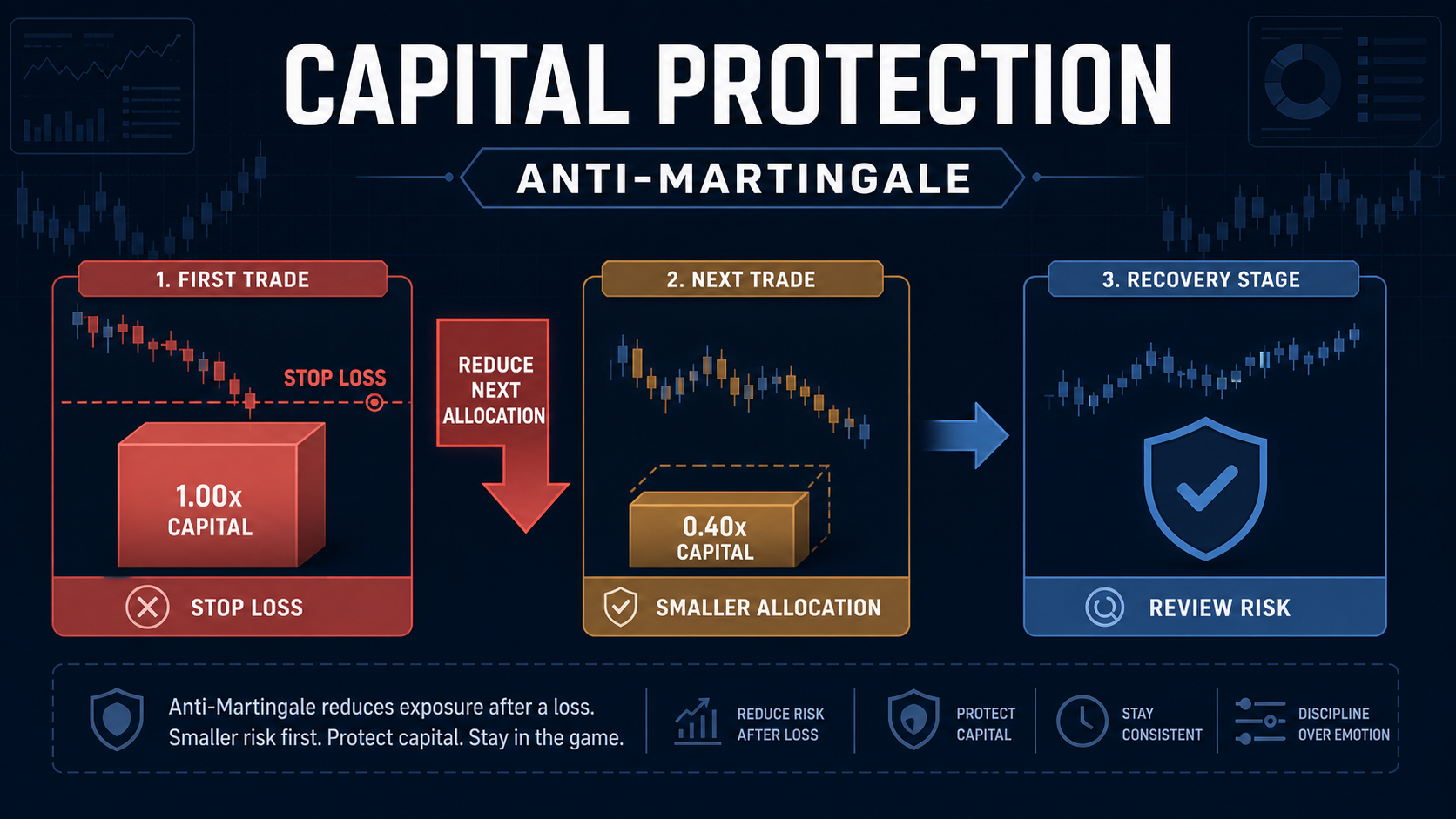
Anti-Martingale Capital Protection is a bot money-management rule that reduces the allocation for the next trade after a Stop Loss. For example, if a bot loses a configured trade, its next allocation can be reduced by 25–50%, then held at that lower level until the trader’s recovery rule is met.
The objective is not to predict the next market move. It is to slow the rate at which capital is exposed during a losing sequence, choppy conditions or a market regime that no longer fits the original setup. Reducing size cannot prevent losses, but it can make consecutive losses smaller in monetary terms. This content is educational, not financial advice.
How the protection rule works
- Set the normal base allocation and a maximum loss response.
- A trade closes by Stop Loss or another defined loss event.
- The bot reduces the next allocation by the chosen percentage.
- After a stated review condition, it either remains smaller, returns gradually to base size, or pauses.
- The process is recorded separately from entry and exit logic.
Parameters that need limits
Define the reduction percentage, the smallest allowed allocation, the trigger event and the recovery condition. A 50% reduction behaves very differently from a 10% reduction. Set a floor so the bot does not trade below exchange minimums or a size that makes fees disproportionate. Decide in advance whether one winning trade restores full size or whether several trades are required.
Illustrative example
A bot normally trades 1,000 USDT. After Stop Loss it reduces the next allocation by 40% to 600 USDT. If another loss occurs, it can remain at the floor or reduce again according to the rule. The trader later returns to 1,000 USDT only after their defined review condition. The figures explain mechanics, not expected results.
Benefits and limitations
- It limits exposure after evidence that the current setup is not working.
- It creates a repeatable response instead of emotionally increasing size after a loss.
- It may slow recovery when the first loss is followed by a valid winning signal.
- It cannot repair a strategy with poor entries, excessive leverage or inadequate stops.
Checklist and FAQ
Before launch, test the reduction rule on a series of trades, set an allocation floor, confirm fees at smaller sizes and define when human review is required. Combine it with a fixed account-level loss limit.
Is Anti-Martingale the same as increasing after profit?
Usage varies, but here it means reducing risk after a loss. The important point is to define the rule precisely in bot settings.
Should size return immediately after one win?
There is no universal answer. A gradual return or manual review may be more consistent with a conservative risk policy.
Bottom line: This strategy is a capital-protection layer. It works only when its reduction, floor and recovery rules are explicit.