
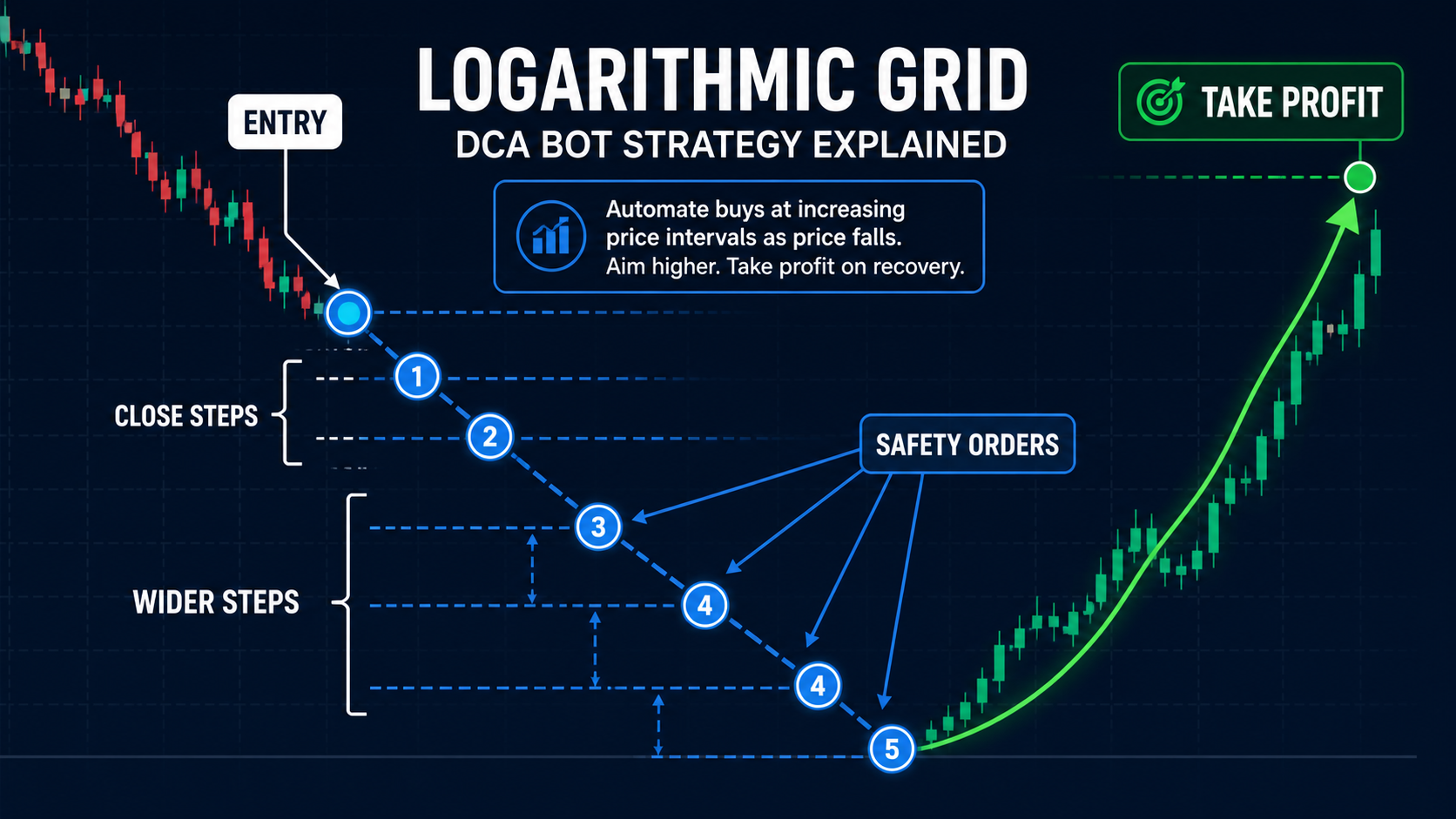
Logarithmic Grid DCA is a crypto-bot averaging strategy in which the distance between safety orders increases as price moves away from the initial entry. Orders near the current price are closer together; lower orders are farther apart. This is different from a flat grid, where every order uses the same percentage step.
The structure can reduce the chance of spending all available capital on small fluctuations while retaining planned coverage for a stronger drawdown. It does not remove risk: price can continue falling beyond the final order, and leverage, fees and slippage can materially affect results. This guide is educational, not financial advice.
How a logarithmic grid works
- The bot opens an initial position from a defined signal or long-term premise.
- Early safety orders are placed at relatively small intervals below the entry.
- Each subsequent interval becomes wider according to the chosen multiplier or curve.
- As orders fill, the average entry price falls and Take Profit is recalculated from that average.
- Capital remains available farther down the planned range instead of being consumed by minor noise.
The word “logarithmic” describes the expanding spacing pattern, not a guarantee that the grid is optimal. The exact implementation may use a percentage multiplier, geometric progression or another platform-specific setting, so always inspect the generated order levels before starting.
Key parameters
Initial step and step multiplier
The first gap should reflect routine volatility. A very small initial step can fill several orders quickly; a very large one may miss modest pullbacks. The step multiplier controls how quickly gaps widen. A higher multiplier makes the lower grid more sparse and preserves capital for a deeper decline, but it also leaves more distance between potential fills.
Coverage and order-volume model
Set total coverage first, then verify every generated order price and cumulative capital requirement. Order sizes may be equal or may grow by a controlled multiplier; both spacing and size determine where capital is concentrated. Include exchange fees, minimum sizes and, for futures, margin, funding and liquidation distance.
Illustrative example
Imagine a Long entry at 100 USDT. The first safety order might be 1% lower, the next 1.5% farther, then 2.25%, then 3.4%, and so on. The exact prices depend on how the platform applies the step. The visual result is a dense upper section and a more widely spaced lower section. If price rebounds after fills, Take Profit can close from the lowered average entry. The numbers are illustrative only.
When it can be useful
- The asset has meaningful volatility and a flat grid would spend capital too quickly near the entry.
- You want gradual averaging while reserving part of the allocation for less frequent, deeper moves.
- You can calculate the full position and accept the risk of holding it during a drawdown.
- Your strategy has been tested across calm, volatile and trending market conditions.
Risks and pre-launch checklist
Expanding steps do not protect against a prolonged downtrend or permanent impairment of an asset. Review the first step, multiplier, final coverage, each order level, total capital, size after all fills, Stop Loss policy and liquidation distance. Do not assume that fewer low orders mean lower risk; a sparse lower grid can also require a larger rebound before an unfilled order improves the average.
FAQ
Is logarithmic spacing always better than equal spacing?
No. It is a different distribution of orders. Equal spacing can be easier to understand in a stable range, while expanding spacing may be more suitable when deeper moves are rarer but possible.
Should order sizes increase too?
That is a separate decision. Increasing size can lower the average faster, but raises capital concentration and risk. Evaluate price spacing and order volume together.
Bottom line: Logarithmic Grid DCA is a way to allocate a grid unevenly across price. Its value is deliberate capital distribution; its requirement is a full calculation of exposure before the bot is launched.