
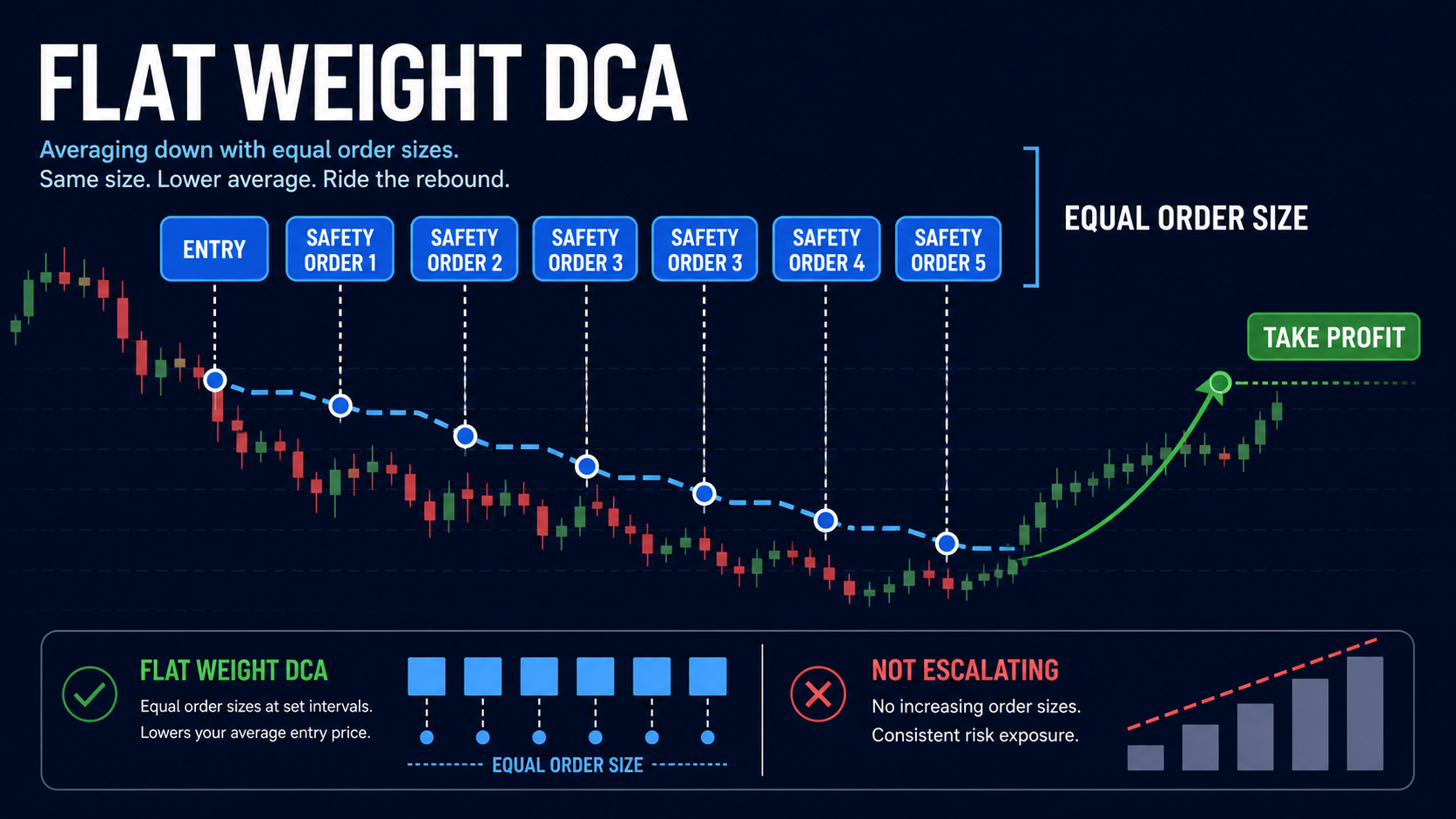
Flat Weight DCA is a crypto-bot averaging strategy where the initial order and each safety order use the same size. It is sometimes described as a zero-Martingale grid. If price moves against a position, the bot buys or sells in equal portions at planned intervals, gradually changing the average entry without making later orders disproportionately large.
Equal sizing makes total exposure easier to calculate in advance and prevents the rapid size escalation of a Martingale model. It does not eliminate market risk: a persistent trend can still fill all orders and leave the position in drawdown. Fees, slippage, leverage and liquidity remain relevant. This is educational content, not financial advice.
How Flat Weight DCA works
- Set a first order, the number of safety orders and their price spacing.
- Assign the same order value to every planned entry.
- When price crosses a level, the next equal-size safety order fills.
- The average entry changes progressively with every fill.
- Take Profit closes the combined position when price recovers to the configured target.
Planning the position
The total planned exposure is straightforward: order size multiplied by the number of orders, plus fees and a reserve where applicable. Start by deciding the maximum amount you can allocate, then derive the equal order size. Check the actual generated prices and ensure the grid coverage reflects the pair’s volatility. On futures, calculate margin and liquidation distance after all fills; equal order size does not make high leverage safe.
Illustrative example
A bot allocates 600 USDT to six equal orders: one initial order and five safety orders of 100 USDT each. If price reaches lower levels, the bot adds the same 100 USDT every time. The average entry moves lower in a smooth, predictable way. In contrast, a Martingale model would allocate progressively more to later levels. Numbers are illustrative only.
Benefits and limitations
- Predictable allocation: the final size is easy to know before launch.
- No size escalation: later fills do not dominate the position.
- Clear testing: it is easier to compare spacing and order count across results.
- Slower average shift: after a deep move, a larger rebound may be needed than with increasing order sizes.
- Trend risk remains: a flat grid can still be fully filled during a prolonged move.
Pre-launch checklist and FAQ
Verify total capital, equal order value, range coverage, order count, Take Profit, Stop Loss policy, fees and minimum order sizes. Do not add new orders outside the plan merely because all planned orders have filled. Review outcomes by market regime.
Is Flat Weight DCA safer than Martingale?
It avoids rapid order-size escalation, which makes exposure more predictable. It is not automatically safe: the asset, range, total allocation and leverage still determine risk.
Should every price step be equal too?
Not necessarily. Flat Weight refers to order volume. Spacing can be equal or expanding, but each design has different fill behavior and must be tested.
Bottom line: Flat Weight DCA prioritizes transparent, even allocation over aggressive average-price movement. It works best with a calculated range and a total size you can afford to keep exposed.