
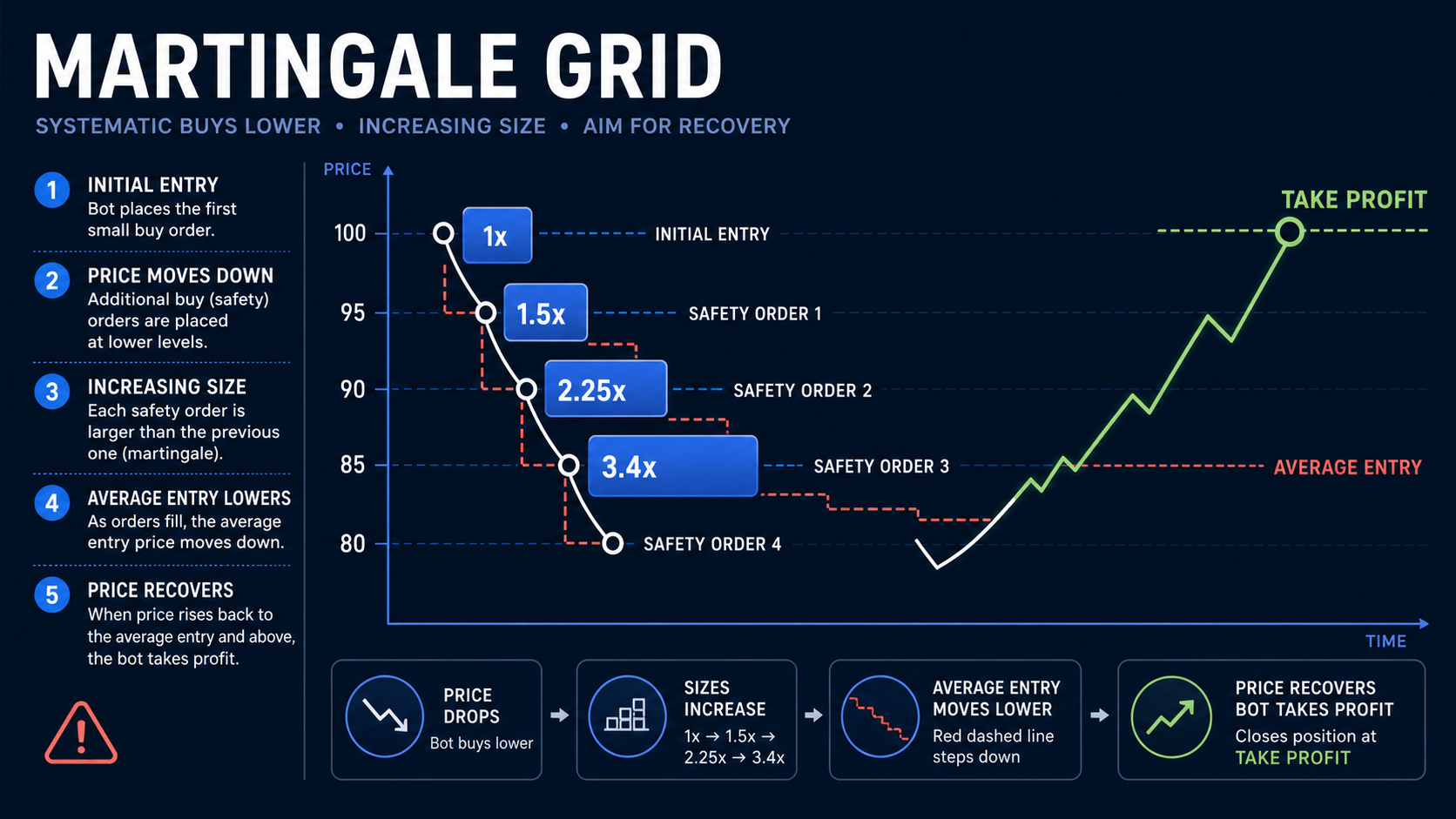
Martingale Grid is a DCA approach in which every next safety order is larger than the preceding order by a chosen multiplier. For example, an order sequence may grow from 1x to 1.5x, 2.25x and 3.4x. When price moves against an initial Long or Short, these larger orders shift the average entry toward the current price more quickly than equal-size orders.
The mechanism can make a modest rebound sufficient to reach Take Profit after several fills. It also concentrates a large part of the capital at the lower end of the grid. A prolonged move in the wrong direction can exhaust margin or capital rapidly. Martingale does not eliminate losses and is not financial advice.
How the Martingale grid works
- The bot opens an initial order from a defined signal.
- Safety orders are placed at lower or higher prices, depending on direction.
- Each later safety order grows by the Martingale multiplier.
- Filled orders reduce the average entry distance to the market price.
- Take Profit is calculated from the new average, while Stop Loss or a maximum coverage rule controls the downside.
Critical parameters
Multiplier and maximum order count
The multiplier determines how fast exposure grows. A higher value shifts the average faster but also makes the last few orders dominate the total position. Calculate every order before launch, including the final order-not only the initial deposit. Limit the number of safety orders and total coverage so the worst planned case remains affordable.
Spacing, leverage and exit plan
Order spacing controls when the size escalation occurs. Tight spacing can fill the largest orders during ordinary volatility; wide spacing may leave the average high for longer. On futures, leverage reduces available room before liquidation. Define a hard Stop Loss, a maximum loss or an explicit rule to stop opening new orders; never assume a rebound is certain.
Illustrative example
A bot starts with a 100 USDT order and a 1.5 Martingale multiplier. Its next planned order sizes are 150, 225 and 337.5 USDT. The last order is more than three times the initial order, so the total exposure rises much faster than the number of orders suggests. This explains both the faster average-price adjustment and the capital risk. Values are illustrative only.
When to be especially careful
- Do not use a Martingale grid without first calculating full exposure, fees and worst-case margin.
- Be cautious with volatile or illiquid assets and with high leverage.
- Do not increase the multiplier to compensate for a grid that is already underfunded.
- Test conservative settings and record results across trending, ranging and high-volatility markets.
FAQ
Why can Martingale close faster after a rebound?
Larger lower orders carry more weight in the average entry, so the average moves closer to the latest price. A smaller recovery can then reach the target-but only after accepting greater exposure.
Is Martingale suitable for every bot?
No. It is an aggressive capital-allocation model. It needs strict limits, sufficient reserves and an understanding that an extended trend can produce large losses.
Bottom line: Martingale Grid trades a faster average-price shift for sharply rising exposure. Use transparent calculations and predefined limits before enabling it.