
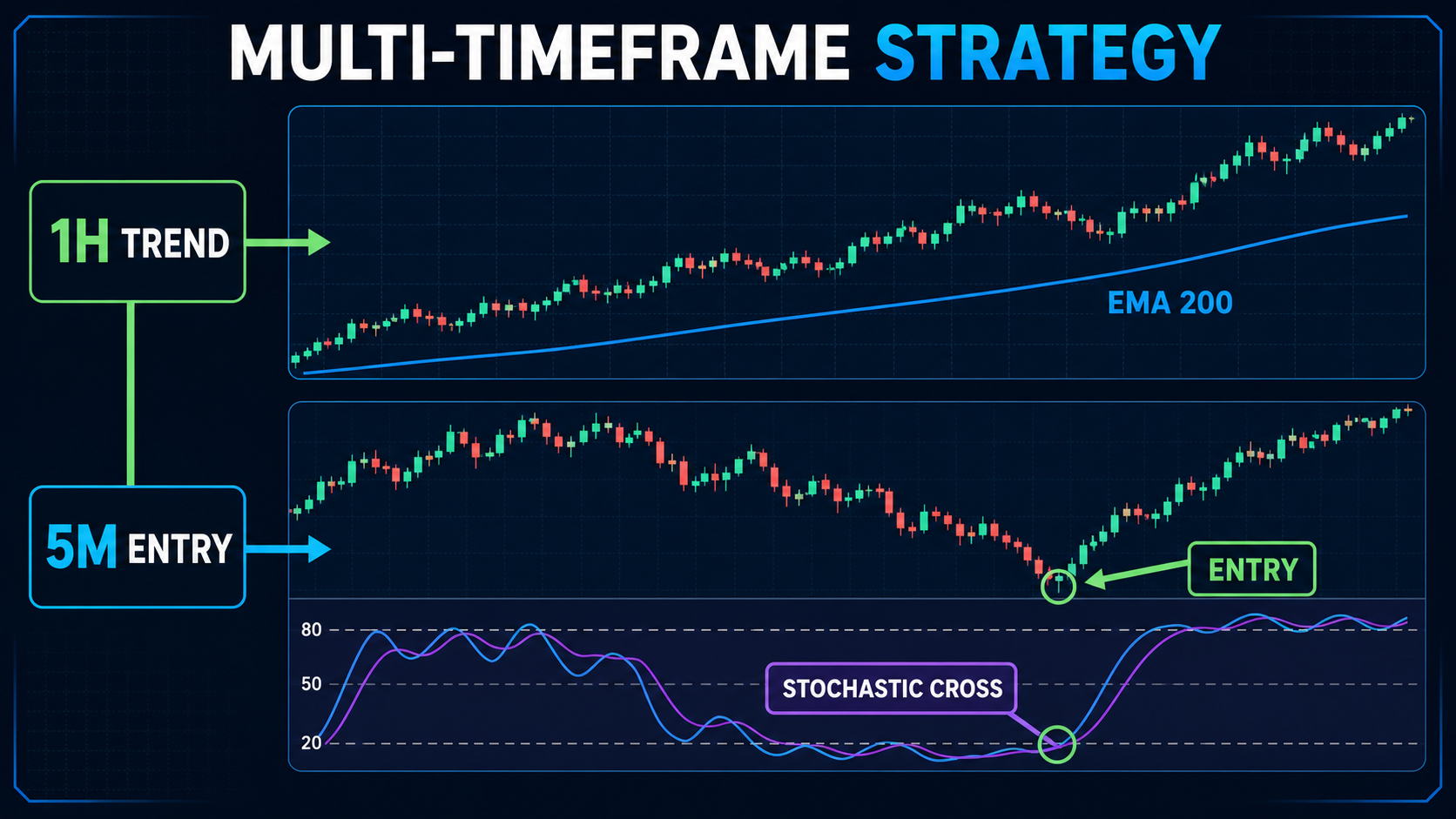
Multi-timeframe analysis (MTF) separates the decision “which side may I trade?” from “where should I enter?”. A higher timeframe defines market context and a lower one finds a pullback or breakout with a tighter invalidation point. For example, EMA 200 on 1h can permit Long only while price is above it, while a 5m Stochastic cross can time the entry after a local pullback. This is an execution framework, not a guarantee that the larger trend will persist.
Build the timeframe hierarchy first
Choose a stable relationship between charts. A common structure is 1h for direction and 5m or 15m for entry, but the exact pair must be tested together. The higher chart must finish its candle before its state is used; otherwise the bot can react to a temporary value that changes at close. Define Long, Short and no-trade states explicitly.
- Long filter: price above EMA 200 on 1h, with EMA flat-to-rising if that is part of the test.
- Short filter: price below the same filter; do not simply invert an untested Long rule.
- No-trade: price repeatedly crossing the higher EMA, or the higher-timeframe signal is stale or unavailable.
Configure the lower-timeframe trigger
The lower chart does not overrule the higher trend. It supplies timing: a Stochastic %K/%D bullish cross after a pullback can be one Long trigger; a close above a local swing high can be a second confirmation. Test Stochastic length, smoothing and the zone in which a cross is valid. A cross anywhere on the panel is a very different rule from a cross below 20 followed by recovery.
- Use closed 5m candles so the cross cannot vanish during the candle.
- Specify whether entry is market, stop above the confirming candle, or a limit on a retest.
- Reject a trigger that is already too far from its local stop relative to ATR or a fixed tested distance.
Detailed bot settings and sizing
Keep the trend filter, entry trigger and exit rule independent. EMA 200 is a useful example because it is widely understood, but EMA 100, a SuperTrend or market structure can be tested as an alternative higher-timeframe filter. On the lower chart, select one trigger family instead of stacking many correlated indicators. The initial order size follows the stop distance under the 5m pullback structure, not the apparent strength of the 1h trend.
- Safety orders: use only if their maximum exposure and spacing are defined before launch; a deep grid can conflict with a precise-entry design.
- Stop Loss: place beyond the lower-timeframe invalidation and check that a higher-timeframe reversal has a separate exit rule.
- Take Profit: test a fixed reward/risk target, previous higher-timeframe level, trailing exit or partial exit-then keep the chosen rule consistent.
Common MTF errors and risk
MTF can create false confidence because it displays more data, not necessarily better evidence. Different chart time zones, unfinished higher candles and mixed exchange feeds can invalidate a backtest. A good higher trend still contains deep lower-timeframe pullbacks. Limit account risk per idea, include fees and slippage, and measure results separately in trend, range and news conditions.
Conclusion. MTF works as a decision hierarchy: the higher timeframe gives permission, the lower timeframe supplies timing, and risk is controlled at the entry level.