
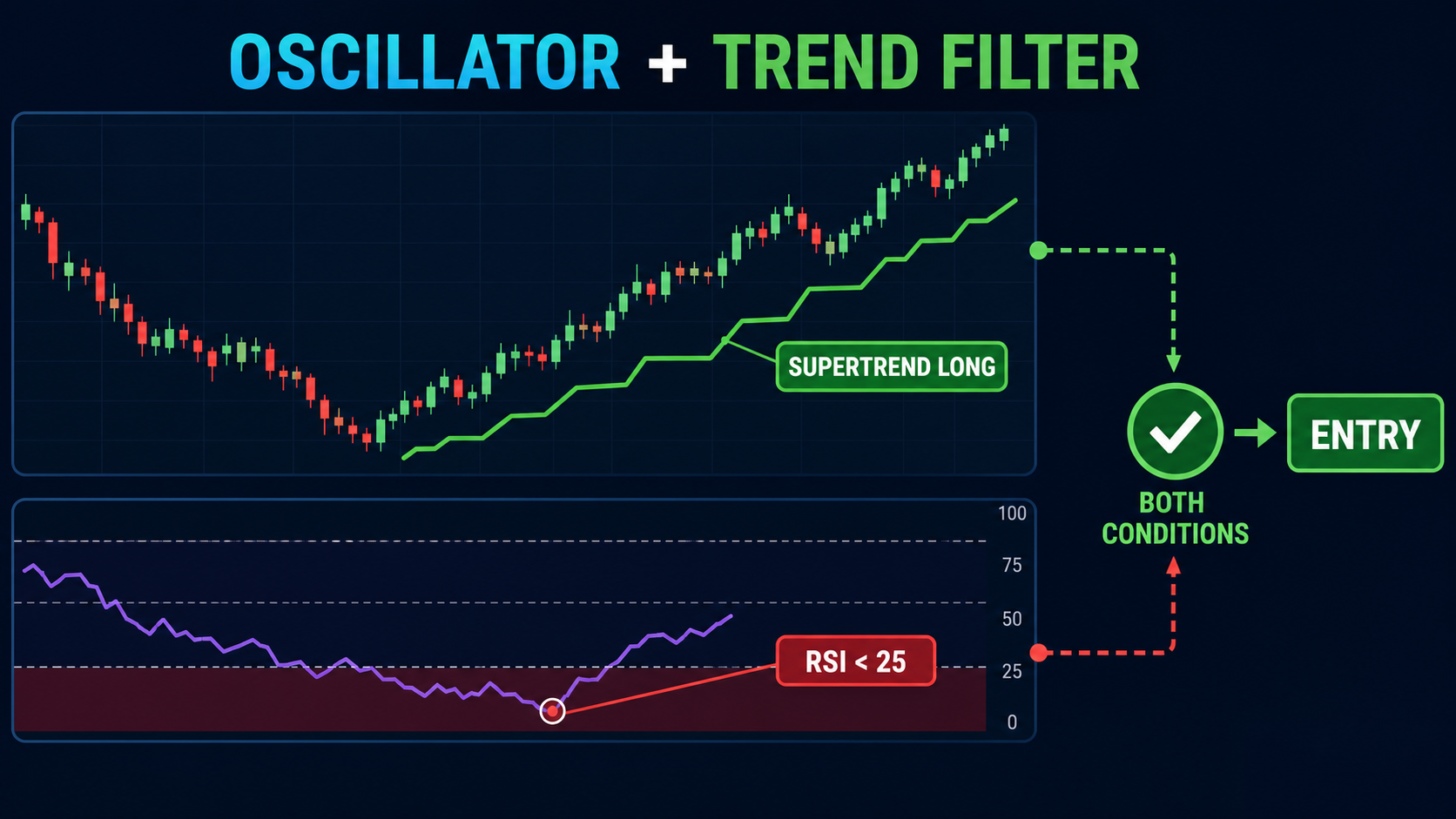
An oscillator can identify a stretched move, but RSI alone can remain oversold during a strong decline or overbought during a strong advance. This strategy uses two different jobs: an oscillator finds the pullback, and a trend indicator decides whether that pullback is in the permitted direction. A common Long example is RSI below 25 while SuperTrend is bullish.
The two conditions must agree
For a Long, first define the trend state on the chosen chart or on a higher timeframe. If SuperTrend is Long, the bot is allowed to watch for a temporary RSI oversold condition. It does not buy every RSI < 25 reading: it waits for the oscillator to turn up or for price to close back above a confirmation level. For Short, use a bearish trend state and an overbought oscillator.
- Keep the rule explicit: trend filter first, oscillator trigger second, entry confirmation third.
- RSI(14) with 25/75 is a conservative starting point; shorter RSI reacts faster but generates more noise.
- Do not mix a higher-timeframe trend with a lower-timeframe trigger without testing the time alignment.
Settings that deserve testing
SuperTrend usually depends on ATR period and multiplier. A shorter period or smaller multiplier flips direction sooner but can whipsaw; a longer period or larger multiplier filters more noise but enters later. Test these separately from RSI length and threshold. Record how many signals occur and how often a signal appears immediately after a SuperTrend flip.
- Trend module: test SuperTrend ATR period around 7–14 and multiplier around 2–4 as ranges, not fixed instructions.
- Oscillator module: test RSI length, oversold/overbought boundaries and whether it must cross back out of the extreme zone.
- Entry module: require a closed confirmation candle, a break of its high/low, or a limit order near the pullback-choose one consistent rule.
Bot construction and exits
Because this is filtered countertrend trading, a small pullback is expected but a full trend reversal is not assumed. Keep the initial position sized for the stop, and avoid a deep averaging grid that contradicts the filter. A reasonable invalidation can sit beyond the pullback structure or beyond the SuperTrend line, after allowing for normal volatility.
- For Long, cancel a setup if SuperTrend turns bearish before entry or while the order is waiting.
- Use a Take Profit that matches the tested target: prior swing, fixed reward-to-risk, or partial exit at the trend direction.
- Limit safety orders and specify their maximum combined exposure before launch.
Failure modes and risk
The filter deliberately rejects many oscillator signals, so fewer trades are not evidence of a problem. It can still fail in choppy markets where SuperTrend changes repeatedly or in violent trends where RSI stays extreme. Fees, spread and slippage matter more on short holding periods. Use a daily loss cap and review a series of trades rather than optimizing after one loss.
- Never treat “oversold” as proof that price cannot fall further.
- Pause after a trend-state change if your test shows the first signals are unstable.
- Use liquid instruments and verify the exchange’s minimum order rules.
Conclusion. The oscillator supplies timing; the trend filter supplies permission. Their value comes from fixed, testable conditions and a predefined loss limit, not from the number of indicators.