
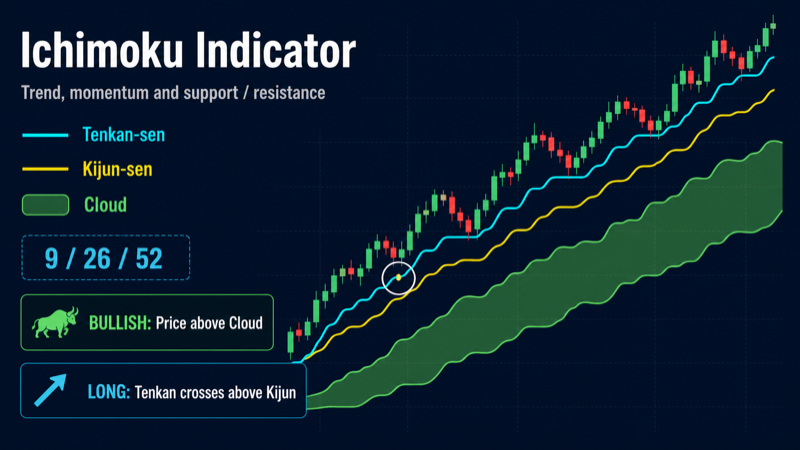
In der Kategorie Start Bots Signal finden Sie Beschreibungen von Signalen und Indikatoren, die einen Trading-Bot starten können. Einer der technischen Indikatoren ist Ichimoku.
Beim Erstellen und Bearbeiten jedes Bots gibt es unten in den Einstellungen den Block Startsignal-Editor. Dort können Sie einzelne Indikatoren, fertige Voreinstellungen und deren Kombinationen wählen. Bedingungen werden in Gruppen zusammengefasst: innerhalb einer Gruppe gilt UND, zwischen Gruppen ODER. Derselbe Indikator lässt sich unterschiedlich konfigurieren - für Long und Short, für Ausbrüche und Absprünge, für Levelvergleiche und Kreuzungen.
Was ist Ichimoku
Ichimoku Kinko Hyo („Gleichgewichtschart auf einen Blick“) ist ein japanischer Trendindikator, der Richtung, Impuls und Support-/Resistance-Zonen auf einem Bildschirm zeigt. Im ELIXOAI Startsignal-Editor stehen vier Presets auf Basis des TAAPI-Indikators ichimoku bereit.
Kernelemente: Tenkan-sen (conversion) - schnelle Linie, Mittelwert aus high/low über 9 Perioden; Kijun-sen (base) - langsame 26-Perioden-Linie, Trend-Anker; Kumo-Wolke - Bereich zwischen Span A und Span B, 26 Kerzen nach vorne verschoben. Bullische Wolke - Span A über Span B; bärisch - umgekehrt. Kurs über der Wolke = bullischer Kontext, darunter bärisch, in der Wolke Unsicherheit.
Ichimoku eignet sich als Filtersystem: Ausbruch über Kumo top bestätigt Käuferstärke, Tenkan/Kijun-Kreuzung fängt lokalen Impuls, Wolkenfarbenwechsel markiert mittelfristigen Trendwechsel. In Seitwärtsphasen viele noisy Signale - Presets kombinieren oder höheren Zeitrahmen filtern.
Ichimoku vs EMA and MACD
Ichimoku overlaps with other trend tools but gives a more complete picture:
- EMA - a single moving average of close. Ichimoku uses high/low averages (Tenkan, Kijun) and builds a zone (the cloud), not one line. EMA is easier to tune but does not show support/resistance “thickness”.
- MACD - difference of two EMAs, a momentum oscillator. Ichimoku also has fast/langsame Linies (Tenkan/Kijun), but TK cross is only one of four presets; the main filter is price vs Kumo.
- Ichimoku vereint Trend, impulse, and levels: Kumo top/bottom are dynamic cloud boundaries; currentSpanA/B are live boundaries without displacement. In ELIXOAI each component is available as an output for custom conditions.
Wie Ichimoku funktioniert
Standardberechnung (TAAPI-Defaults):
- Tenkan (conversion) = (max high + min low) / 2 over conversionPeriod (9). Fast line, reacts to local extremes.
- Kijun (base) = (max high + min low) / 2 over basePeriod (26). Slow line; price above Kijun - bullish bias, below - bearish.
- Span A = (Tenkan + Kijun) / 2, shifted displacement (26) bars forward. Span B = (max high + min low) / 2 over spanPeriod (52), also shifted.
- Kumo (cloud) - zone between Span A and Span B. currentSpanA/B - values without shift (current cloud on chart). max(currentSpanA, currentSpanB) - cloud top (Kumo top), min(...) - bottom (Kumo bottom).
Im Editor wählen Sie ein Preset or build a condition manually: compare an output to price, another output, or a level. The system fetches Ichimoku values via TAAPI and checks the condition on your timeframe - beim Kerzenschluss or every minute.
Verfügbare Outputs
Der ichimoku-Indikator liefert folgende Werte:
- conversion (Tenkan): schnelle Linie; used in the Tenkan/Kijun-Kreuzung preset.
- base (Kijun): langsame Linie; cross target for Tenkan or trend filter.
- spanA: cloud Span A (shifted); compared to spanB in cloud color preset.
- spanB: cloud Span B (shifted); slow Kumo boundary.
- currentSpanA: live Span A without shift - the “current” cloud on the bar.
- currentSpanB: live Span B without shift.
- max(currentSpanA, currentSpanB) - Kumo top: upper cloud boundary; ichimoku_kumo_breakout_up uses price cross up through it.
- min(currentSpanA, currentSpanB) - Kumo bottom: lower cloud boundary; ichimoku_kumo_breakout_down uses price cross down through it.
Ichimoku-Parameter
- conversionPeriod (Tenkan): Standard 9, Bereich 1–300. Lower - more sensitive Tenkan and more TK crosses.
- basePeriod (Kijun): Standard 26, Bereich 1–300. Classic 9/26 ratio for 15m–1h.
- spanPeriod (Span B): Standard 52, Bereich 1–500. Sets cloud “thickness” and slowness.
- displacement: Standard 26, Bereich 1–300. Forward shift of Span A/B; currentSpanA/B have no shift.
Standard 9/26/52/26 is Hosoda’s daily setting. On crypto 15m–4h defaults often stay; for 5m scalping you may scale periods down proportionally (e.g. 5/13/26/13) - backtest first.
Fertige Voreinstellungen im Editor
Im Editor stehen vier Ichimoku-Presets bereit with defaults (15m, check at bar close, parameters 9/26/52/26). Each is fully customizable: different operator, timeframe, or output.
ichimoku_kumo_breakout_up - Wolkenausbruch nach oben
Standardbedingung: max(currentSpanA, currentSpanB) (Kumo top) crosses price from below to above (cross up) on 15m.
Long signal: price breaks above the cloud top - exit from uncertainty or bearish context. Stronger if the cloud is already bullish (Span A > Span B) or Tenkan is above Kijun. For Short use ichimoku_kumo_breakout_down.
ichimoku_kumo_breakout_down - Wolkenausbruch nach unten
Standardbedingung: min(currentSpanA, currentSpanB) (Kumo bottom) crosses price from above to below (cross down) on 15m.
Short signal: price falls below Kumo bottom - loss of bullish structure. More effective with bearish cloud and Tenkan below Kijun. Combine with RSI > 60 for shorts from overbought.
ichimoku_cloud_color - bullische Wolke
Standardbedingung: spanA crosses spanB from below to above (cross up) on 15m - cloud turns bullish.
Medium-term trend shift: Span A rises above Span B - buyers dominate cloud structure. For bearish cloud set cross down. Often used as a filter with kumo_breakout_up, not as the only condition.
ichimoku_tenkan_kijun - Tenkan/Kijun-Kreuzung
Standardbedingung: conversion (Tenkan) crosses base (Kijun) from below to above (cross up) on 15m.
Classic “TK cross”: schnelle Linie overtakes slow - local upward impulse. Short-term golden cross analogue. For Short - cross down. Many false signals in ranges; add “price above Kumo top” or bullische Wolke filter.
Verfügbare Operatoren- Kreuzt nach oben (cross up): left output was below right and moved above. Main Long operator for all four presets.
- Kreuzt nach unten (cross down): left output was above and dropped below. Short versions of presets.
- Größer (gt): e.g. price gt Kumo top - sustained above cloud without fresh breakout.
- Kleiner (lt): price lt Kumo bottom - bearish context, Short filter.
- Größer oder gleich (gte): Tenkan gte Kijun - bullish bias without a cross.
- Kleiner oder gleich (lte): Tenkan lte Kijun - bearish bias on higher TF as filter.
Allgemeine Editor-Einstellungen
- Zeitrahmen (Intervall): 1m, 5m, 15m, 30m, 1h, 4h, 1d. Kürzere Intervalle liefern mehr Signale, aber mehr Rauschen. Swing-Bots nutzen oft 1h–4h, Scalping 5m–15m.
- Prüfmodus: Bei Kerzenschluss - Prüfung nach Kerzenschluss, weniger Fehlauslösungen. Jede Minute - Prüfung innerhalb der laufenden Kerze, schnellere Reaktion, höheres Fehlstart-Risiko.
- Operator: größer, kleiner, kreuzt nach oben/unten, größer oder gleich usw. legen fest, wie der Indikatorwert mit dem Ziel verglichen wird.
- Zielwert: Zahl (z. B. 30 beim RSI), Indikatorlinie (z. B. %D beim Stochastic) oder Preis (bei Bollinger Bands).
- Bedingungsgruppen: bis zu 3 Gruppen mit je bis zu 5 Bedingungen. Beispiel: Gruppe 1 - RSI < 30 UND Preis < unteres Band; Gruppe 2 - Stochastic < 20. Der Bot startet, wenn Gruppe 1 ODER Gruppe 2 erfüllt ist.
Einrichtungsbeispiele für verschiedene Strategien
Kumo breakout up - classic Long
Ziel: start when price exits above the cloud.
Long: preset ichimoku_kumo_breakout_up, 15m, Prüfung beim Schluss.
Filter: ichimoku_cloud_color cross up on same 15m OR price already gt Kumo top on 4h.
Strong trend scenario after consolidation inside or below the cloud.
Kumo breakout down - Short
Short: preset ichimoku_kumo_breakout_down, 15m, Kumo bottom cross down vs price.
Filter: spanA cross down spanB (bearish cloud) on 1h.
Fits short grids when higher-TF bullish structure breaks down.
Bullish cloud + price above Kumo
Long: ichimoku_cloud_color cross up (spanA cross up spanB) on 1h AND price gt max(currentSpanA, currentSpanB) on 15m.
Logik: medium-term trend turned; lower TF confirms hold above cloud. Fewer false entries than TK cross alone.
Tenkan/Kijun-Kreuzung - impulse Long
Long: ichimoku_tenkan_kijun (conversion cross up base) on 15m.
Filter: price gt Kijun (base) on same 15m - TK cross only in bullish half of chart.
Short: conversion cross down base AND price lt Kijun.
Kumo breakout + cloud confirmation
Gruppe 1: ichimoku_kumo_breakout_up on 15m AND ichimoku_cloud_color - spanA gt spanB (gte) on 15m.
Logik: Kumo top break with already bullische Wolke - double strength confirmation. One of the most conservative Ichimoku Long setups.
Pullback to cloud
Long: on 4h price gt Kumo top (separate gt condition) AND on 15m ichimoku_tenkan_kijun cross up after pullback to Kijun.
Logik: higher TF bullish trend; lower TF catches resumption from Kijun or cloud top support.
Scalping: TK cross on 5m
Long: ichimoku_tenkan_kijun cross up on 5m, conversionPeriod 9, basePeriod 26.
Filter: on 15m price gt Kumo bottom (min currentSpan) - avoid shorting structure inside bearish cloud.
Frequent signals; higher-TF or bullische Wolke filter required.
Swing: Kumo breakout on 4h
Long: ichimoku_kumo_breakout_up on 4h, parameters 9/26/52/26, Prüfung beim Schluss.
Short: ichimoku_kumo_breakout_down on 4h.
Rare but meaningful signals - suited for swing bots with wide stops and DCA.
Short: bearish cloud + breakdown
Short: ichimoku_cloud_color cross down on 1h AND ichimoku_kumo_breakout_down on 15m.
Alternative: Tenkan cross down Kijun on 15m AND price lt Kumo bottom.
Symmetric bearish version of trend presets.
Multi-Timeframe
Long: on 4h spanA gt spanB (bullische Wolke) AND ichimoku_kumo_breakout_up on 15m.
Short: spanA lt spanB on 4h AND kumo_breakout_down on 15m.
Global cloud context + local breakout trigger - classic Ichimoku MTF.
DCA at Kumo bottom
Long: price cross up min(currentSpanA, currentSpanB) on 1h (bounce from Kumo bottom) AND ichimoku_tenkan_kijun cross up on 15m.
Filter: spanA gt spanB on 1h - DCA only in bullische Wolke on pullbacks to support.
Ichimoku + RSI
Long: ichimoku_kumo_breakout_up on 15m AND RSI cross up 40 on 15m - cloud break without extreme overbought.
Short: kumo_breakout_down AND RSI cross down 60.
RSI filters breakouts on exhausted moves.
Bedingungsgruppen: Praxisbeispiel
Bot with two Long scenarios:
Gruppe 1: ichimoku_kumo_breakout_up on 15m AND ichimoku_cloud_color cross up on 1h - breakout with bullische Wolke.
Gruppe 2: ichimoku_tenkan_kijun cross up on 15m AND price gt Kumo top on 4h - TK cross in global uptrend.
Groups combined with OR. Configure Short symmetrically (kumo_breakout_down, TK cross down, bearish cloud).
Tipp
Ichimoku ist ein System, not one signal: in ranges TK cross and cloud color flip often. Use Kumo breakout on a higher TF as filter for lower presets. A “thick” cloud (Span A far from Span B) is strong support/resistance; thin cloud breaks easier. Check at bar close reduces false Kumo breaks on intrabar noise. All four presets cover different trend facets - combine them rather than relying on one.