
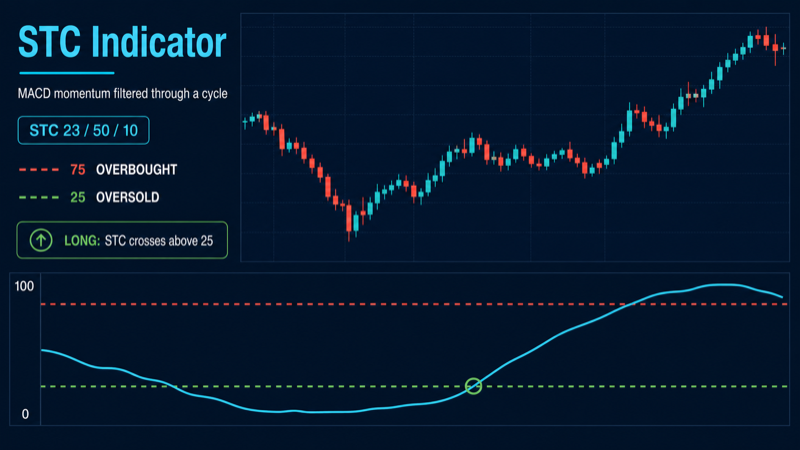
Na categoria Start Bots Signal ficam as descrições de sinais e indicadores que podem iniciar um bot de trading. Um dos indicadores técnicos é STC (Schaff Trend Cycle).
Ao criar e editar qualquer bot, existe um bloco Construtor de sinais de início na parte inferior das configurações. Nele você pode escolher indicadores individuais, presets prontos e suas combinações. As condições são agrupadas: E dentro do grupo, OU entre grupos. O mesmo indicador pode ser configurado de formas diferentes - para Long e Short, para rompimentos e repiques, para comparar com um nível ou para cruzamentos.
O que é STC (Schaff Trend Cycle)
STC (Schaff Trend Cycle) é um oscilador desenvolvido por Doug Schaff. It combines MACD ideas (trend moving averages) and Stochastic logic (normalizing momentum into a 0–100 range) to deliver earlier, smoother trend-change signals.
STC values oscillate from 0 to 100. Classic levels: below 25 - oversold zone (Long potential), above 75 - overbought zone (Short potential). No construtor de sinais ELIXOAI, STC is used as an automatic bot start condition - via value level crosses or text trend output changes.
TAAPI returns two outputs: numeric value (STC 0–100) and text trend (bullish/bearish). STC works well in trending and transitional phases; in prolonged ranges, frequent 25/75 crosses produce false starts - add a trend filter or EMA.
STC vs MACD and Stochastic
As três ferramentas relate to momentum and trend, but solve the problem differently:
- MACD is built on the difference of price EMAs (fastLength/slowLength) and often lags on reversals. STC runs MACD through double stochastic smoothing - signals arrive earlier while staying on a 0–100 oscillator scale.
- Stochastic compares close price to the High–Low range over a period. STC does not use High/Low directly - it normalizes an already smoothed MACD-like impulse. STC is less noisy in ranges than “raw” Stochastic on short timeframes.
- STC is a hybrid: trend base (fastLength 23, slowLength 50) + cycle smoothing (cycleLength, d1Length, d2Length). Levels 25/75 replace MACD’s zero line; the trend output gives a ready direction filter without manual comparison.
Como o STC funciona
STC calculation is multi-step - first a MACD-like EMA difference is built, then the result is run through stochastic normalization twice:
MACD = EMA(Close, fastLength) − EMA(Close, slowLength), then STC = Stochastic(MACD, cycleLength) with additional smoothing d1Length and d2Length. The result is value in the 0–100 range.
- STC < 25 - oversold: weak impulse, bounce possible; preset stc_oversold_exit catches the cross up 25 moment.
- STC > 75 - overbought: overheated impulse, pullback possible; for Short set cross down 75 or trend changed_to bearish.
- STC between 25 and 75 - neutral or transitional zone; trend bullish/bearish helps read direction without hard extremes.
No construtor you set a comparison condition: “value crosses above 25,” “trend changed to bullish,” and so on. The system fetches live value and trend from the exchange via TAAPI and checks the condition on your timeframe - at candle close or every minute.
Duas saídas STC
O indicador stc expõe two outputs - one numeric and one text:
- value - STC line in the 0–100 range. Used in stc_oversold_exit for crosses and gt/lt/gte/lte comparisons with levels 25, 50, 75.
- trend - text output: bullish or bearish. Used in stc_trend_change with eq, neq, changed_to, changed_from operators.
Preset stc_oversold_exit uses numeric value; preset stc_trend_change uses text trend. Both share the same fastLength, slowLength, cycleLength, d1Length, d2Length parameters.
Parâmetros STC
Por padrão o construtor usa TAAPI parameters - standard Schaff Trend Cycle settings:
- fastLength (23): fast EMA period in the MACD part of the calculation. Lower value - STC reacts faster, more 25/75 crosses.
- slowLength (50): slow EMA period. Defines the base trend horizon; classic for 15m–1h.
- cycleLength (10): stochastic normalization period for MACD into 0–100. Analogous to Stochastic %K period.
- d1Length (3): first smoothing after stochastic - removes sharp value spikes.
- d2Length (3): second smoothing; final STC line is smoother, fewer but more stable signals.
Settings 23/50/10/3/3 work well on 15m–4h. For 5m scalping reduce fastLength and cycleLength; for 4h swing increase slowLength.
Presets prontos no construtor
O construtor offers two STC presets with default settings. Each can be fully customized: different operator, level, parameters, or timeframe.
STC cross_up 25 - oversold exit (stc_oversold_exit)
Condição padrão: output value crosses level 25 from below to above (cross up) on the selected timeframe (15m interval, parameters 23/50/10/3/3, check no fechamento da vela).
Long signal on oversold reversal: STC was below 25 and rose above - impulse started recovering. Unlike “value < 25” (lt), the cross captures the exit moment from weakness. For Short set cross down 75.
Operadores para stc_oversold_exit- Cruza para cima (cross up): value was below the level and moved above. Classic Long - cross up 25: oversold exit.
- Cruza para baixo (cross down): value was above the level and dropped below. Short signal - cross down 75: overbought exit.
- Maior que (gt): value is strictly above the level. E.g. value > 50 - STC in upper half of range, bullish context.
- Menor que (lt): value is strictly below the level. value < 25 - oversold, useful for bounce filters.
- Maior ou igual (gte): value is at or above the threshold. Handy for “value ≥ 50” filter on a higher timeframe.
- Menor ou igual (lte): value is at or below the threshold. Oversold filter: value ≤ 25 on 1h.
Trend changed_to bullish - trend change (stc_trend_change)
Condição padrão: output trend changed to bullish (changed_to) on the selected timeframe (15m interval, parameters 23/50/10/3/3, check no fechamento da vela).
Direction shift signal: TAAPI records trend switching to bullish - STC confirmed a bullish cycle. More precise than trend eq bullish at the reversal moment. For Short set changed_to bearish or eq bearish.
Operadores para stc_trend_change- Igual a (eq): trend strictly equals the target - bullish or bearish right now. trend eq bullish - bot starts only with bullish STC.
- Diferente de (neq): trend does not equal the specified value. trend neq bearish - Long only when trend is not bearish.
- Mudou para (changed to): trend just switched to the target value. trend changed_to bullish - moment of shift from bearish to bullish; main preset signal.
- Mudou de (changed from): trend equaled the specified value on the previous check and changed. Useful to capture exit from bearish phase: changed_from bearish.
25 and 75 are STC’s main references: cross up 25 means oversold exit; cross down 75 means overbought exit. In a strong trend STC can stay above 75 or below 25 for a long time - then trend eq bullish/bearish or gt/lt gives direction filter while cross gives pullback entry.
Configurações gerais do construtor
- Timeframe (intervalo): 1m, 5m, 15m, 30m, 1h, 4h, 1d. Intervalos menores geram mais sinais, porém mais ruído. Bots swing costumam usar 1h–4h; scalping usa 5m–15m.
- Modo de verificação: No fechamento da vela - verificação após o fechamento, menos disparos falsos. A cada minuto - verificação dentro da vela atual, reação mais rápida, maior risco de início falso.
- Operador: maior, menor, cruza para cima/baixo, maior ou igual etc. definem como o valor do indicador é comparado ao alvo.
- Valor alvo: número (ex.: 30 no RSI), linha do indicador (ex.: %D no Stochastic) ou preço (no Bollinger Bands).
- Grupos de condições: até 3 grupos com até 5 condições cada. Exemplo: grupo 1 - RSI < 30 E preço < banda inferior; grupo 2 - Stochastic < 20. O bot inicia se o grupo 1 OU o grupo 2 for atendido.
Exemplos de configuração para diferentes estratégias
Scalping: reduced parameters on 5m–15m
Objetivo: frequent starts on short STC cycles.
Long: stc_oversold_exit preset, cross up 25, 5m timeframe, fastLength 12, cycleLength 6, check no fechamento da vela.
Short: cross down 75, same settings.
Filtro: trend eq bullish on 15m - fewer false crosses in a range.
Swing: standard 23/50/10/3/3 on 1h–4h
Objetivo: fewer but more meaningful cycle shifts.
Long: STC cross up 25 on 4h, standard parameters, check at close.
Short: cross down 75 on 4h.
On a higher TF STC smooths noise and signals closer to a sustained trend change.
Trend confirmation via trend output
Objetivo: Long only when STC confirms bullish context.
Grupo 1: trend eq bullish on 4h (stc_trend_change preset) AND value cross up 25 on 15m.
Short: trend eq bearish on 4h AND cross down 75 on 15m.
Higher TF sets direction, lower TF catches entry timing.
Level vs trend: when to use which
stc_oversold_exit - impulse signal at 25/75 cross moment; triggers more often.
stc_trend_change - bullish/bearish shift filter; changed_to catches reversals more precisely, eq holds in trend.
Combo: trend eq bullish on 1h AND value gt 50 on 15m - entry without waiting for a fresh cross.
STC + EMA
Long: price cross up EMA 20 on 15m AND STC cross up 25 on the same 15m - double confirmation: both price and STC cycle turned up.
Short: price cross down EMA 20 AND STC cross down 75.
Alternative: trend eq bullish on 1h AND price > EMA 50 on 1h - trend Long.
Short on cycle shift
Condição: STC cross down 75 or trend changed_to bearish, 15m, check at close.
Filtro: RSI > 65 in the same group - short after overbought with STC reversal confirmation.
Fits short grids at local peaks.
Strong cycle (gt filter)
Long: STC value gt 50 on 1h - bot starts only with STC in upper half of range, without waiting for a cross.
Short: value lt 50 on 1h.
Useful in trends where cross up 25 already happened but cycle remains bullish.
Pullback in trend
Grupo 1: trend eq bullish on 4h AND STC cross up 25 on 15m.
Lógica: higher TF shows sustained bullish cycle; lower TF catches resumption after a short correction into < 25.
STC + RSI
Long: RSI cross up 30 on 15m AND STC cross up 25 on 15m - oscillator and STC cycle aligned.
Short: RSI cross down 70 AND STC cross down 75.
RSI catches oversold/overbought; STC checks trend cycle shift.
Multi-timeframe
Long: trend eq bullish on 4h (separate condition) AND STC cross up 25 on 15m.
Short: trend eq bearish on 4h AND STC cross down 75 on 15m.
Avoids buying every local cross against global bearish trend.
DCA em pullback
Long: STC cross up 25 em 1h E RSI < 45 em 1h - repique do ciclo a partir de fraqueza sem sobrevenda extrema.
Short: cross down 75 E RSI > 55.
Para bot DCA, cross up 25 é mais suave que RSI < 30 estrito.
Grupos de condições: exemplo prático
Bot com dois cenários Long:
Grupo 1: STC cross up 25 em 15m E trend eq bullish em 1h - retomada do ciclo por impulso.
Grupo 2: trend changed_to bullish em 4h E preço > EMA 50 em 15m - reversão STC com confirmação de preço.
Entre grupos lógica OU. Configure Short simetricamente (cross down 75, trend eq bearish).
Dica
Em mercado lateral, STC frequentemente cruza 25 e 75 nos dois sentidos - cross up 25 e cross down 75 produzem inícios falsos. Aumente slowLength, adicione filtro trend eq bullish em timeframe superior ou EMA. O preset stc_trend_change com changed_to captura reversões com mais precisão que eq em tendência prolongada. Use verificação no fechamento da vela para ignorar ruído intrabar.