
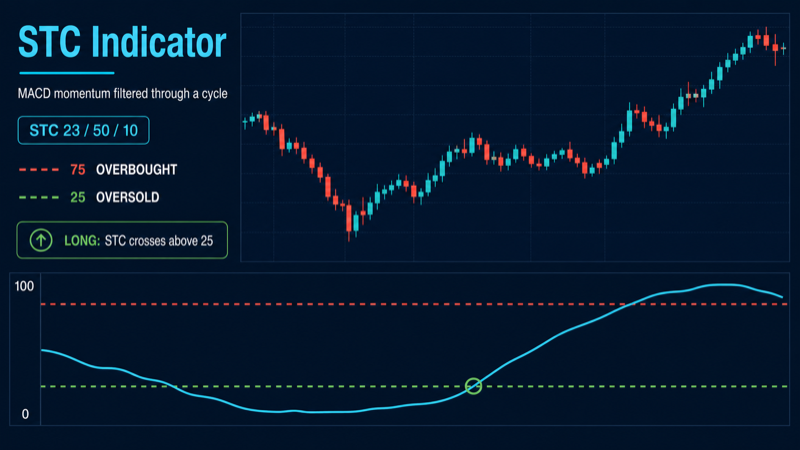
En la categoría Start Bots Signal se recopilan descripciones de señales e indicadores que pueden iniciar un bot de trading. Uno de los indicadores técnicos es STC (Schaff Trend Cycle).
Al crear y editar cada bot, en la parte inferior de la configuración hay un bloque Constructor de señales de inicio. Allí puedes elegir indicadores individuales, presets listos y sus combinaciones. Las condiciones se agrupan: Y dentro del grupo, O entre grupos. El mismo indicador puede configurarse de formas distintas - para Long y Short, para rupturas y rebotes, para comparar con un nivel o para cruces.
Qué es STC (Schaff Trend Cycle)
STC (Schaff Trend Cycle) es un oscilador desarrollado por Doug Schaff. It combines MACD ideas (trend moving averages) and Stochastic logic (normalizing momentum into a 0–100 range) to deliver earlier, smoother trend-change signals.
STC values oscillate from 0 to 100. Classic levels: below 25 - oversold zone (Long potential), above 75 - overbought zone (Short potential). En el constructor de señales ELIXOAI, STC is used as an automatic bot start condition - via value level crosses or text trend output changes.
TAAPI returns two outputs: numeric value (STC 0–100) and text trend (bullish/bearish). STC works well in trending and transitional phases; in prolonged ranges, frequent 25/75 crosses produce false starts - add a trend filter or EMA.
STC vs MACD and Stochastic
Las tres herramientas relate to momentum and trend, but solve the problem differently:
- MACD is built on the difference of price EMAs (fastLength/slowLength) and often lags on reversals. STC runs MACD through double stochastic smoothing - signals arrive earlier while staying on a 0–100 oscillator scale.
- Stochastic compares close price to the High–Low range over a period. STC does not use High/Low directly - it normalizes an already smoothed MACD-like impulse. STC is less noisy in ranges than “raw” Stochastic on short marco temporals.
- STC is a hybrid: trend base (fastLength 23, slowLength 50) + cycle smoothing (cycleLength, d1Length, d2Length). Levels 25/75 replace MACD’s zero line; the trend output gives a ready direction filter without manual comparison.
Cómo funciona STC
STC calculation is multi-step - first a MACD-like EMA difference is built, then the result is run through stochastic normalization twice:
MACD = EMA(Close, fastLength) − EMA(Close, slowLength), then STC = Stochastic(MACD, cycleLength) with additional smoothing d1Length and d2Length. The result is value in the 0–100 range.
- STC < 25 - oversold: weak impulse, bounce possible; preset stc_oversold_exit catches the cross up 25 moment.
- STC > 75 - overbought: overheated impulse, pullback possible; for Short set cross down 75 or trend changed_to bearish.
- STC between 25 and 75 - neutral or transitional zone; trend bullish/bearish helps read direction without hard extremes.
En el constructor you set a comparison condition: “value crosses above 25,” “trend changed to bullish,” and so on. The system fetches live value and trend from the exchange via TAAPI and checks the condition on your marco temporal - at candle close or every minute.
Dos salidas STC
El indicador stc expone two outputs - one numeric and one text:
- value - STC line in the 0–100 range. Used in stc_oversold_exit for crosses and gt/lt/gte/lte comparisons with levels 25, 50, 75.
- trend - text output: bullish or bearish. Used in stc_trend_change with eq, neq, changed_to, changed_from operators.
Preset stc_oversold_exit uses numeric value; preset stc_trend_change uses text trend. Both share the same fastLength, slowLength, cycleLength, d1Length, d2Length parameters.
Parámetros STC
Por defecto el constructor usa TAAPI parameters - standard Schaff Trend Cycle settings:
- fastLength (23): fast EMA period in the MACD part of the calculation. Lower value - STC reacts faster, more 25/75 crosses.
- slowLength (50): slow EMA period. Defines the base trend horizon; classic for 15m–1h.
- cycleLength (10): stochastic normalization period for MACD into 0–100. Analogous to Stochastic %K period.
- d1Length (3): first smoothing after stochastic - removes sharp value spikes.
- d2Length (3): second smoothing; final STC line is smoother, fewer but more stable signals.
Settings 23/50/10/3/3 work well on 15m–4h. For 5m scalping reduce fastLength and cycleLength; for 4h swing increase slowLength.
Presets listos en el constructor
El constructor offers two STC presets with default settings. Each can be fully customized: different operator, level, parameters, or marco temporal.
STC cross_up 25 - oversold exit (stc_oversold_exit)
Condición por defecto: output value crosses level 25 from below to above (cross up) on the selected marco temporal (15m interval, parameters 23/50/10/3/3, check al cierre de vela).
Long signal on oversold reversal: STC was below 25 and rose above - impulse started recovering. Unlike “value < 25” (lt), the cross captures the exit moment from weakness. For Short set cross down 75.
Operadores de stc_oversold_exit- Cruza hacia arriba (cross up): value was below the level and moved above. Classic Long - cross up 25: oversold exit.
- Cruza hacia abajo (cross down): value was above the level and dropped below. Short signal - cross down 75: overbought exit.
- Mayor que (gt): value is strictly above the level. E.g. value > 50 - STC in upper half of range, bullish context.
- Menor que (lt): value is strictly below the level. value < 25 - oversold, useful for bounce filters.
- Mayor o igual (gte): value is at or above the threshold. Handy for “value ≥ 50” filter on a higher marco temporal.
- Menor o igual (lte): value is at or below the threshold. Oversold filter: value ≤ 25 on 1h.
Trend changed_to bullish - trend change (stc_trend_change)
Condición por defecto: output trend changed to bullish (changed_to) on the selected marco temporal (15m interval, parameters 23/50/10/3/3, check al cierre de vela).
Direction shift signal: TAAPI records trend switching to bullish - STC confirmed a bullish cycle. More precise than trend eq bullish at the reversal moment. For Short set changed_to bearish or eq bearish.
Operadores de stc_trend_change- Igual a (eq): trend strictly equals the target - bullish or bearish right now. trend eq bullish - bot starts only with bullish STC.
- Distinto de (neq): trend does not equal the specified value. trend neq bearish - Long only when trend is not bearish.
- Cambió a (changed to): trend just switched to the target value. trend changed_to bullish - moment of shift from bearish to bullish; main preset signal.
- Cambió desde (changed from): trend equaled the specified value on the previous check and changed. Useful to capture exit from bearish phase: changed_from bearish.
25 and 75 are STC’s main references: cross up 25 means oversold exit; cross down 75 means overbought exit. In a strong trend STC can stay above 75 or below 25 for a long time - then trend eq bullish/bearish or gt/lt gives direction filter while cross gives pullback entry.
Ajustes generales del constructor
- Marco temporal (intervalo): 1m, 5m, 15m, 30m, 1h, 4h, 1d. Intervalos menores dan más señales pero más ruido. Los bots swing suelen usar 1h–4h; el scalping usa 5m–15m.
- Modo de comprobación: Al cierre de la vela - se comprueba tras el cierre, menos falsos disparos. Cada minuto - comprobación dentro de la vela actual, reacción más rápida, mayor riesgo de inicio falso.
- Operador: mayor, menor, cruza hacia arriba/abajo, mayor o igual, etc. definen cómo se compara el valor del indicador con el objetivo.
- Valor objetivo: número (p. ej. 30 en RSI), línea del indicador (p. ej. %D en Stochastic) o precio (en Bollinger Bands).
- Grupos de condiciones: hasta 3 grupos con hasta 5 condiciones cada uno. Ejemplo: grupo 1 - RSI < 30 Y precio < banda inferior; grupo 2 - Stochastic < 20. El bot inicia si se cumple el grupo 1 O el grupo 2.
Ejemplos de configuración para distintas estrategias
Scalping: reduced parameters on 5m–15m
Objetivo: frequent starts on short STC cycles.
Long: stc_oversold_exit preset, cross up 25, 5m marco temporal, fastLength 12, cycleLength 6, check al cierre de vela.
Short: cross down 75, same settings.
Filtro: trend eq bullish on 15m - fewer false crosses in a range.
Swing: standard 23/50/10/3/3 on 1h–4h
Objetivo: fewer but more meaningful cycle shifts.
Long: STC cross up 25 on 4h, standard parameters, check at close.
Short: cross down 75 on 4h.
On a higher TF STC smooths noise and signals closer to a sustained trend change.
Trend confirmation via trend output
Objetivo: Long only when STC confirms bullish context.
Grupo 1: trend eq bullish on 4h (stc_trend_change preset) AND value cross up 25 on 15m.
Short: trend eq bearish on 4h AND cross down 75 on 15m.
Higher TF sets direction, lower TF catches entry timing.
Level vs trend: when to use which
stc_oversold_exit - impulse signal at 25/75 cross moment; triggers more often.
stc_trend_change - bullish/bearish shift filter; changed_to catches reversals more precisely, eq holds in trend.
Combo: trend eq bullish on 1h AND value gt 50 on 15m - entry without waiting for a fresh cross.
STC + EMA
Long: price cross up EMA 20 on 15m AND STC cross up 25 on the same 15m - double confirmation: both price and STC cycle turned up.
Short: price cross down EMA 20 AND STC cross down 75.
Alternative: trend eq bullish on 1h AND price > EMA 50 on 1h - trend Long.
Short on cycle shift
Condición: STC cross down 75 or trend changed_to bearish, 15m, check at close.
Filtro: RSI > 65 in the same group - short after overbought with STC reversal confirmation.
Fits short grids at local peaks.
Strong cycle (gt filter)
Long: STC value gt 50 on 1h - bot starts only with STC in upper half of range, without waiting for a cross.
Short: value lt 50 on 1h.
Useful in trends where cross up 25 already happened but cycle remains bullish.
Pullback in trend
Grupo 1: trend eq bullish on 4h AND STC cross up 25 on 15m.
Lógica: higher TF shows sustained bullish cycle; lower TF catches resumption after a short correction into < 25.
STC + RSI
Long: RSI cross up 30 on 15m AND STC cross up 25 on 15m - oscillator and STC cycle aligned.
Short: RSI cross down 70 AND STC cross down 75.
RSI catches oversold/overbought; STC checks trend cycle shift.
Multi-marco temporal
Long: trend eq bullish on 4h (separate condition) AND STC cross up 25 on 15m.
Short: trend eq bearish on 4h AND STC cross down 75 on 15m.
Avoids buying every local cross against global bearish trend.
DCA en retroceso
Long: STC cross up 25 en 1h Y RSI < 45 en 1h - rebote del ciclo desde debilidad sin sobreventa extrema.
Short: cross down 75 Y RSI > 55.
Para un bot DCA, cross up 25 es más suave que RSI < 30 estricto.
Grupos de condiciones: ejemplo práctico
Bot con dos escenarios Long:
Grupo 1: STC cross up 25 en 15m Y trend eq bullish en 1h - reanudación del ciclo por impulso.
Grupo 2: trend changed_to bullish en 4h Y precio > EMA 50 en 15m - reversión STC con confirmación de precio.
Entre grupos lógica O. Configure Short de forma simétrica (cross down 75, trend eq bearish).
Consejo
En mercado lateral STC a menudo cruza 25 y 75 en ambos sentidos - cross up 25 y cross down 75 producen inicios falsos. Aumente slowLength, añada filtro trend eq bullish en marco temporal superior o EMA. El preset stc_trend_change con changed_to captura reversiones con más precisión que eq en tendencia prolongada. Use comprobación al cierre de vela para ignorar ruido intrabar.