
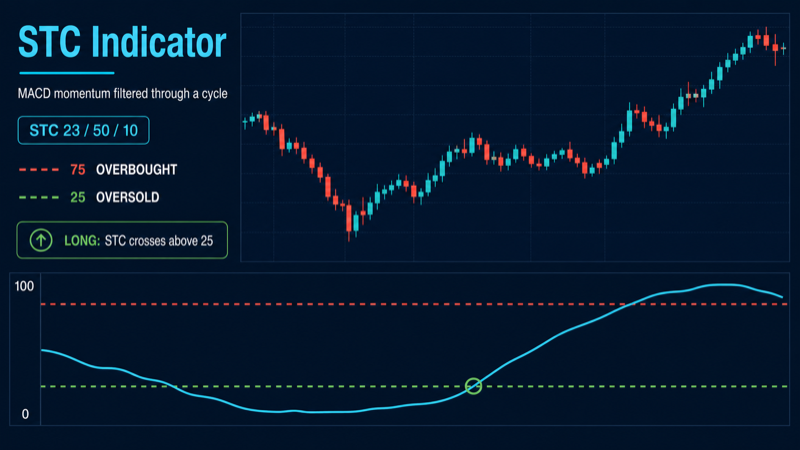
La catégorie Start Bots Signal regroupe les descriptions des signaux et indicateurs pouvant démarrer un bot de trading. L’un des indicateurs techniques est STC (Schaff Trend Cycle).
Lors de la création et de la modification de chaque bot, un bloc Générateur de signaux de démarrage est disponible en bas des paramètres. Vous pouvez y choisir des indicateurs individuels, des préréglages et leurs combinaisons. Les conditions sont regroupées : ET dans un groupe, OU entre les groupes. Le même indicateur peut être configuré de différentes manières - pour Long et Short, pour les cassures et les rebonds, pour comparer un niveau ou pour des croisements.
Qu'est-ce que STC (Schaff Trend Cycle)
STC (Schaff Trend Cycle) est un oscillateur développé par Doug Schaff. It combines MACD ideas (trend moving averages) and Stochastic logic (normalizing momentum into a 0–100 range) to deliver earlier, smoother trend-change signals.
STC values oscillate from 0 to 100. Classic levels: below 25 - oversold zone (Long potential), above 75 - overbought zone (Short potential). Dans le générateur de signaux ELIXOAI, STC is used as an automatic bot start condition - via value level crosses or text trend output changes.
TAAPI returns two outputs: numeric value (STC 0–100) and text trend (bullish/bearish). STC works well in trending and transitional phases; in prolonged ranges, frequent 25/75 crosses produce false starts - add a trend filter or EMA.
STC vs MACD and Stochastic
Les trois outils relate to momentum and trend, but solve the problem differently:
- MACD is built on the difference of price EMAs (fastLength/slowLength) and often lags on reversals. STC runs MACD through double stochastic smoothing - signals arrive earlier while staying on a 0–100 oscillator scale.
- Stochastic compares close price to the High–Low range over a period. STC does not use High/Low directly - it normalizes an already smoothed MACD-like impulse. STC is less noisy in ranges than “raw” Stochastic on short unité de tempss.
- STC is a hybrid: trend base (fastLength 23, slowLength 50) + cycle smoothing (cycleLength, d1Length, d2Length). Levels 25/75 replace MACD’s zero line; the trend output gives a ready direction filter without manual comparison.
Comment fonctionne STC
STC calculation is multi-step - first a MACD-like EMA difference is built, then the result is run through stochastic normalization twice:
MACD = EMA(Close, fastLength) − EMA(Close, slowLength), then STC = Stochastic(MACD, cycleLength) with additional smoothing d1Length and d2Length. The result is value in the 0–100 range.
- STC < 25 - oversold: weak impulse, bounce possible; preset stc_oversold_exit catches the cross up 25 moment.
- STC > 75 - overbought: overheated impulse, pullback possible; for Short set cross down 75 or trend changed_to bearish.
- STC between 25 and 75 - neutral or transitional zone; trend bullish/bearish helps read direction without hard extremes.
Dans le générateur you set a comparison condition: “value crosses above 25,” “trend changed to bullish,” and so on. The system fetches live value and trend from the exchange via TAAPI and checks the condition on your unité de temps - at candle close or every minute.
Deux sorties STC
L'indicateur stc expose two outputs - one numeric and one text:
- value - STC line in the 0–100 range. Used in stc_oversold_exit for crosses and gt/lt/gte/lte comparisons with levels 25, 50, 75.
- trend - text output: bullish or bearish. Used in stc_trend_change with eq, neq, changed_to, changed_from operators.
Preset stc_oversold_exit uses numeric value; preset stc_trend_change uses text trend. Both share the same fastLength, slowLength, cycleLength, d1Length, d2Length parameters.
Paramètres STC
Par défaut le générateur utilise TAAPI parameters - standard Schaff Trend Cycle settings:
- fastLength (23): fast EMA period in the MACD part of the calculation. Lower value - STC reacts faster, more 25/75 crosses.
- slowLength (50): slow EMA period. Defines the base trend horizon; classic for 15m–1h.
- cycleLength (10): stochastic normalization period for MACD into 0–100. Analogous to Stochastic %K period.
- d1Length (3): first smoothing after stochastic - removes sharp value spikes.
- d2Length (3): second smoothing; final STC line is smoother, fewer but more stable signals.
Settings 23/50/10/3/3 work well on 15m–4h. For 5m scalping reduce fastLength and cycleLength; for 4h swing increase slowLength.
Préréglages prêts dans le générateur
Le générateur offers two STC presets with default settings. Each can be fully customized: different operator, level, parameters, or unité de temps.
STC cross_up 25 - oversold exit (stc_oversold_exit)
Condition par défaut : output value crosses level 25 from below to above (cross up) on the selected unité de temps (15m interval, parameters 23/50/10/3/3, check à la clôture).
Long signal on oversold reversal: STC was below 25 and rose above - impulse started recovering. Unlike “value < 25” (lt), the cross captures the exit moment from weakness. For Short set cross down 75.
Opérateurs pour stc_oversold_exit- Croise au-dessus (cross up): value was below the level and moved above. Classic Long - cross up 25: oversold exit.
- Croise en dessous (cross down): value was above the level and dropped below. Short signal - cross down 75: overbought exit.
- Supérieur à (gt): value is strictly above the level. E.g. value > 50 - STC in upper half of range, bullish context.
- Inférieur à (lt): value is strictly below the level. value < 25 - oversold, useful for bounce filters.
- Supérieur ou égal (gte): value is at or above the threshold. Handy for “value ≥ 50” filter on a higher unité de temps.
- Inférieur ou égal (lte): value is at or below the threshold. Oversold filter: value ≤ 25 on 1h.
Trend changed_to bullish - trend change (stc_trend_change)
Condition par défaut : output trend changed to bullish (changed_to) on the selected unité de temps (15m interval, parameters 23/50/10/3/3, check à la clôture).
Direction shift signal: TAAPI records trend switching to bullish - STC confirmed a bullish cycle. More precise than trend eq bullish at the reversal moment. For Short set changed_to bearish or eq bearish.
Opérateurs pour stc_trend_change- Égal à (eq): trend strictly equals the target - bullish or bearish right now. trend eq bullish - bot starts only with bullish STC.
- Différent de (neq): trend does not equal the specified value. trend neq bearish - Long only when trend is not bearish.
- Changé en (changed to): trend just switched to the target value. trend changed_to bullish - moment of shift from bearish to bullish; main preset signal.
- Changé depuis (changed from): trend equaled the specified value on the previous check and changed. Useful to capture exit from bearish phase: changed_from bearish.
25 and 75 are STC’s main references: cross up 25 means oversold exit; cross down 75 means overbought exit. In a strong trend STC can stay above 75 or below 25 for a long time - then trend eq bullish/bearish or gt/lt gives direction filter while cross gives pullback entry.
Paramètres généraux du générateur
- Unité de temps (intervalle) : 1m, 5m, 15m, 30m, 1h, 4h, 1d. Des intervalles plus courts donnent plus de signaux mais plus de bruit. Les bots swing utilisent souvent 1h–4h ; le scalping utilise 5m–15m.
- Mode de vérification : À la clôture de la bougie - vérification après la clôture, moins de faux déclenchements. Chaque minute - vérification dans la bougie en cours, réaction plus rapide, risque de faux départ plus élevé.
- Opérateur : supérieur, inférieur, croise à la hausse/baisse, supérieur ou égal, etc. définissent comment la valeur de l’indicateur est comparée à la cible.
- Valeur cible : nombre (ex. 30 pour le RSI), ligne d’indicateur (ex. %D pour le Stochastic) ou prix (pour les Bollinger Bands).
- Groupes de conditions : jusqu’à 3 groupes avec jusqu’à 5 conditions chacun. Exemple : groupe 1 - RSI < 30 ET prix < bande inférieure ; groupe 2 - Stochastic < 20. Le bot démarre si le groupe 1 OU le groupe 2 est satisfait.
Exemples de configuration pour différentes stratégies
Scalping: reduced parameters on 5m–15m
Objectif : frequent starts on short STC cycles.
Long: stc_oversold_exit preset, cross up 25, 5m unité de temps, fastLength 12, cycleLength 6, check à la clôture.
Short: cross down 75, same settings.
Filtre : trend eq bullish on 15m - fewer false crosses in a range.
Swing: standard 23/50/10/3/3 on 1h–4h
Objectif : fewer but more meaningful cycle shifts.
Long: STC cross up 25 on 4h, standard parameters, check at close.
Short: cross down 75 on 4h.
On a higher TF STC smooths noise and signals closer to a sustained trend change.
Trend confirmation via trend output
Objectif : Long only when STC confirms bullish context.
Groupe 1 : trend eq bullish on 4h (stc_trend_change preset) AND value cross up 25 on 15m.
Short: trend eq bearish on 4h AND cross down 75 on 15m.
Higher TF sets direction, lower TF catches entry timing.
Level vs trend: when to use which
stc_oversold_exit - impulse signal at 25/75 cross moment; triggers more often.
stc_trend_change - bullish/bearish shift filter; changed_to catches reversals more precisely, eq holds in trend.
Combo: trend eq bullish on 1h AND value gt 50 on 15m - entry without waiting for a fresh cross.
STC + EMA
Long: price cross up EMA 20 on 15m AND STC cross up 25 on the same 15m - double confirmation: both price and STC cycle turned up.
Short: price cross down EMA 20 AND STC cross down 75.
Alternative: trend eq bullish on 1h AND price > EMA 50 on 1h - trend Long.
Short on cycle shift
Condition : STC cross down 75 or trend changed_to bearish, 15m, check at close.
Filtre : RSI > 65 in the same group - short after overbought with STC reversal confirmation.
Fits short grids at local peaks.
Strong cycle (gt filter)
Long: STC value gt 50 on 1h - bot starts only with STC in upper half of range, without waiting for a cross.
Short: value lt 50 on 1h.
Useful in trends where cross up 25 already happened but cycle remains bullish.
Pullback in trend
Groupe 1 : trend eq bullish on 4h AND STC cross up 25 on 15m.
Logique : higher TF shows sustained bullish cycle; lower TF catches resumption after a short correction into < 25.
STC + RSI
Long: RSI cross up 30 on 15m AND STC cross up 25 on 15m - oscillator and STC cycle aligned.
Short: RSI cross down 70 AND STC cross down 75.
RSI catches oversold/overbought; STC checks trend cycle shift.
Multi-unité de temps
Long: trend eq bullish on 4h (separate condition) AND STC cross up 25 on 15m.
Short: trend eq bearish on 4h AND STC cross down 75 on 15m.
Avoids buying every local cross against global bearish trend.
DCA sur pullback
Long : STC cross up 25 en 1h ET RSI < 45 en 1h - rebond du cycle depuis une faiblesse sans survente extrême.
Short : cross down 75 ET RSI > 55.
Pour un bot DCA, cross up 25 est plus souple qu'un strict RSI < 30.
Groupes de conditions : exemple pratique
Bot avec deux scénarios Long :
Groupe 1 : STC cross up 25 en 15m ET trend eq bullish en 1h - reprise du cycle par impulsion.
Groupe 2 : trend changed_to bullish en 4h ET prix > EMA 50 en 15m - retournement STC avec confirmation du prix.
Entre groupes logique OU. Configurez Short symétriquement (cross down 75, trend eq bearish).
Conseil
En marché latéral, STC croise souvent 25 et 75 dans les deux sens - cross up 25 et cross down 75 produisent de faux départs. Augmentez slowLength, ajoutez un filtre trend eq bullish sur unité de temps supérieure ou EMA. Le preset stc_trend_change avec changed_to capture les retournements plus précisément qu'eq en tendance prolongée. Utilisez la vérification à la clôture pour ignorer le bruit intrabar.