
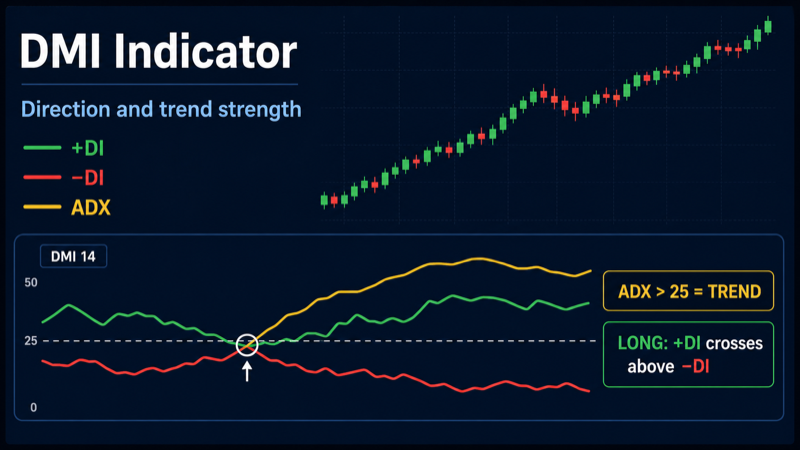
Na categoria Start Bots Signal ficam as descrições de sinais e indicadores que podem iniciar um bot de trading. Um dos indicadores técnicos é DMI (Directional Movement Index).
Ao criar e editar qualquer bot, existe um bloco Construtor de sinais de início na parte inferior das configurações. Nele você pode escolher indicadores individuais, presets prontos e suas combinações. As condições são agrupadas: E dentro do grupo, OU entre grupos. O mesmo indicador pode ser configurado de formas diferentes - para Long e Short, para rompimentos e repiques, para comparar com um nível ou para cruzamentos.
O que é o DMI (Directional Movement Index)
DMI (Directional Movement Index) é um indicador de tendência de Welles Wilder com três linhas: +DI, −DI e ADX. Responde à direção e à força da tendência.
O cruzamento +DI/−DI é o sinal clássico de mudança de dominância. O ADX mede a intensidade da tendência independentemente da direção.
No construtor ELIXOAI, o DMI inicia o bot automaticamente: dmi_cross captura +DI cruzando −DI, dmi_adx_strength dispara quando ADX excede 25.
DMI vs MACD e EMA
As três ferramentas tratam de tendência, mas resolvem problemas diferentes:
- MACD is built on the difference between two EMAs and shows momentum through line or zero crosses. MACD has no separate “trend strength” metric - only direction and acceleration. DMI explicitly separates direction (+DI vs −DI) and strength (ADX).
- EMA is a price moving average; price position vs EMA shows trend but not strength. DMI +DI/−DI crosses give earlier momentum shift signals; ADX filters weak moves in chop.
- DMI is the only one of the three that gives a numeric trend strength reading via ADX. Classic thresholds: ADX < 20 - weak trend or range; 20–25 - trend forming; > 25 - trend strong enough to trade; > 40–50 - very strong trend (watch for reversals).
Como o DMI funciona
DMI is calculated from True Range and directional movement over a period (default 14 candles):
- +DI (pdi) - upward movement strength. The higher +DI vs −DI, the more buyers dominate.
- −DI (mdi) - downward movement strength. When −DI is above +DI, bears control the market.
- ADX (adx) - smoothed measure of divergence between +DI and −DI. ADX does not show direction - it can rise in both rallies and selloffs. High ADX means the trend is strong, Long or Short.
In the builder you set a comparison condition on one output: “+DI crosses above −DI,” “ADX greater than 25,” “+DI greater than −DI,” and so on. The system fetches live DMI values from the exchange via TAAPI and checks the condition on your timeframe - at candle close or every minute.
Três saídas DMI
The builder exposes three numeric outputs for the dmi indicator:
- pdi (+DI): positive directional indicator. Used as the main line in dmi_cross - pdi crossing mdi.
- mdi (−DI): negative directional indicator. In dmi_cross it is the cross target: pdi cross up mdi.
- adx (ADX): trend strength index. Used in dmi_adx_strength - ADX > 25 as a “trend strong enough” filter. Any threshold works: gt 20, gt 30, gte 25.
Parâmetro período
- Faixa: 1 to 300.
- Padrão: 14 - Wilder’s classic setting; balanced for 15m–4h.
- Short period (7–10): DMI reacts faster, more +DI/−DI crosses, more false signals in ranges. Useful on 5m–15m for scalping with a mandatory ADX filter.
- Long period (20–28): smoother DMI, less frequent dominance changes. Better for 1h–4h swing - fewer but more sustained trend signals.
DMI(14) on 15m and DMI(14) on 4h are different indicators. When changing timeframe, revisit period and preset mix (cross vs adx_strength).
Presets prontos no construtor
O construtor oferece dois presets DMI with default settings. Each can be fully customized: different operator, output, threshold, or timeframe.
dmi_cross - +DI crosses above −DI (Long)
Condição padrão: pdi (+DI) crosses mdi (−DI) from below to above (cross up) on the selected timeframe (15m interval, period 14, check no fechamento da vela).
Classic DMI Long signal: bullish direction begins to dominate bearish. Unlike “pdi > mdi,” the cross captures the transition moment, not just current position. For Short, set operator “crosses below” - pdi cross down mdi.
dmi_adx_strength - ADX > 25 (strong trend)
Condição padrão: ADX greater than 25 (gt) on the selected timeframe (15m interval, period 14, check no fechamento da vela).
Trend strength filter: the bot starts when the market leaves chop and the trend becomes strong enough. ADX > 25 alone gives no direction - combine with dmi_cross, EMA, or price above/below a key average. For Short context, add mdi > pdi in the same group.
Operadores disponíveis- Cruza para cima (cross up): Output was below the target and moved above. For dmi_cross: pdi cross up mdi - Long. Custom: adx cross up 25 - ADX just exceeded the strength threshold.
- Cruza para baixo (cross down): Output was above the target and dropped below. pdi cross down mdi - Short. adx cross down 25 - trend weakening, exit from strong move.
- Maior que (gt): Value strictly above threshold. ADX gt 25 - strong trend right now. pdi gt mdi - bulls dominate without requiring a fresh cross.
- Menor que (lt): Value strictly below threshold. ADX lt 20 - weak trend, range. mdi gt pdi (or pdi lt mdi) - bears dominate.
- Maior ou igual (gte): Value at or above threshold. ADX gte 25 on 4h - sustained higher-TF trend as a filter.
- Menor ou igual (lte): Value at or below threshold. ADX lte 20 - market in range, DMI crosses unreliable.
ADX is the key to filtering DMI noise. ADX < 20 - weak or no trend; +DI/−DI crosses are often false. ADX 20–25 - trend forming. ADX > 25 - trend strong enough to trade (dmi_adx_strength preset threshold). ADX > 40–50 - extremely strong trend; sharp corrections possible. ADX shows strength, not direction - for Long check pdi > mdi, for Short mdi > pdi.
Configurações gerais do construtor
- Timeframe (intervalo): 1m, 5m, 15m, 30m, 1h, 4h, 1d. Intervalos menores geram mais sinais, porém mais ruído. Bots swing costumam usar 1h–4h; scalping usa 5m–15m.
- Modo de verificação: No fechamento da vela - verificação após o fechamento, menos disparos falsos. A cada minuto - verificação dentro da vela atual, reação mais rápida, maior risco de início falso.
- Operador: maior, menor, cruza para cima/baixo, maior ou igual etc. definem como o valor do indicador é comparado ao alvo.
- Valor alvo: número (ex.: 30 no RSI), linha do indicador (ex.: %D no Stochastic) ou preço (no Bollinger Bands).
- Grupos de condições: até 3 grupos com até 5 condições cada. Exemplo: grupo 1 - RSI < 30 E preço < banda inferior; grupo 2 - Stochastic < 20. O bot inicia se o grupo 1 OU o grupo 2 for atendido.
Exemplos de configuração para diferentes estratégias
Long clássico: dmi_cross
Objetivo: bot start on dominance shifting to bulls.
Long: dmi_cross preset, pdi cross up mdi, 15m timeframe, period 14, check no fechamento da vela.
Short: pdi cross down mdi, same settings.
Basic DMI strategy without extra filters - more signals, higher false-cross risk in ranges.
Short em cruzamento −DI
Condição: mdi cross up pdi (equivalent to pdi cross down mdi), period 14, 15m, check at close.
Filtro: ADX gt 20 in the same group - short only when trend is forming, not in dead chop.
Fits short grids on local uptrend reversals.
Cruzamento DI + força ADX
Grupo 1: dmi_cross (pdi cross up mdi) on 15m E dmi_adx_strength (ADX gt 25) on the same 15m.
Lógica: Long only when both direction (+DI above −DI) and strength (ADX > 25) confirm. Fewer false starts than pure dmi_cross.
Short: pdi cross down mdi E ADX gt 25 E mdi > pdi.
Confirmação de tendência via EMA
Long: dmi_cross on 15m E close price above EMA 50 on 1h.
Short: pdi cross down mdi on 15m E price below EMA 50 on 1h.
EMA shows global direction; DMI catches local momentum shift with the trend.
Scalping: período 10 em 5m–15m
Long: dmi_cross, period 10, 5m timeframe, check at close E ADX gt 20.
Short: pdi cross down mdi, same settings.
Period 10 speeds up DMI; ADX filter is mandatory - without it 5m whipsaws heavily.
Swing: período 14 em 1h–4h
Long: dmi_cross on 4h, period 14, check at close E ADX gt 25.
Short: pdi cross down mdi on 4h, ADX gt 25.
Rare but meaningful signals - closer to a “real” trend shift on a higher interval.
Multi-timeframe
Long: ADX gt 25 on 4h (separate condition, dmi_adx_strength) E dmi_cross on 15m.
Short: ADX gt 25 on 4h E pdi cross down mdi on 15m.
Higher TF confirms trend strength; lower TF gives entry - avoids buying every local cross against weak global ADX.
DMI + RSI
Long: dmi_cross on 15m E RSI cross up 30 (or RSI < 40) on the same 15m - DMI direction and RSI bounce aligned.
Short: pdi cross down mdi E RSI cross down 70.
RSI catches oversold/overbought; DMI confirms directional dominance shift.
Pullback em tendência
Grupo 1: pdi gt mdi on 4h (period 14) E dmi_cross on 15m.
Lógica: higher TF shows sustained bullish dominance (+DI above −DI); lower TF catches resumption after a short correction. Fewer false starts against the global trend.
Tendência forte: ADX gt 30
Long: ADX gt 30 on 1h E pdi gt mdi on 1h - bot starts only in clearly strong trends.
Short: ADX gt 30 E mdi gt pdi on 1h.
Stricter than 25 - fewer trades, higher quality in trending phases. Downside - later entry vs move start.
DCA na retomada de tendência
Long: dmi_cross on 1h (period 14) E ADX gte 20 on 1h E price > EMA 200 on 4h.
Short: pdi cross down mdi E ADX gte 20 E price < EMA 200 on 4h.
For DCA bots on pullbacks: +DI/−DI cross is softer than a hard breakout; EMA 200 sets global context.
Grupos de condições: exemplo prático
Bot with two Long scenarios:
Grupo 1: dmi_cross on 15m E ADX gt 25 on 15m - impulse entry with confirmed strength.
Group 2: ADX gt 25 on 4h E pdi gt mdi on 15m - higher-TF trend, bullish dominance on lower TF.
Groups combined with OU: either scenario can start the bot. Configure Short symmetrically (pdi cross down mdi, mdi gt pdi).
Dica
Cruzamento DMI sem filtro ADX em ranges produz inícios falsos com ADX < 20. Combine dmi_cross com dmi_adx_strength (ADX gt 25).