
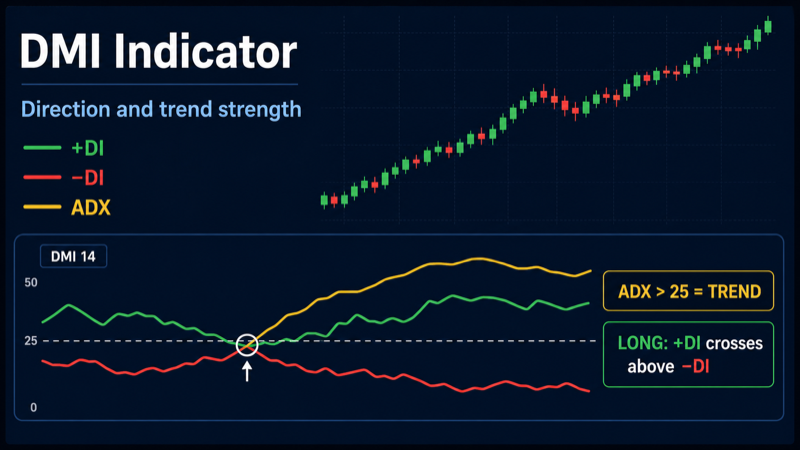
En la categoría Start Bots Signal se recopilan descripciones de señales e indicadores que pueden iniciar un bot de trading. Uno de los indicadores técnicos es DMI (Directional Movement Index).
Al crear y editar cada bot, en la parte inferior de la configuración hay un bloque Constructor de señales de inicio. Allí puedes elegir indicadores individuales, presets listos y sus combinaciones. Las condiciones se agrupan: Y dentro del grupo, O entre grupos. El mismo indicador puede configurarse de formas distintas - para Long y Short, para rupturas y rebotes, para comparar con un nivel o para cruces.
Qué es el DMI (Directional Movement Index)
DMI (Directional Movement Index) es un indicador de tendencia desarrollado por Welles Wilder. Consta de tres líneas: +DI, −DI y ADX. Responde a dos preguntas: hacia dónde se mueve el mercado y con qué fuerza se expresa la tendencia.
El cruce +DI/−DI es la señal clásica de cambio de dominancia. Pero el cruce solo no mide la fuerza - en rangos las líneas oscilan. Para eso está ADX: mide la intensidad del trend sin importar la dirección.
En el constructor de señales ELIXOAI, el DMI se usa como condición de inicio automático: el preset dmi_cross captura +DI cruzando −DI, dmi_adx_strength se activa cuando el ADX supera 25.
DMI vs MACD y EMA
Las tres herramientas están ligadas a la tendencia, pero resuelven problemas distintos:
- MACD is built on the difference between two EMAs and shows momentum through line or zero crosses. MACD has no separate “trend strength” metric - only direction and acceleration. DMI explicitly separates direction (+DI vs −DI) and strength (ADX).
- EMA is a price moving average; price position vs EMA shows trend but not strength. DMI +DI/−DI crosses give earlier momentum shift signals; ADX filters weak moves in chop.
- DMI is the only one of the three that gives a numeric trend strength reading via ADX. Classic thresholds: ADX < 20 - weak trend or range; 20–25 - trend forming; > 25 - trend strong enough to trade; > 40–50 - very strong trend (watch for reversals).
Cómo funciona el DMI
DMI is calculated from True Range and directional movement over a period (default 14 candles):
- +DI (pdi) - upward movement strength. The higher +DI vs −DI, the more buyers dominate.
- −DI (mdi) - downward movement strength. When −DI is above +DI, bears control the market.
- ADX (adx) - smoothed measure of divergence between +DI and −DI. ADX does not show direction - it can rise in both rallies and selloffs. High ADX means the trend is strong, Long or Short.
In the builder you set a comparison condition on one output: “+DI crosses above −DI,” “ADX greater than 25,” “+DI greater than −DI,” and so on. The system fetches live DMI values from the exchange via TAAPI and checks the condition on your timeframe - at candle close or every minute.
Tres salidas DMI
The builder exposes three numeric outputs for the dmi indicator:
- pdi (+DI): positive directional indicator. Used as the main line in dmi_cross - pdi crossing mdi.
- mdi (−DI): negative directional indicator. In dmi_cross it is the cross target: pdi cross up mdi.
- adx (ADX): trend strength index. Used in dmi_adx_strength - ADX > 25 as a “trend strong enough” filter. Any threshold works: gt 20, gt 30, gte 25.
Parámetro periodo
- Rango: 1 to 300.
- Valor por defecto: 14 - Wilder’s classic setting; balanced for 15m–4h.
- Short period (7–10): DMI reacts faster, more +DI/−DI crosses, more false signals in ranges. Useful on 5m–15m for scalping with a mandatory ADX filter.
- Long period (20–28): smoother DMI, less frequent dominance changes. Better for 1h–4h swing - fewer but more sustained trend signals.
DMI(14) on 15m and DMI(14) on 4h are different indicators. When changing timeframe, revisit period and preset mix (cross vs adx_strength).
Presets listos en el constructor
El constructor ofrece dos presets DMI with default settings. Each can be fully customized: different operator, output, threshold, or timeframe.
dmi_cross - +DI crosses above −DI (Long)
Condición por defecto: pdi (+DI) crosses mdi (−DI) from below to above (cross up) on the selected timeframe (15m interval, period 14, check al cierre de vela).
Classic DMI Long signal: bullish direction begins to dominate bearish. Unlike “pdi > mdi,” the cross captures the transition moment, not just current position. For Short, set operator “crosses below” - pdi cross down mdi.
dmi_adx_strength - ADX > 25 (strong trend)
Condición por defecto: ADX greater than 25 (gt) on the selected timeframe (15m interval, period 14, check al cierre de vela).
Trend strength filter: the bot starts when the market leaves chop and the trend becomes strong enough. ADX > 25 alone gives no direction - combine with dmi_cross, EMA, or price above/below a key average. For Short context, add mdi > pdi in the same group.
Operadores disponibles- Cruza hacia arriba (cross up): Output was below the target and moved above. For dmi_cross: pdi cross up mdi - Long. Custom: adx cross up 25 - ADX just exceeded the strength threshold.
- Cruza hacia abajo (cross down): Output was above the target and dropped below. pdi cross down mdi - Short. adx cross down 25 - trend weakening, exit from strong move.
- Mayor que (gt): Value strictly above threshold. ADX gt 25 - strong trend right now. pdi gt mdi - bulls dominate without requiring a fresh cross.
- Menor que (lt): Value strictly below threshold. ADX lt 20 - weak trend, range. mdi gt pdi (or pdi lt mdi) - bears dominate.
- Mayor o igual (gte): Value at or above threshold. ADX gte 25 on 4h - sustained higher-TF trend as a filter.
- Menor o igual (lte): Value at or below threshold. ADX lte 20 - market in range, DMI crosses unreliable.
ADX is the key to filtering DMI noise. ADX < 20 - weak or no trend; +DI/−DI crosses are often false. ADX 20–25 - trend forming. ADX > 25 - trend strong enough to trade (dmi_adx_strength preset threshold). ADX > 40–50 - extremely strong trend; sharp corrections possible. ADX shows strength, not direction - for Long check pdi > mdi, for Short mdi > pdi.
Ajustes generales del constructor
- Marco temporal (intervalo): 1m, 5m, 15m, 30m, 1h, 4h, 1d. Intervalos menores dan más señales pero más ruido. Los bots swing suelen usar 1h–4h; el scalping usa 5m–15m.
- Modo de comprobación: Al cierre de la vela - se comprueba tras el cierre, menos falsos disparos. Cada minuto - comprobación dentro de la vela actual, reacción más rápida, mayor riesgo de inicio falso.
- Operador: mayor, menor, cruza hacia arriba/abajo, mayor o igual, etc. definen cómo se compara el valor del indicador con el objetivo.
- Valor objetivo: número (p. ej. 30 en RSI), línea del indicador (p. ej. %D en Stochastic) o precio (en Bollinger Bands).
- Grupos de condiciones: hasta 3 grupos con hasta 5 condiciones cada uno. Ejemplo: grupo 1 - RSI < 30 Y precio < banda inferior; grupo 2 - Stochastic < 20. El bot inicia si se cumple el grupo 1 O el grupo 2.
Ejemplos de configuración para distintas estrategias
Long clásico: dmi_cross
Objetivo: bot start on dominance shifting to bulls.
Long: dmi_cross preset, pdi cross up mdi, 15m timeframe, period 14, check al cierre de vela.
Short: pdi cross down mdi, same settings.
Basic DMI strategy without extra filters - more signals, higher false-cross risk in ranges.
Short en cruce −DI
Condición: mdi cross up pdi (equivalent to pdi cross down mdi), period 14, 15m, check at close.
Filtro: ADX gt 20 in the same group - short only when trend is forming, not in dead chop.
Fits short grids on local uptrend reversals.
Cruce DI + fuerza ADX
Grupo 1: dmi_cross (pdi cross up mdi) on 15m Y dmi_adx_strength (ADX gt 25) on the same 15m.
Lógica: Long only when both direction (+DI above −DI) and strength (ADX > 25) confirm. Fewer false starts than pure dmi_cross.
Short: pdi cross down mdi Y ADX gt 25 Y mdi > pdi.
Confirmación de tendencia via EMA
Long: dmi_cross on 15m Y close price above EMA 50 on 1h.
Short: pdi cross down mdi on 15m Y price below EMA 50 on 1h.
EMA shows global direction; DMI catches local momentum shift with the trend.
Scalping: periodo 10 en 5m–15m
Long: dmi_cross, period 10, 5m timeframe, check at close Y ADX gt 20.
Short: pdi cross down mdi, same settings.
Period 10 speeds up DMI; ADX filter is mandatory - without it 5m whipsaws heavily.
Swing: periodo 14 en 1h–4h
Long: dmi_cross on 4h, period 14, check at close Y ADX gt 25.
Short: pdi cross down mdi on 4h, ADX gt 25.
Rare but meaningful signals - closer to a “real” trend shift on a higher interval.
Multi-timeframe
Long: ADX gt 25 on 4h (separate condition, dmi_adx_strength) Y dmi_cross on 15m.
Short: ADX gt 25 on 4h Y pdi cross down mdi on 15m.
Higher TF confirms trend strength; lower TF gives entry - avoids buying every local cross against weak global ADX.
DMI + RSI
Long: dmi_cross on 15m Y RSI cross up 30 (or RSI < 40) on the same 15m - DMI direction and RSI bounce aligned.
Short: pdi cross down mdi Y RSI cross down 70.
RSI catches oversold/overbought; DMI confirms directional dominance shift.
Pullback en tendencia
Grupo 1: pdi gt mdi on 4h (period 14) Y dmi_cross on 15m.
Lógica: higher TF shows sustained bullish dominance (+DI above −DI); lower TF catches resumption after a short correction. Fewer false starts against the global trend.
Tendencia fuerte: ADX gt 30
Long: ADX gt 30 on 1h Y pdi gt mdi on 1h - bot starts only in clearly strong trends.
Short: ADX gt 30 Y mdi gt pdi on 1h.
Stricter than 25 - fewer trades, higher quality in trending phases. Downside - later entry vs move start.
DCA en reanudación de tendencia
Long: dmi_cross on 1h (period 14) Y ADX gte 20 on 1h Y price > EMA 200 on 4h.
Short: pdi cross down mdi Y ADX gte 20 Y price < EMA 200 on 4h.
For DCA bots on pullbacks: +DI/−DI cross is softer than a hard breakout; EMA 200 sets global context.
Grupos de condiciones: ejemplo práctico
Bot with two Long scenarios:
Grupo 1: dmi_cross on 15m Y ADX gt 25 on 15m - impulse entry with confirmed strength.
Group 2: ADX gt 25 on 4h Y pdi gt mdi on 15m - higher-TF trend, bullish dominance on lower TF.
Groups combined with O: either scenario can start the bot. Configure Short symmetrically (pdi cross down mdi, mdi gt pdi).
Consejo
El cruce DMI sin filtro ADX en rangos produce muchos inicios falsos cuando ADX < 20. Combine dmi_cross con dmi_adx_strength (ADX gt 25). El ADX muestra fuerza, no dirección.